
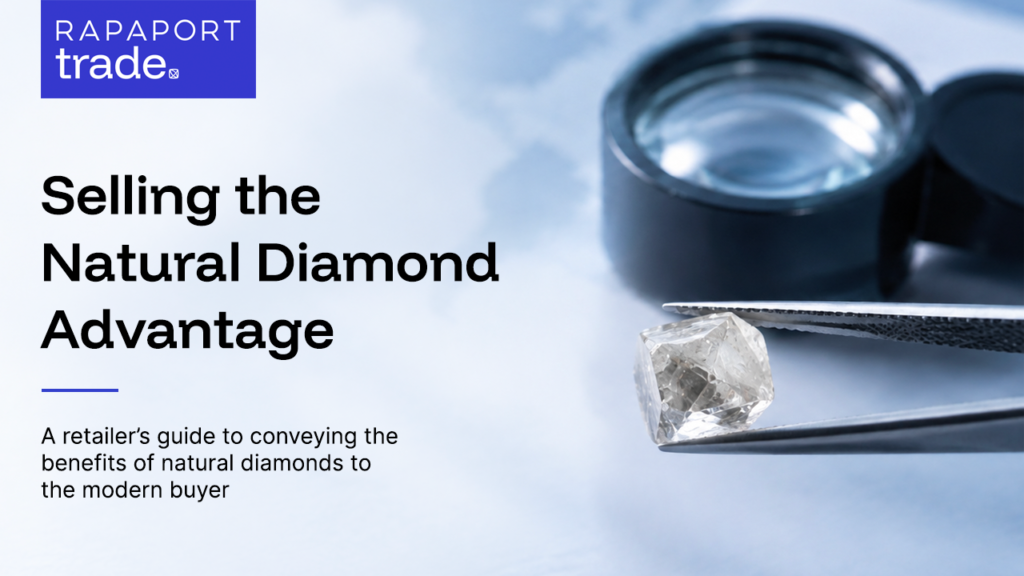
A retailer’s guide to conveying the benefits of natural diamonds to the modern buyer
Useful talking points to help your sales team confidently articulate the benefits of natural diamonds
It is a daily occurrence on jewelry sales floors worldwide. A customer presents a TikTok video and asks a direct question: Why pay a premium for a natural diamond when a lab-grown alternative looks identical for a fraction of the cost?
It’s a reasonable question from a consumer who has done their preliminary research and is seeking an honest, straightforward answer.
The problem is that many retail associates lack the specific training required to navigate this narrative. When a response is too defensive, it comes across as a transparent attempt to protect store margins. When a response is too vague, the customer leaves unconvinced—politely exiting to purchase a synthetic stone from a competitor who had a more compelling pitch.
Below is a playbook featuring seven data-driven talking points and direct responses designed specifically for the modern diamond buyer. It’s based on the underlying truth that rarity creates value, and only nature can create true rarity.
In this blog:
- Step One: Define Your Diamond Categories
- The Sales Floor Playbook: 5 Core Talking Points
- Navigating the Conversation
- The Toughest Room: Winning Over Gen Z
Step One: Define Your Diamond Categories
Before a retailer can make the case to a customer, the case has to be clear on the sales floor itself. Natural diamonds and manufactured alternatives are not two versions of the same product, they are two different categories, priced and valued based on entirely different premises, in the same way cubic zirconia and moissanite are treated as their own category rather than a cheaper natural diamond.
The Strategy: Display, price, and position natural and lab-grown stones as fundamentally different entities. Never present them as interchangeable options side-by-side in the same display case. Establishing this clear boundary protects the consumer’s trust and preserves the intrinsic value of your natural diamond inventory.
The Sales Floor Playbook: 5 Core Talking Points
Equip your team with these arguments to skillfully guide customer conversations.
1. The Reality of Rarity
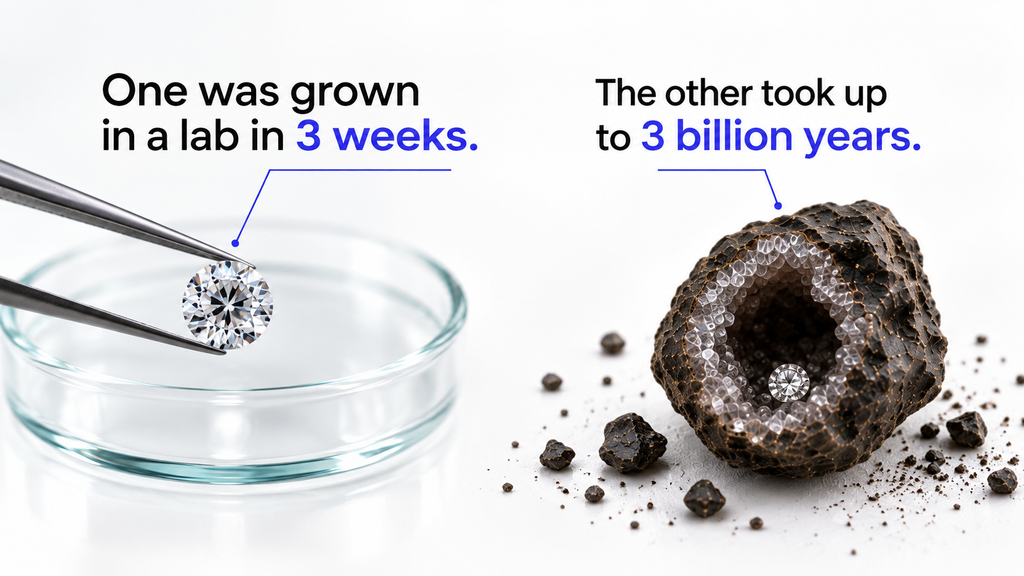
Natural diamonds are a finite, non-renewable resource, forged deep within the earth’s mantle between 90 million and 3 billion years ago, and brought to the surface by rare volcanic events. Conversely, a lab-grown stone is manufactured in a matter of weeks inside a factory capable of infinite scaling. True scarcity is only accelerating: global rough diamond production dropped 8% in 2023 to 111.5 million carats—the lowest level in two decades of Kimberley Process records (excluding 2020). Rio Tinto’s Diavik mine in Canada, which produced more than 150 million carats over 23 years, ends commercial production in 2026; Canada’s Renard mine has already been mothballed. Few new mines are being discovered to replace them.
2. Long-Term Value Retention
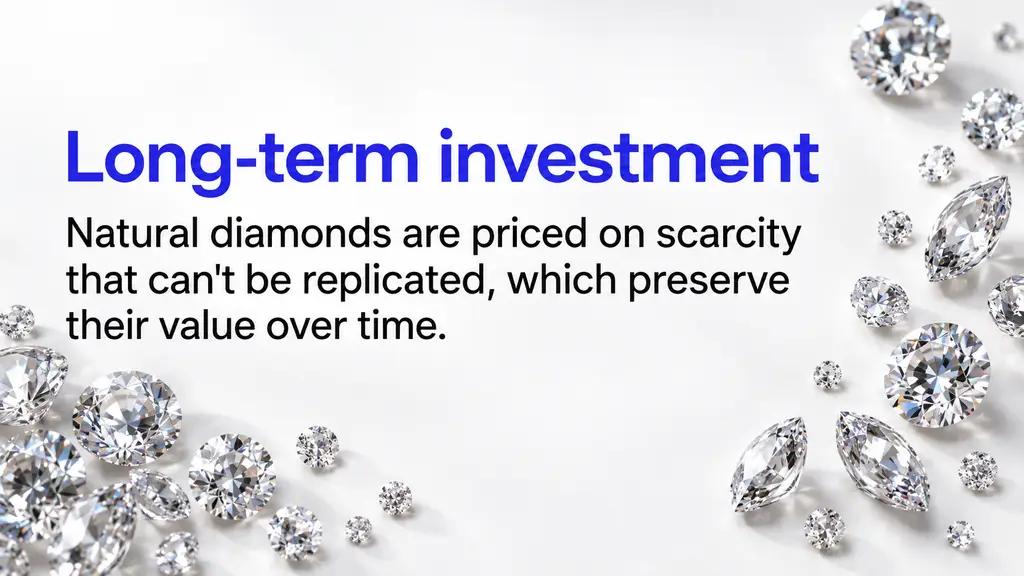
Every natural diamond possesses an ancient origin story that a factory production schedule cannot replicate. This geological history is the foundation of its financial worth. Backed by a mature market of grading, certification, and resale, natural diamonds have historically appreciated by roughly 3% annually over the past 35 years. In stark contrast, the influx of lab-grown manufacturers caused production costs to plummet by 90% between 2008 and 2018. Today, a one-carat lab-grown stone holds roughly 80% less value than its natural equivalent.
3. Ethics and Global Traceability The modern diamond industry is rigorously regulated. With over 80 countries enforcing the Kimberley Process, conflict diamonds have plummeted from 15% of the global supply in the 1990s to under 1% today. Furthermore, blockchain technology now allows many stones to be seamlessly tracked from the mine directly to the store. Beyond ethics, natural diamonds are an economic pillar for developing nations; in Botswana, diamond mining generated 33% of the national GDP in 2021. Responsible mining operators also fund massive conservation efforts, managing reserve networks that span 200,000 hectares across southern Africa.
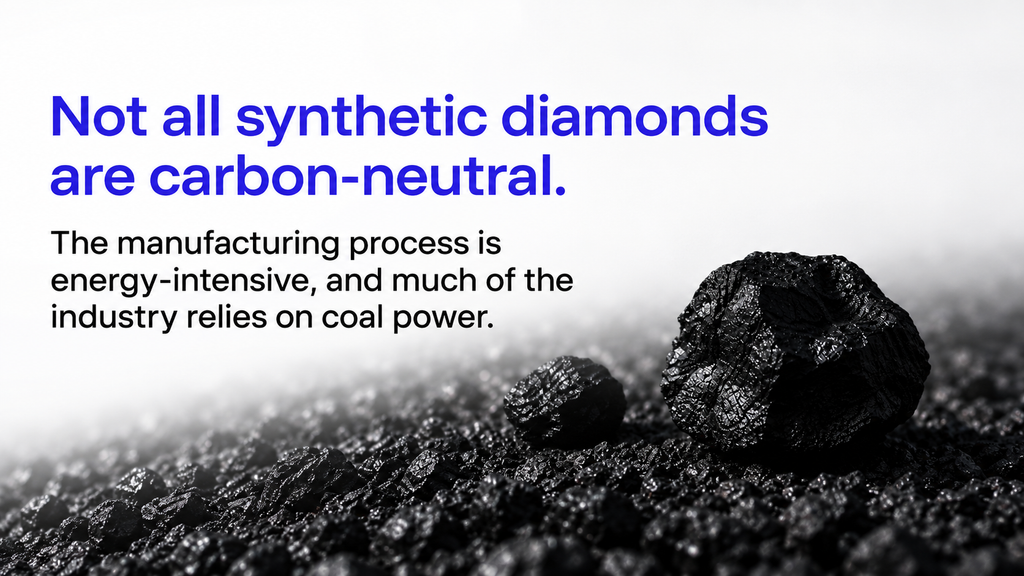
4. The Truth About Sustainability When a customer raises environmental concerns, respond with hard data rather than deflection. Manufacturing a single lab-grown diamond requires an immense energy load, demanding approximately 870,000 pounds of pressure per square inch and temperatures nearing 1,600 degrees Celsius. With an estimated 60% of lab-grown stones originating in China and India—where coal powers 63% and 74% of the respective electrical grids, the blanket claim that “synthetics are greener” simply collapses under scrutiny.
5. Heirloom Status and Legacy For over a century, natural diamonds have served as the ultimate symbol of enduring love precisely because they are permanent, singular, and rare. The traditional two-to-three-month salary guideline was established based on the intrinsic value of a natural stone. Because lab-grown alternatives retail for roughly 80% less, they rarely meet the financial threshold of a legacy investment. A natural diamond is meant to be passed down, carrying genuine history, certified authenticity, and enduring wealth across generations. It is a standard of legacy that a manufactured product cannot borrow.
Navigating the Conversation
When a customer asks about lab-grown options, it is an invitation to educate, not a threat to the sale. Acknowledge their question directly, maintain a confident tone, and pivot toward the unique attributes of a natural stone. The objective is not to aggressively bash lab-grown products, but to clearly demonstrate why a natural diamond is the superior investment, allowing the customer to arrive at that conclusion themselves.
Ensure your staff is prepared with concrete answers to the most common questions, such as:
- “Isn’t lab-grown the exact same thing, just produced faster?”
- “If lab-grown costs significantly less, why should I pay the premium?”
- “Which option will actually hold its value over the next decade?”
The Toughest Room: Winning Over Gen Z
Gen Z represents the most challenging demographic for this conversation. They enter the store with sky-high expectations, stricter budgets, and a predisposition toward sustainability claims. Many also arrive armed with misconceptions cultivated by social media influencers.
The Approach: Counter the hype with clinical facts, not sales pressure. This generation demands transparency. Speak to them about the Kimberley Process, mine-to-store blockchain tracking, and the heavy carbon footprint of lab-grown factories.
When it comes to aesthetics, Gen Z favors timeless, understated elegance over flashy displays of wealth. Remind them that an engagement ring is a once-in-a-lifetime acquisition. Position the natural diamond not as a trendy purchase, but as a permanent, heirloom-quality asset, and let the evidence close the sale.
“Our responsibility is to preserve the credibility of the market, and the confidence consumers depend on.”
— Dan Mano, CEO, Rapaport Group
Every conversation on the sales floor is a localized test of the industry’s credibility. Retailers who are armed with empirical facts, rather than emotional pleas, are the ones who will successfully secure the customer’s trust and their business.
Download the guide here.
Rapaport Trade FAQ’s
Yes, Rapaport Trade’s marketplace is exclusively for natural diamonds.
No. All members are strictly vetted before joining Rapaport Trade. Applicants must provide proof of identity, a valid business license in the industry, trading references and invoices, and pass an OFAC compliance check.
No. Rapaport Trade operates on a commission-free model, meaning there are no hidden commissions or transaction fees when you buy or sell a diamond or gemstone, allowing you to maximize your profits.
With thousands of Rapaport Trade suppliers worldwide listing their merchandise, buyers can access highly competitive pricing on over 1.6 million diamonds, gems, and jewelry pieces.