

There’s a pattern worth paying attention to.
Over the past year or so, an increasing number of experienced diamond traders who have experimented with alternative trading platforms are deciding to focus their trading on Rapaport Trade. After spending time trading on other channels, they came to realize that the trade-offs didn’t make business sense.
We spoke with some of them. What they shared was candid, sometimes blunt, and worth hearing.
In this blog:
- The commission math changes fast at higher price points
- Knowing who you’re buying from still matters
- Transparency as a business tool, not a feature
- The tools help, but they’re not the point
- The tools help, but they’re not the point
The commission math changes fast at higher price points
The platforms that have gained traction in recent years, built their appeal on convenience. Consolidated purchasing and handling the entire buying process attracted certain buyers who found the promise of hassle-free trading alluring.
But convenience has a cost, and in this trade, that cost scales with the stone.
One returning member put it plainly: “[They] take a commission on every diamond. When you buy a stone for $2,000, it’s manageable, even with shipping. But when you buy a stone for $15,000, the cost changes completely. Imagine a $100,000 diamond.” The math helps explain why this matters. A 3% commission on a $2,000 stone is $60. On a $15,000 stone, it is $450. On a $100,000 diamond, it would be $3,000. The higher the stone price, the more significant that commission becomes.
As another member shared: “[Rapaport] is more subscription based. And so at least you know when you’re working with Rapaport that once you’ve paid the subscription, you’re getting the price of the stone.”
That math is hard to argue with. For smaller, faster-moving stones, an added commission is manageable friction. For high-value goods, the kind of transaction where a few percentage points represent real money, it becomes a different conversation entirely.
Another dealer who had experimented with the brokerage-style platform described the shift in thinking once he started working with larger stones again:
“For big stones, expensive stones, Rapaport Trade is much better. No commission fees, and the possibility of negotiation with suppliers.”
“For big stones, expensive stones, Rapaport Trade is much better. No commission fees, and the possibility of negotiation with suppliers.”
That word, negotiation, keeps coming up. It’s not incidental.
Knowing who you’re buying from still matters
One of the more telling stories came from a veteran dealer based in France. He’d been sourcing through another platform for some time, and by most measures, it was working. He was one of their top buyers. Volume wasn’t the problem.
The problem came when the platform removed visibility into supplier identities. Suddenly, he was buying diamonds without knowing who was selling them.
For someone who has spent a career in this trade, that felt like a step backward.
“Business needs to get back to the roots. Talking with suppliers, dealing directly, building a relationship, saying ‘Mazal.’ We need to talk with humans, not machines.”
It’s easy to dismiss that kind of sentiment as nostalgia. But there’s something practical underneath it. When you know your supplier and there’s a real relationship built over time, you get access to better goods, better terms, and a level of flexibility that no algorithm can replicate. You also have recourse when something goes wrong.
Anonymized, frictionless transactions work fine until they don’t. Then you’re dealing with a customer service queue instead of a person you’ve done business with for years.
That same concern came up recently with a new Rapaport Trade member who joined at the Hong Kong show. After sourcing through another platform, he said he had become frustrated with feeling like “just a number” and not being able to speak directly with the people behind the transaction.
While considering a 2-carat diamond on Rapaport Trade, he wanted to know whether the supplier was trustworthy. His Rapaport representative was able to explain the member-vetting process and confirm that the supplier had been part of the network for 23 years. He could then communicate directly with the vendor, ask questions and make his own decision about the transaction.
It was a simple interaction, but it highlighted something experienced traders continue to tell us: knowing who you are dealing with still matters.
Transparency as a business tool, not a feature
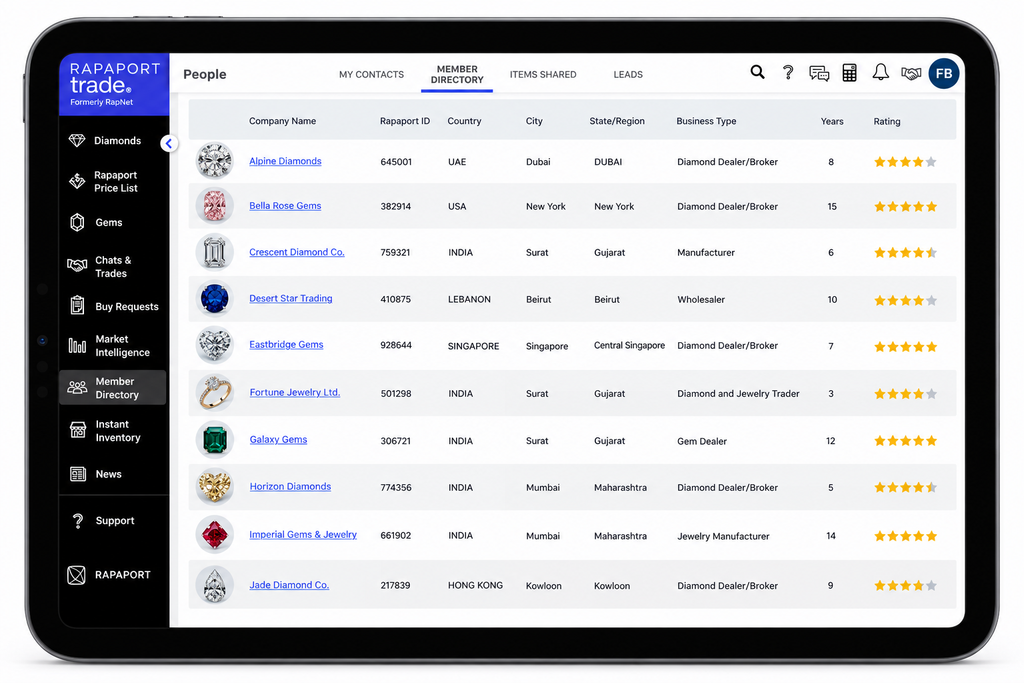
Rapaport Trade’s Member Directory is built for precision and professional confidence, serving as a vital resource for dealers worldwide. You can instantly filter by company name, location, or Rapaport Trade ID, and see exactly how long a company has been a member; when combined with peer-to-peer supplier ratings and endorsements, you get a clear picture of who you are dealing with before a conversation even begins. This transparent approach allows buyers to vet potential partners at a glance, ensuring every connection is built on a foundation of established credibility.
There’s also the practical side: sourcing from suppliers in closer proximity cuts shipping costs and lead time. When you’re working without a broker, those savings stay in your margin instead of disappearing into the transaction.
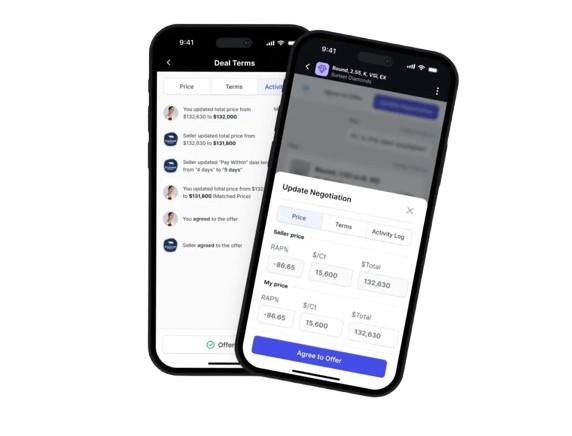
Rapaport Trade is more than a directory; it’s a high-energy marketplace where direct communication and negotiation serve as the engine of every deal. From a single window, buyers can instantly verify availability, request high-resolution media, and negotiate terms in real-time through Rapaport Trade Chat. By removing the intermediary, you are trading exactly the way the diamond industry works best: direct, fast, and transparent. When you reach an agreement and say mazal, you haven’t just closed a deal. You’ve strengthened a professional relationship while keeping your entire conversation history in one secure, searchable place.
The tools help, but they’re not the point
Members often return to Rapaport Trade for the network and liquidity, then discover features that deepen the platform’s value. A couple of valuable features include Buy Requests and the Trade Screen. Buy Requests are a catalyst for diamond deals that may be available from dealers even before they are listed, while also giving sellers direct visibility into active buying demand. The Trade Screen is one of Rapaport Trade’s most distinctive and unique features, offering a powerful lens into real market activity, supply, and pricing. Far from secondary tools, both play a meaningful role in how members source stones, understand the market, and do business more effectively.
But notably, none of the dealers we spoke with led with technology. The tools were context, not the argument. The argument was control.
Diamond buyers and diamond sellers can discuss every part of the deal directly, from price and delivery timing to location. Because they are dealing with each other, every detail is open for discussion and negotiation. As one member put it simply, “We want to control our purchases.”
The traders who came back tell the story
The dealers we spoke with didn’t leave Rapaport Trade’s competitors because those platforms collapsed or failed in some dramatic way. They left because, over time, the limitations became impossible to ignore. Commissions that compound on high-value stones. Suppliers hidden behind anonymized listings. No room to negotiate, no relationship to fall back on.
At a certain level of the trade, those things matter too much to overlook.
In a business built on trust, relationships, and the ability to negotiate, that control is not a nice-to-have. It’s the whole point.
For 30 years, Rapaport Trade has connected diamond and gem professionals worldwide through direct, transparent trading, backed by deep experience and knowledge of the industry. Every member is supported by both a success representative and a customer service representative, so help is always close at hand.