
The Luxury and JCK Las Vegas shows reflected the varied state of the industry, with higher-end jewelers reporting good sales while loose-diamond dealers saw patchy results.
Exhibitors at the more exclusive Luxury show, which focuses on finished pieces, were satisfied with the six days of trading as they packed up their booths on Monday.
Traffic and buyer interest exceeded their expectations, with consumer demand and retailer stocking holding up despite challenges from tariffs and high gold prices.
Many suppliers went into the show with caution, in line with sentiment they had seen from their retailer customers since US President Donald Trump announced 10% tariffs on imports in April.
The customs duties and high gold prices have forced several wholesalers to raise the prices at which they sell to stores. Overall economic uncertainty has also made retailers reluctant to make purchases.
However, buyers turned up with an appetite for fresh goods, appearing to put their desire to meet steady consumer demand ahead of their fears about the market.
The tanking prices of lab-grown diamonds also made the category less attractive to retailers, prompting them to shift back to natural, exhibitors observed.
Price sensitivity
The tariffs had little impact on US consumer demand, exhibitors said. However, many retailers stopped buying when Trump announced the tariffs, as they were trying to understand the situation, said Dario Pastorelli, president of IFE Lux Group, which displayed its men’s jewelry brand Baraka at the Luxury fair. The show itself appeared to be a turning point.
“The mentality has changed,” said Pastorelli. “They are saying, ‘What can we do about it?’ The confidence level of the customer at this show has been beyond our expectations.”
Rajeev Pandya, a partner in New York-based diamond-jewelry manufacturer Ashi Diamonds, had expected to see resistance from buyers because of the tariffs and gold prices, which he estimated were increasing the cost of products by as much as 12% to 15%. Retailers had also been predicting a recession that did not arrive, he explained.
The atmosphere at Luxury was more positive than at the more diverse JCK Las Vegas show, which takes place at the same venue.
“Typically, the customer that will come [to Luxury] is your better independent [retailer],” said Pandya, whose company exhibited at that show. “They’re not as price sensitive, [and] their customer is not that price sensitive.”
Patchy polished
JCK Las Vegas, which also ended on Monday, set a more mixed tone. Mid-range jewelry suppliers were not as happy overall as the higher-end sellers at Luxury. Loose polished traders varied from jubilant to disappointed, depending on their business model, product range, and whether they were based in the US or India.
Dealers that provide programs and broad service to retailers, rather than just selling individual goods, were more successful, said Sam Indelicato, chief sales officer at Rochester, New York-based polished dealer RDI Diamonds. He reported strong sales at RDI’s booth in the natural-diamond hall.
“I did very well at the show, and I didn’t show one diamond,” Indelicato commented. “They said, ‘I’ll buy $200,000 from you: [You] pick; look at my data.’”
Exhibitors reported decent sales of higher-end stones, long fancy shapes — especially ovals — and 3-carat and larger diamonds in rounds and fancies. Performances in bread-and-butter goods were mixed.
US-based inventory was more popular than Indian goods because of the tariff costs built into the latter.
In addition, companies that imported diamonds for the show with a temporary importation under bond (TIB) could not sell directly. The tariff-free arrangement enabled them only to display stones, but they had to export anything they wanted to sell back to the country from which it came and reimport it to the US at the full tariff rate.
Meanwhile, retailers are showing more willingness to buy finished jewelry than loose diamonds, influencing trading at the show, some exhibitors said.
Activity was solid at the Couture show, which focuses on high-end brands and designers, as well as at the Las Vegas Antique Jewelry & Watch Show. Both fairs ended Sunday at the Wynn Las Vegas. However, tariffs have had a negative impact on sourcing, exhibitors there said.
Fundamentally, the consensus at all the shows was that US consumer demand for jewelry was robust — breeding hopes that all points of the supply chain would eventually benefit.
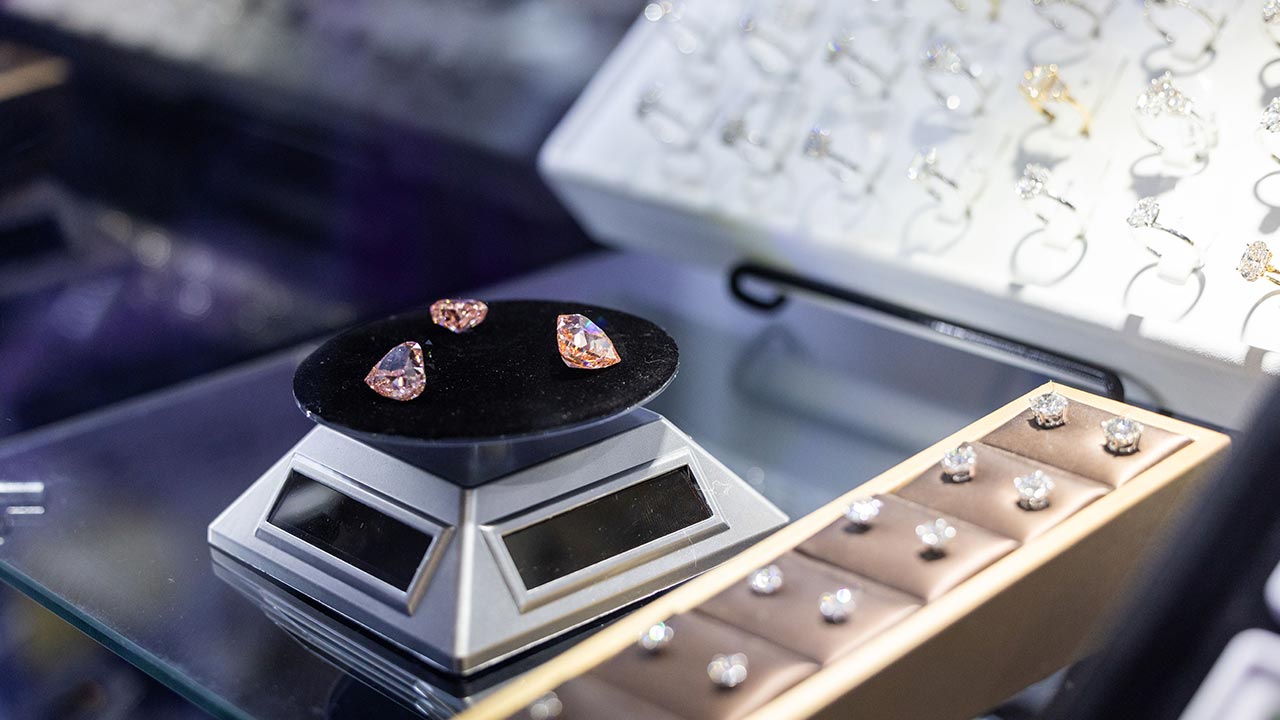
Image: A jewelry exhibit at the JCK show. (JCK Events)