
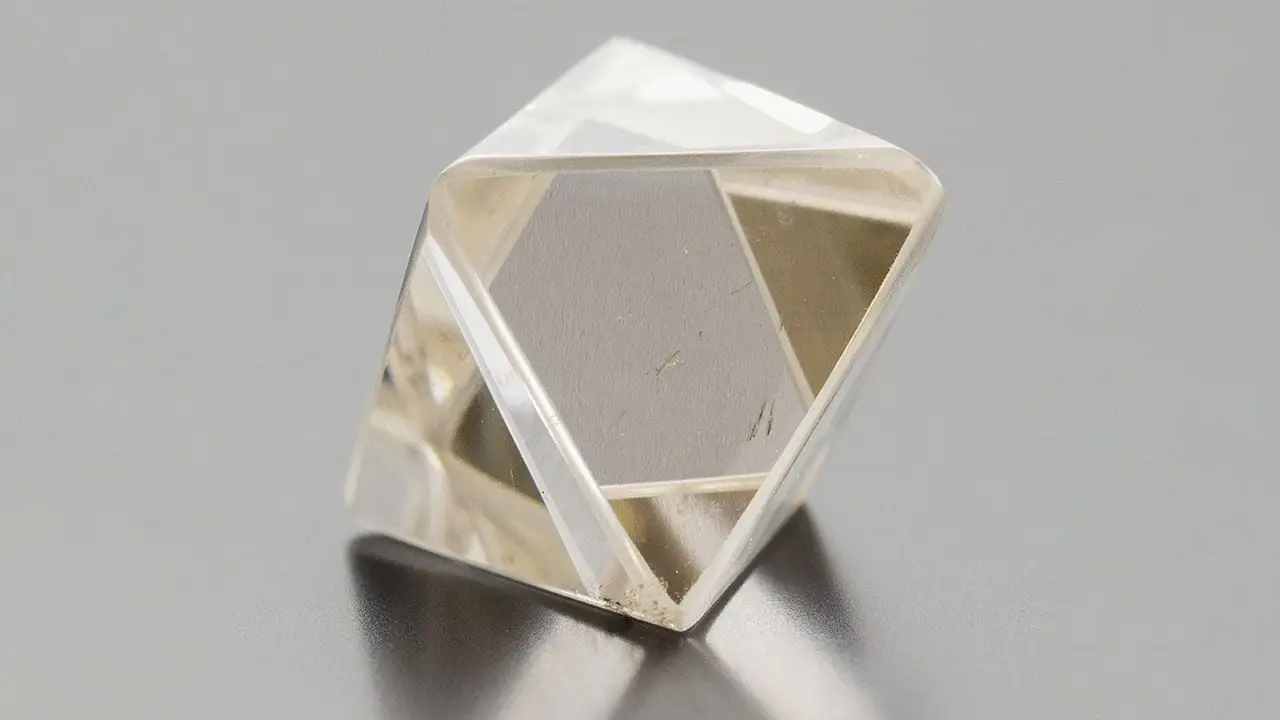
Scientists at De Beers examined a lab-grown 6.87-carat stone that growers intentionally shaped to imitate a rough natural-diamond crystal.
The near-colorless stone is believed to be the first time creators of a synthetic chemical vapor deposition (CVD) diamond have shaped it to resemble a rough diamond, according to an article submitted by the De Beers UK science and technology team for the spring issue of Gems & Gemology, the quarterly journal of the Gemological Institute of America (GIA).
Upon investigation with the use of raman spectroscopy, the results confirmed that the material was a diamond, with its near-octahedral shape similar to that of a natural rough crystal. Further analysis showed that it was not a true octahedron, as only one set of opposing faces was parallel. Microscopic observation under differential interference contrast revealed extremely flat faces marked mainly by parallel polishing lines, unlike the growth steps and trigons typically seen on natural octahedral faces. The facet junctions were extremely rough, possibly due to measures taken to improve the color, after which the main faces appear to have been repolished, the authors explained.
X-ray Laue diffraction showed that none of the stone’s faces matched the planes in a way that is typical of a natural-diamond octahedron. Two opposite faces matched planes in a manner consistent with the stone being cut from a block of CVD-grown synthetic. The De Beers team believes that fashioning the material into this shape would require careful processing and result in significantly lower yield, suggesting the purpose was to deceive.
DiamondView imaging definitively identified the material as a CVD-grown synthetic, with orange luminescence bands indicating nitrogen-vacancy centers formed during growth.
Infrared absorption identified the material as type IIa, containing no detectable nitrogen. Some 1% to 2% of natural diamonds are type IIa, but irregular in shape. However, well-formed natural octahedral crystals are almost always type Ia, making this combination inconsistent with a natural origin. Colorless synthetic diamonds are typically type IIa or weak type IIb.
The analysis of the stone showed characteristics consistent with those seen in polished synthetic diamonds. At this time, there is no evidence of widespread switching of synthetic for rough natural diamonds. Existing screening instruments could be adapted for rough material if such incidents become more common, the article added.
Correction, September 2, 2026: Scientists at De Beers examined and analyzed the stone. An earlier version of this article incorrectly said this was carried out by the Gemological Institute of America (GIA).
Image: The 6.87-carat lab-grown diamond. (Danny Bowler/De Beers)