
Botswana hopes to leverage its 0% import-tariff rate to the US to start exporting more jewelry there, Bogolo Joy Kenewendo, minister of minerals and energy, said during New York Climate Week.
“We’re starting to see those that actually make jewelry in Botswana also export here to the US, and we are looking to create a much more concerted line to market in the US to take advantage of that tariff,” Kenewendo said in an exclusive interview with Rapaport News last week.
The country was “excited” and “glad” to achieve the exemption, she observed.
Botswana’s diamond industry has boosted the country’s development far beyond the economic aspect, she continued. Diamond revenue contributed to enabling legislation allowing every child to finish high school, she explained, and university students don’t need to take out loans.
“This is just the social development aspect; the economic development, the cornerstone of our economy has been diamonds,” Kenewendo elaborated. “Granted, now we are seeing the importance of diversifying and moving away from a mono-sectoral economy, but diamonds remain such a strong pillar of who we are and where we’re going – what we wish to bequeath to the next generation.”
Focus on diversification
The slump in the diamond trade has been “painful” for Botswana, given its reliance on the industry, but it has also allowed it to think creatively about diversification, Kenewendo observed.
She pointed to the country’s Botswana Economic Transformation Programme (BETP), which focuses on six pillars such as manufacturing, agriculture and mining to help it to diversify. Both the president and the vice president lead the initiative.
Meanwhile, Kenewendo predicted Botswana’s diamond industry would now focus on provenance, origin and impact.
“That’s why we’re here telling the story beyond the schools, the roads, the hospitals and venturing into one of the things were most proud of, which is conservation,” she said.
Partnering on progress
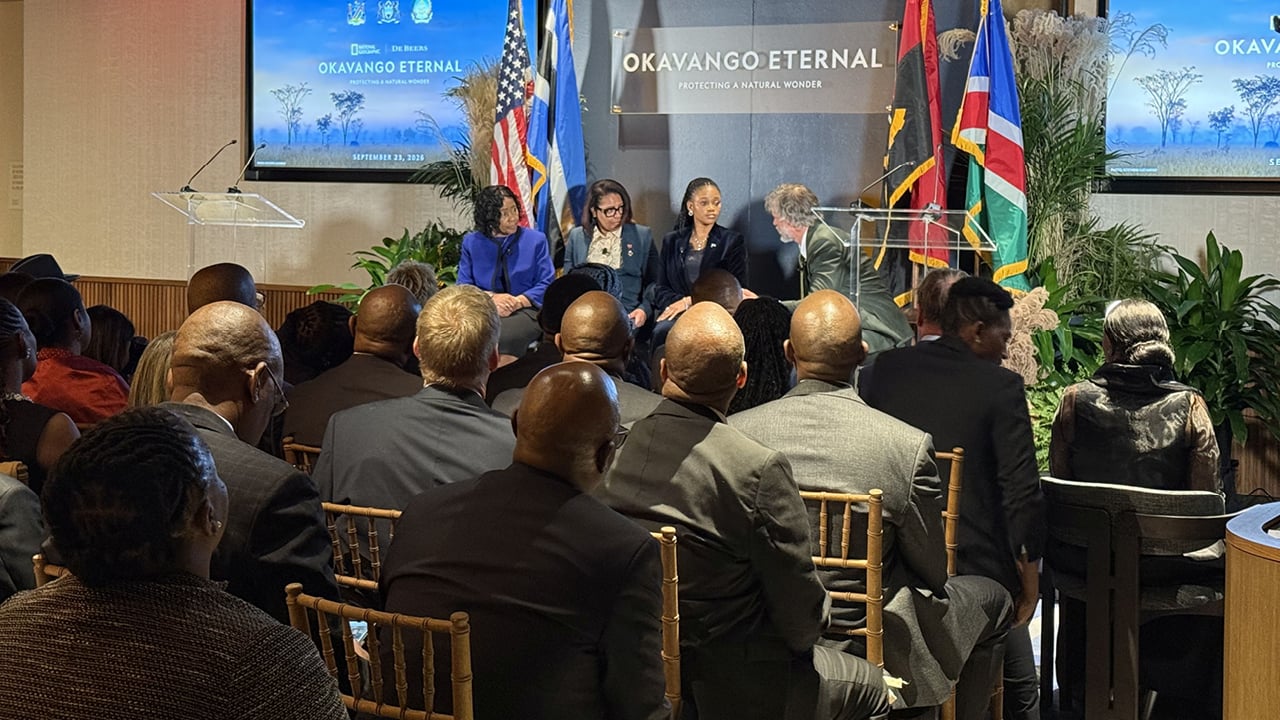
Kenewendo spoke to Rapaport News after an event in New York City last Wednesday at which the National Geographic Society and De Beers Group announced they were extending the Okavango Eternal partnership for another five years. The meeting took place during New York Climate Week.
The partnership, which initially began in 2021, aims to protect the Okavango River Basin and to support livelihoods related to conservation. The Okavango Basin begins in the Angolan Highlands before flowing through Namibia and Botswana, and provides resources and economic opportunity for all three countries.
The event brought together many world leaders, including Botswana President Duma Boko, ministers from Botswana, Namibia, and Angola, and Prince Harry, Duke of Sussex.
“Our diamond story is not simply one of extraction,” Boko said. “It is a story of endurance, responsibility, and shared progress. It is living proof of how natural resources, when governed with integrity and purpose, can uplift nations, drive inclusive economic growth, and expand opportunity for our people.”
Beyond beauty
You cannot talk about the diamond industry without talking about the Okavango Delta and the opportunities that diamond revenue and mining efforts have created, Kenewendo said at the session.
“It’s what we do in our mines and around our mines to enable opportunity,” she commented. “When we gained independence, we had 3 kilometers of road, we had one hospital and we barely had proper education.”
Sandrine Conseiller, CEO of De Beers brands, emphasized the importance of sharing stories like these, calling preserving the river system “not a gesture, [but] a responsibility.”
“It’s about being able to bring those stories outside this room to the world, so that when someone is buying a natural diamond, they know they are contributing as well to protect beautiful places like the one [Okavango Delta] we are honoring tonight,” Conseiller said.
As for how the mining giant’s impending sale could affect other infrastructure projects like the protection of the Okavango Delta, “it can only be better” if a sale brought extra funds to Botswana to spend on bettering the country, Kenewendo told Rapaport.
“The president is in the driver’s seat,” she observed. “He is personally responsible for the negotiation and it is to ensure that the outcomes are favorable to the development agenda of Botswana. So, the way we see it, it can only add value and things can only look up.”
Image: Ministers from Namibia, Angola and Botswana speaking at the Okavango Eternal event at NYC Climate Week. (Jacklyn Pellegrino)