

Fine-jewelry consumers increasingly want to connect with the people and practices behind a brand, asserts Randi Molofsky, founder of Los Angeles-based branding agency For Future Reference. That’s why a shift some time ago toward what she calls “overproduced” content – content that was not “specific to a brand or designer, but created solely to project an image or follow social media trends” – ultimately proved unsuccessful, she believes.
As AI makes polished imagery and narratives easier to produce at scale, the need to prove authenticity could become more pronounced.
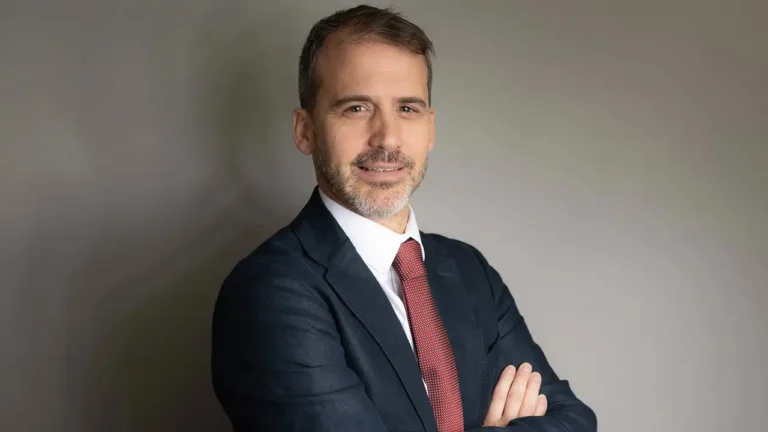
“It will no longer be enough [for a brand] to say ‘handcrafted’ or ‘exceptional craftsmanship,’” says Laura Inghirami, founder of Italian consulting firm Donna Jewel. “We will want to see who made the piece, where, how and why.”
Inghirami believes we are entering what she calls an “authenticity economy”: one “in which proof of reality will become increasingly valuable.” A designer speaking to a camera, a jeweler at the bench, or a stone displaying its natural inclusions are “not simply pieces of content,” she says. “They are evidence.”
Matter of trust
The issue, then, is not necessarily whether consumers can identify AI, but whether they can trust what they are seeing.
“Creating an imaginary universe for a campaign is one thing. Creating a fake workshop, fake artisan or fake sourcing story to support claims of authenticity is something entirely different,” says Inghirami. “The line is ultimately very simple: Are you being honest about what the consumer is looking at?”
Provenance, traceability, identifiable craftspeople, techniques, and archives could consequently become increasingly important components of brand communication. “In a synthetic digital environment, credibility itself becomes a luxury asset,” she says.
For jewelry, this could present an opportunity. The industry is rooted in materiality, craftsmanship, and human skill – qualities that one cannot simply generate. As AI produces increasingly convincing approximations of perfection, Inghirami argues, factors like “the hand, provenance, time, expertise, personality, memory, culture, reputation and trust” become more valuable.
AI tends to optimize familiar luxury codes, she explains: “perfect light, perfect skin, flawless jewelry, aspirational worlds and familiar luxury language,” with results that can be technically beautiful but “culturally interchangeable.” The challenge for brands may therefore shift from producing ever more spectacular imagery to establishing a distinctive personality for themselves.
A new aesthetic
Workshop footage, founder-led videos, phone-shot imagery and candid behind-the-scenes moments are some of the ways that industry content creators are bringing audiences closer to the people and processes behind a jewel.
Molofsky sees particular value in making labor more visible – “showing people how much time, work and energy goes into creating each piece.” She points to designer Vanessa Fernandez, who does everything from documenting loose stones and bench work to explaining techniques and revealing mistakes during production. Such access can make craftsmanship more tangible while drawing collectors further into the creative process.
For many of the brands Molofsky works with, however, this trend is not simply a reaction to AI. “It’s become increasingly clear that this personal touch is a large part of what draws customers to fine jewelry,” she says. AI may simply be amplifying a need that was already there: to communicate human qualities like craftsmanship, expertise and the creative process.
Italian high jeweler Picchiotti started to embrace AI and computer-generated imagery (CGI) in its 2024 campaigns and has seen strong engagement with behind-the-scenes content. “What [consumers] really crave today is that peek behind the curtain,” says marketing director Maria Carola Picchiotti, such as seeing pieces in progress and family involvement in jewelry-making.
Yet the growing appetite for visibly human content could create a paradox: As imperfect imagery becomes more desirable, imperfection itself risks becoming another curated aesthetic. For Inghirami, authenticity lies not in how the content looks, but in what sits behind it. “True authenticity is not an aesthetic. It is the consistency between what a brand is, what it does and what it communicates.”
As the volume of easily generated AI material increases, the pendulum could ultimately swing toward less content, not more, she predicts. “The point won’t be how much content a brand can produce, but whether a piece of content is strong enough to cut through the noise and be remembered.”
Turning the tech into a tool
None of this necessitates rejecting AI. For smaller brands and emerging designers in particular, the technology can provide access to capabilities once dependent on substantial creative teams and budgets.
“AI can amplify a vision; it should not replace the vision,” says Inghirami, pointing to its potential for research, exploration, visualization and experimentation. What it cannot provide, she explains, is the fundamental reasoning behind a creative decision: “Why this form? Why this stone? Why this material? Why does this piece need to exist now? These are cultural and creative questions, not technological ones.”
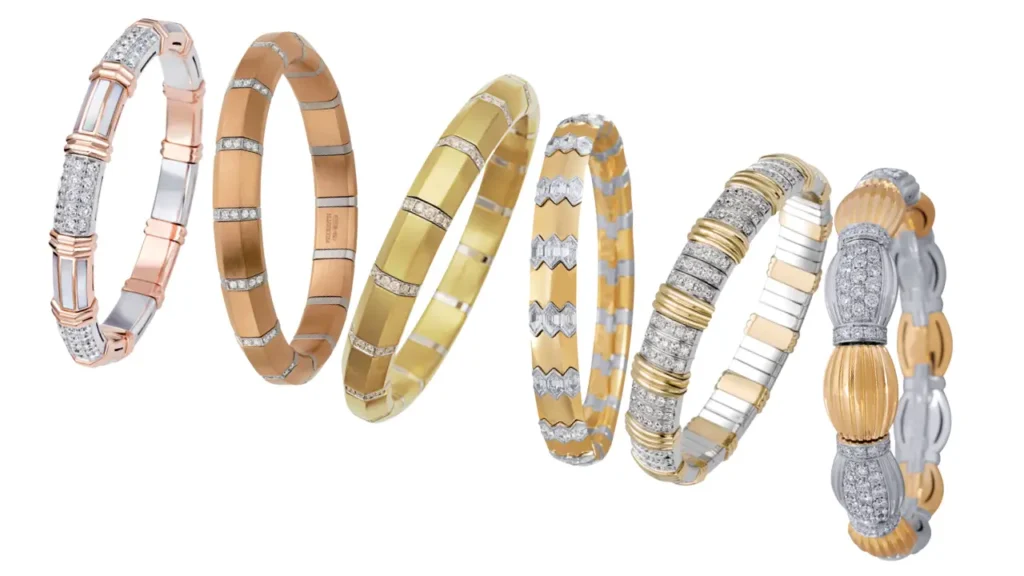
Picchiotti provides a practical example. The Italian jeweler began experimenting with AI and CGI to demonstrate the functionality of its Xpandable collection, as the line’s expanding and contracting mechanism was difficult to communicate through still photography alone.
“AI could never design or create a piece of Picchiotti fine jewelry,” says the brand’s marketing director. “Where AI is most relevant is in helping us to build marketing campaigns to promote the beautiful jewelry that we make.”
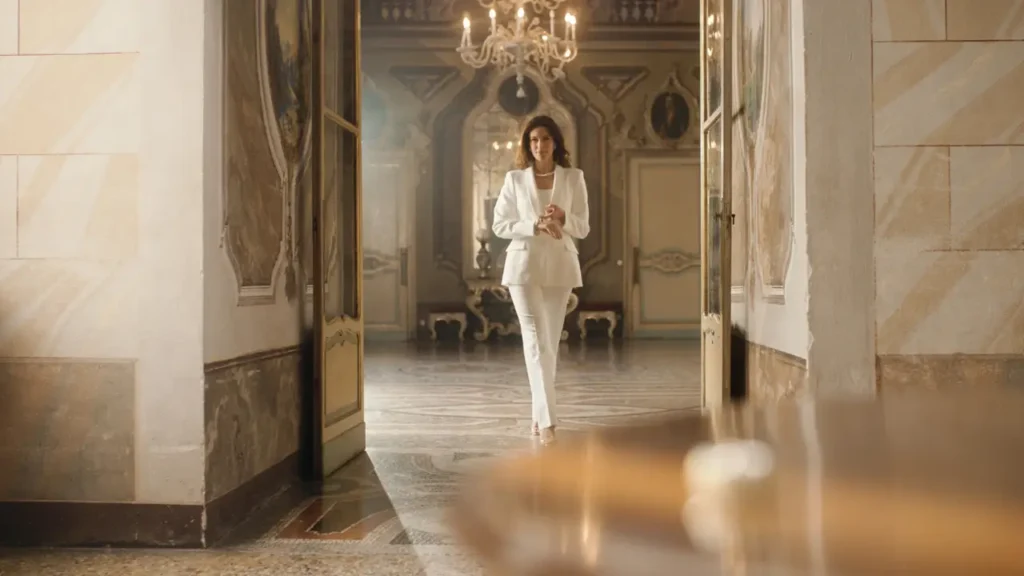
While its first AI- and CGI-led video campaign in 2024 was successful, retail partners felt it “lacked the human touch.” Picchiotti subsequently hired a real model to convey the emotion and experience of wearing the jewelry, while retaining the digital imagery to demonstrate its mechanism. “We still use CGI to show the expanding and contracting pieces, but the model now puts the pieces on in the video and shows how comfortably they slide on both fingers and wrists,” she says, reporting that this hybrid approach has proven more effective.
Let the people know
That selective use of the technology also raises questions around transparency. “‘Is this AI?’ is now a huge part of the lexicon,” reflecting growing sensitivity around undisclosed synthetic content, observes Molofsky.
If AI-generated imagery depicts jewelry that does not yet exist, Picchiotti believes in disclosing that. “Transparency is key,” she says – though she sees less need for disclosure when the content shows genuine jewelry and only uses AI in the production or editing stages. The pertinent question may then be less whether the creators used AI, and more whether that changes what the consumer believes to be real.
The question is also moving beyond individual brands. At the World Jewellery Confederation (CIBJO) Centenary Congress, which took place at the Vicenzaoro show in September, a dedicated session examined the legal and ethical implications of AI for the jewelry industry. The Futurist founder Paola De Luca argued for using AI strategically rather than simply because the technology was available, while Stéphane Fischler, chair of CIBJO’s Technology Committee, warned against relying too heavily on AI.
As AI lowers the technical barrier to sophisticated visual communication, visual polish alone may become a less meaningful differentiator. “The future of jewelry will not belong to those who reject technology, nor to those who surrender their creativity to it,” states Inghirami. “It will belong to those who use technology while protecting the human point of view that gives the jewel its meaning.”
Her advice to young designers: “Learn to think so well that AI remains your tool, never your brain or your soul.”
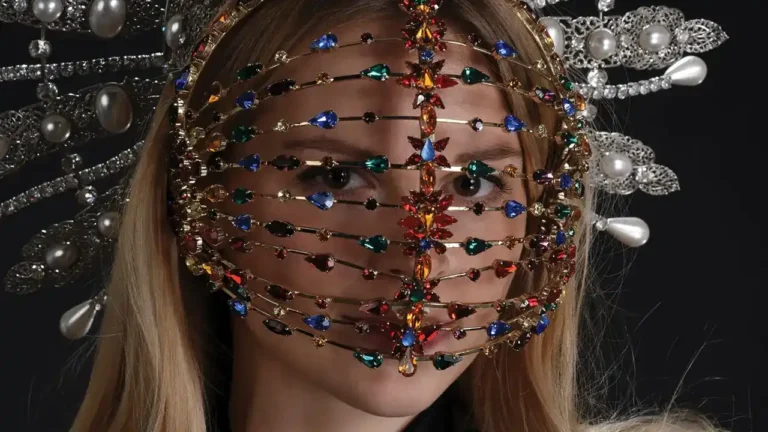
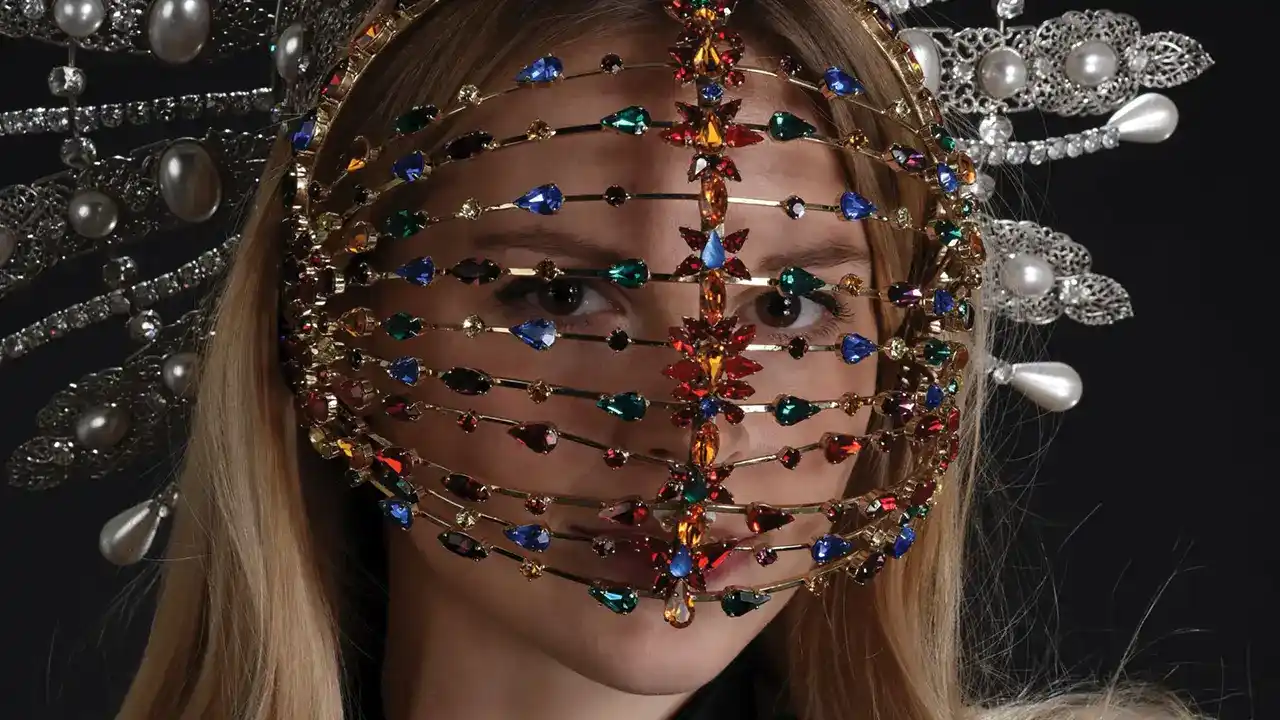
Main image: Laura Inghirami in a custom jewelry mask by De Liguoro. (Dilya London)