
Rough-diamond shipments into some of the most important trading centers surged in July, raising several questions about the state of the market.
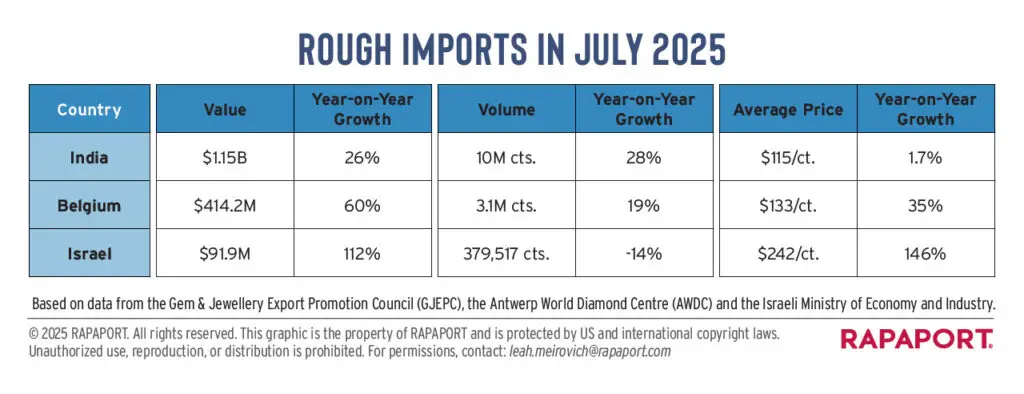
India’s rough imports rose 26% year on year by value to $1.15 billion for the month, according to data the country’s Gem & Jewellery Export Promotion Council (GJEPC) released this week. By volume, imports increased 28% to 10 million carats.
Belgium’s figures were stronger still, with the value of rough imports into the European nation jumping 60% year on year to $414.2 million. The volume of inbound rough shipments was up 19% at 3.1 million carats, the Antwerp World Diamond Centre (AWDC) reported.
Meanwhile, Israel’s rough imports more than doubled to $91.9 million for July from $43.3 million a year earlier, reflecting a sharp increase in the average price, the country’s Ministry of Economy and Industry said this week. Rough exports more than tripled to $73 million, compared with $24 million in July 2024.
The basic explanation is a moderate recovery in the rough market, especially in large stones. Demand at the June and July De Beers sights expanded to 2.50-carat and bigger goods, having previously been focused on 5 carats and up. Sales of 1.50-carat and larger polished have been steady in recent months, though the lack of consistent demand in 1-carat polished does not sit well with the growth in the rough market.
The strength in large rough aligns with the 35% year-on-year increase in Antwerp’s average price of rough imports to $133 per carat. It does not explain India’s 1.7% decline in the average price to $115 per carat.
Favorable comparison
There’s also a base effect, since the summer of 2024 was a weak period for the market that saw Indian manufacturers slash their polished production.
India’s rough imports already fell 17% year on year to $913.2 million in July 2024 and have now returned to approximately the same level as July 2023, when inbound shipments stood at $1.1 billion.
Belgium’s rough imports cratered in July 2024, sliding 45% year on year to $259.2 million from $471.4 million in July 2023. Last month’s increase appears to have been a partial correction, with the total still lagging the figure from two years earlier.
Tender shift
Another explanation that industry members have given for the jump in Belgium’s imports is the occurrence of specific, possibly one-off shipments of rough into Antwerp during July. It’s hard to determine this, since tender houses don’t publicize this type of data.
Petra Diamonds has shifted all its tenders of South African production to Antwerp until the end of 2025, it told customers in a letter on Monday, seen by Rapaport News. These sales usually happen in South Africa.
“Petra has always had a presence in Antwerp, and we feel that there is currently more activity in Antwerp, where many of the mid-tier diamond companies are currently running tenders,” a Petra spokesperson added in a statement to Rapaport News on Thursday.
Bonas will also hold four tenders in September in the city featuring $90 million in rough, Rapaport News reported earlier this week.
Angola and Russia
Another commonly held explanation for the Belgian increase is an influx of goods from Angola, though no statistics were available at press time to substantiate this. Market participants also reported considerable sales by Russian miner Alrosa to the global market in recent months.
The AWDC has not published a breakdown by country, while direct imports of rough from Russia to India were flat at around $25 million in July, according to additional data that GJEPC executive director Sabyasachi Ray shared with Rapaport News. (This doesn’t mean it didn’t import Russian goods via other countries.)
For India, the fastest-growing source of rough in dollar terms in July was the United Arab Emirates (UAE). Shipments from there rose 20% year on year to $771 million, according to Ray’s figures. This is an increase of $130 million compared with a year earlier and accounts for more than half of India’s total increase in rough imports of $238 million. Rough imports from Belgium rose 50% year on year to $206.2 million, representing around $69 million of India’s total year-on-year increase.
As for Belgium, there were some reports that companies were shipping rough to Antwerp instead of Dubai because of difficulties with corporate tax in the Arab hub. The Dubai Multi Commodities Centre (DMCC), which houses the Dubai Diamond Exchange (DDE), has not provided trade data for July and declined to comment on the month’s trends.
Tariffs and optimism
During July, the industry was largely expecting clarity over US import tariffs and hoping for a trade deal with India. This prompted some manufacturers to seek rough in expectation of shortages, especially given the upcoming holiday season.
On the demand side, India also saw an 18% year-on-year increase in polished exports to $1.07 billion in July, mostly because of US restocking and efforts to ship goods before the higher tariffs came in. The nation’s exports of studded gold jewelry rose 17% year on year to $461.4 million for the month.
Ray also cited domestic Indian jewelry demand and the start of the seasonal buying period as a reason for the rise in rough trading, and argued that Chinese demand was returning. India’s polished exports to Hong Kong soared 71% year on year to $320 million in July, according to figures he provided.
“With the uncertainty of trade tariffs and further depreciation of [the Indian rupee], traders have stocked rough diamonds, which can be processed to cater to the demand during the festive season,” the GJEPC said in a statement Wednesday. “This is likely to see…growth in demand not only in the home ground but also in other markets like the UAE, UK, etc.”
There’s often a mixed reaction when rough shipments pick up, as too much buying can cause an oversupply later. It remains unclear whether the July surge was a good one or a troubling one.
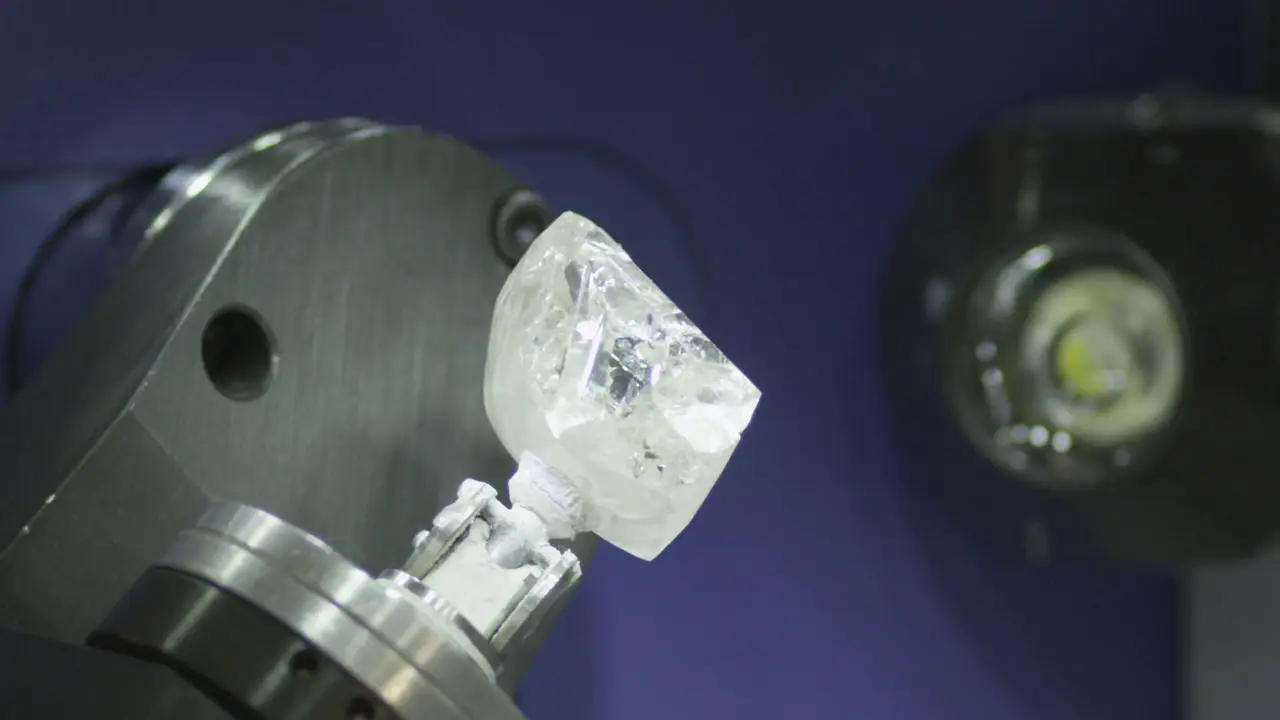
Main image: A rough diamond. (Antwerp World Diamond Centre)