
Rough diamonds of 2.50 carats and larger are seeing solid sales at this week’s De Beers sight, prompting both optimism and bafflement given the mixed demand for polished.
Many sightholders are buying their allocated goods in that size range while leaving smaller items on the table, market insiders told Rapaport News on Monday and Tuesday.
De Beers has kept prices and flexibility rules steady at the year’s sixth trading session, which began Monday and runs through Friday, sightholders said. De Beers does not comment on pricing and demand on a sight-by-sight basis.
Broader recovery
Goods above 5 carats have been the most sought-after items at sights this year because of shortages and steady consumer demand for the 1.50-carat and larger polished they produce.
This strength has broadened to smaller rough sizes in the past two months, especially from 3 carats upward but also starting at 2.50 carats, the sources explained.
This improvement was already visible at the June sight and in the wider rough market. It has fueled confusion given the ongoing weakness in round polished diamonds under 1.50 carats. Manufacturers typically get a 35% to 40% yield on the rough, though this varies depending on the type of stone.
The result has been strong demand for De Beers’ 2- to 4-carat boxes in both June and July. These boxes comprise two lots: One for 2-carat stones (known as 8-grainers) and one for 2.50 to 4 carats. Sightholders can reject one of those lots without it being considered a “refusal” that would usually count against their future allocations.
Many took advantage of this at the July sale, enabling them to keep the larger rough, which is easier to resell on the secondary market. Some of it also produces the more in-demand polished.
Back to natural?
However, even within that 2.50- to 4-carat range, there are goods that yield less salable polished in the 1- to 1.50-carat zone — yet demand for the rough on the secondary market is resurgent.
“Two or three different companies called me to ask if I wanted to sell my 3-caraters,” said an Antwerp-based sightholder on condition of anonymity. “Those people were not in the market in the months before, which sits a bit strange.”
The RapNet Diamond Index (RAPI™) for 1-carat stones — reflecting round, D- to H-color, internally flawless to VS2-clarity diamonds — fell 0.4% in the first six months of the year, with the index for 0.50-carat stones declining 0.5%. Prices of round, SI diamonds dropped 9.4% in 1 carat and slumped 10.7% in 0.50 carats during the same period, according to RapNet data.
“You talk to people on the polished side, and they’re like, ‘We do not understand why the rough is so strong,’” said a second sightholder in Belgium. “Yes, there are [polished] sales, but the prices aren’t up by the percentages that rough has jumped.”
That second sightholder said some of the customers coming to him had been absent from the market in recent years and had instead been investing in synthetics. “Now, all of a sudden, in the last three months, they’re all offering on the 2.50- to 4-carat naturals,” he said. “Maybe there’s a pullback from lab-grown.”
Thinking ahead
Market players gave three further explanations for the rebound.
One of those, consistent with the overall improvement in the rough market, is an expectation that polished will enjoy a more thorough recovery in time for the holiday period. According to this view, manufacturers are seeking the rough now to ensure they can produce goods of around 1 carat in August and September for the peak season.
Another explanation specific to De Beers is some sightholders’ desire to clock up purchases before the miner selects its new list of customers, which will be much shorter than the current one. The company will inform buyers of this decision in late September, the sources said. De Beers uses sightholders’ buying records to determine future supply.
“Everybody has a little bit of fear of losing their sight and losing their credentials,” said an Indian sightholder.
Prices and supply
De Beers has not significantly changed its sight prices since December 2024, making the miner’s goods considerably more expensive than the rest of the rough market. However, the company has reportedly been selling smaller rough to select sightholders at discounts in side deals since early this year. These generate some of the hardest polished sizes to move at present.
Demand for rough of 5 carats and above remained strong at the sight. This reflected deepening shortages and stable polished demand. In addition, prices for this range are more reasonable compared with other sizes, another Indian sightholder pointed out.
Nonetheless, “2 to 3 carats are still very expensive, yet people are buying because [the] goods are not available on the open market,” the manufacturing executive said, providing a third explanation for the upturn. “So that’s a little strength in rough over there.”
The same sightholder expects the range of in-demand rough goods to broaden further as De Beers works through its inventory. “In two months’ time you will see [an improvement in] above 4-grainers [1 carat],” he predicted.
For now, however, that rough remains weak, mirroring the slowdown in polished.
“As soon as you go below 2 carats, it’s very soft,” said one of the Antwerp executives. He cited an oversupply in that area and an even more intense glut in 3-grainers (0.75 carat) and lower, which produce melee and other small polished stones. “If half the goods disappeared, it would be more than enough.”
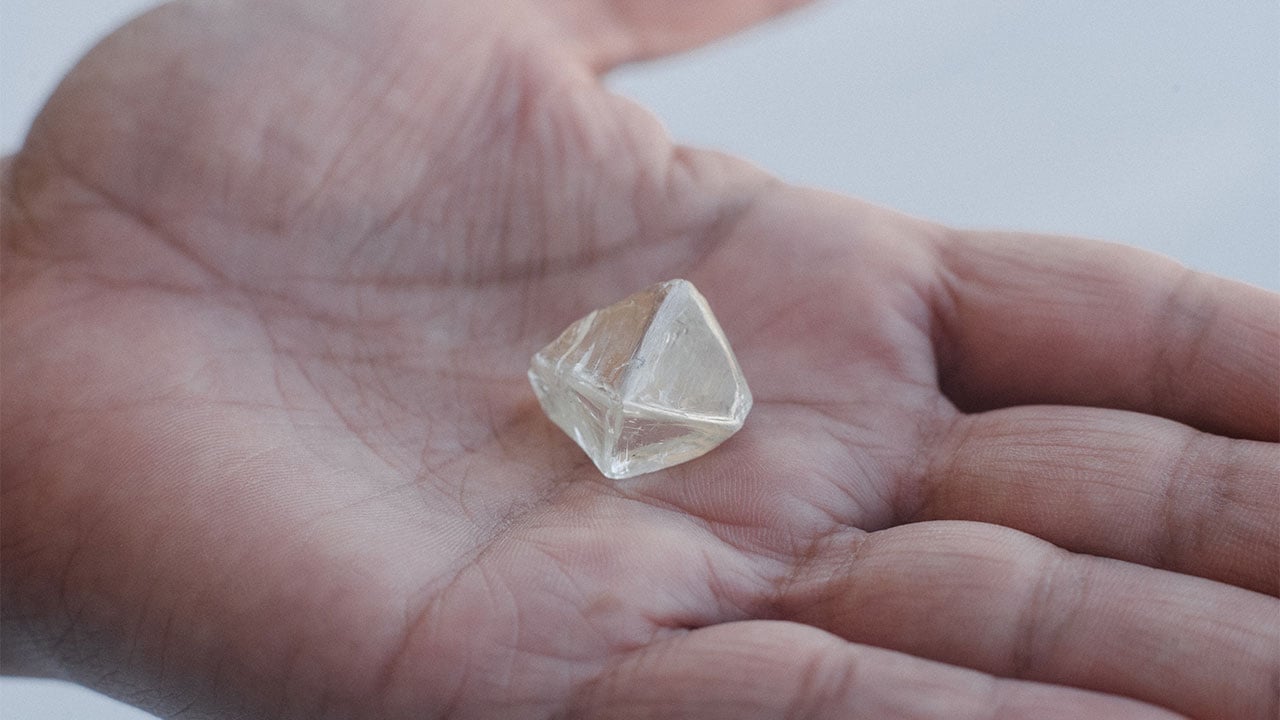
Image: A De Beers employee in South Africa holding a rough diamond. (Ben Perry/Armoury Films/De Beers)