
Trade shows can both reflect and boost the market. Often, they serve as a forum for the prevailing trends to play out over the course of a few days. Sometimes they kickstart sentiment because buyers have been waiting until the fair to place orders.
The loose-diamond area at the recent JCK Las Vegas shows leaned more toward the reflection role. The diamond categories that have been strong in recent months — notably long fancies and 2-carat and larger rounds — sold well. The more standard goods that used to be the bedrock of the US market were harder to move.
JCK also mirrored the geographical fragmentation that had been visible since the US tariffs went into effect on April 5. American companies, or overseas firms with US-based inventory, had an easier time selling than those that had shipped goods specially for the show, as the tariffs prevented them from selling directly. US-based retailers were also cautious about buying loose stones because of the uncertainty around the import duty.
Long fancies: Excellent
Among the strongest items at the show were long fancy shapes, such as ovals, long radiants and long cushions. These give consumers a bigger look with less weight. Demand for them has been steady, but production of the rough has fallen because of mining companies’ cutbacks. Nice makes are hard to find in polished, especially in 2-carat and larger sizes. This has led to intense shortages, which materialized in positive sales at the show.
“The stones look bigger [for] their size in fancies, and…you don’t have a lot of choice,” said Chirag Shah, CEO of Anita Diamonds, a supplier of large stones based in Antwerp. Shah did not attend the show, but his company exhibited in the natural-diamond hall. “If you want to make a layout of pear shapes [with] 100 stones, it’s very hard to find.”
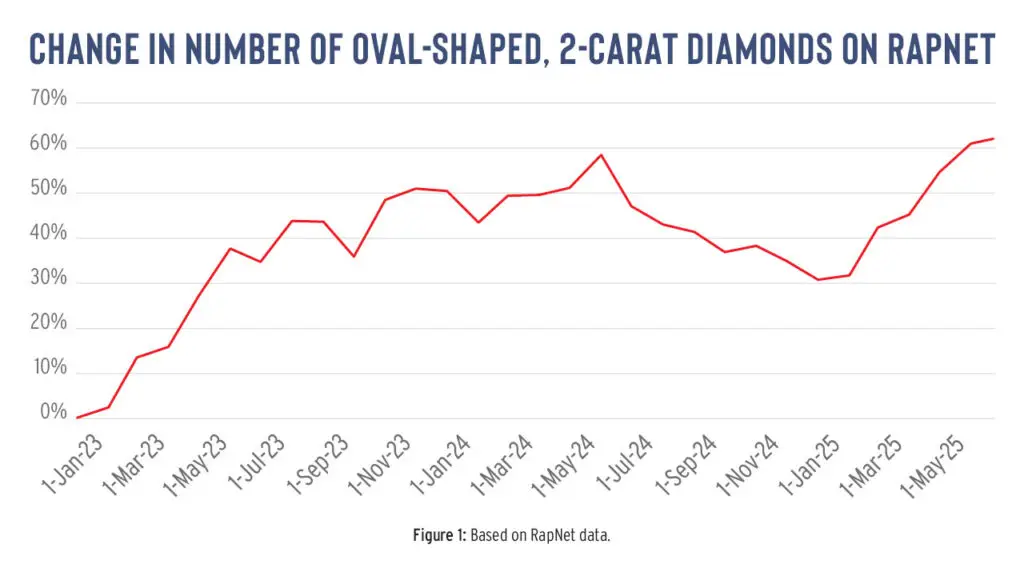
That said, the number of oval-shaped, 2- to 2.99-carat diamonds on RapNet has spiked since the start of 2025 after declining in the second half of 2024 (see Figure 1). This could reflect a number of factors. One is that the shortages are mainly in the superbly crafted stones, while badly made inventory is hard to move. A second is that manufacturers often focus on items that they see are in demand, leading to increases in production and supply.
While it can sometimes be possible to create a larger stone of a different shape from a particular rough, “we still start pushing ourselves to manufacture the oval, because we know that [it] would be easier for us to sell it than the other shape,” said Nilesh Chhabria, chief operating officer at Mumbai-based manufacturer Finestar Jewellery & Diamond, on a post-JCK episode of the Rapaport Diamond Podcast.
Ovals, long cushions, long radiants, emeralds and marquise diamonds in 2 to 5 carats were strong at the show, said another Indian diamond manufacturer who preferred to remain anonymous. “I had two customers who needed 6-carat total weight pears, and I didn’t have any left,” he added.
The quick business also reflected an acute shortage of diamonds at the show specifically, as overseas exhibitors brought far fewer goods than normal, the manufacturer pointed out. Companies that shipped merchandise through a Temporary Importation under Bond (TIB) were able to display goods without paying the 10% US import tariff. However, anything they wanted to sell they had to ship back to their home country and then deliver again to the customer in the US, this time attracting the levy.
Large rounds: Good
Round diamonds of 2 carats and larger had a solid show. Stones of 3 carats with D to J color and SI1 to SI2 clarity were especially strong, particularly in F to I colors, said the same anonymous manufacturer. “We sold everything we had — at least for us, [that] was one the best categories,” he reported. “[For] most of the customers, that was the first thing they were looking for and the first they were seeing if they could find something nice.”
Shortages have driven this market, too. Rough of 5 carats and larger has been scarce since earlier this year as miners slashed production in response to market weakness. Sightholders reported difficulties obtaining these sizes at De Beers sales from February onward and were able to resell boxes of these goods from the March-April sight at premiums. While overall sentiment dipped in April and May because of the tariffs, these larger items remained hard to obtain. Large stones were also hot at the GemGenève show in Switzerland in May.
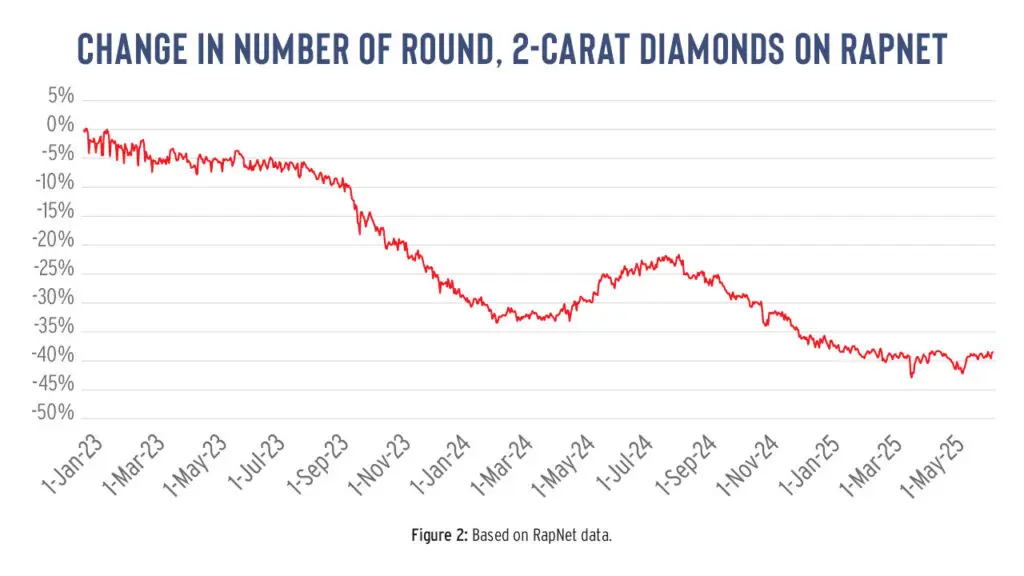
The number of round, 2- to 2.99-carat diamonds on RapNet fell 18% between July 1, 2024, and June 25, 2025, according to data from Rapaport’s online trading platform (see Figure 2). The number of stones in that range has fallen 39% since January 1, 2023.
Inventory levels usually fluctuate along seasonal lines, declining from September to March as the trade sells goods for the holiday and increasing from April to August as it restocks. But there has been very little increase in 2- to 2.99-caraters this year: The RapNet stone count for that size has risen by just under 1% since April 1, 2025.
Demand for 7-carat and larger stones, up to 20 carats, was also robust at the show, dealers said.
Nice SI diamonds: Good
The show also reflected another trend that has been present since the start of the crisis in 2023: Diamonds with SI clarity that look attractive — usually because they are eye-clean — were hard to find and in demand, whereas the less nice SIs are languishing in inventories.
The tariffs have intensified this, as many of the better goods that Indians sent to the US ahead of the import duty going into effect have run out. “Everything that was shipped there was sold,” said another manufacturer who preferred to remain anonymous. “If you want [the goods] in the US, New York especially, you cannot find good SI stones in four-grainers” — referring to 1-carat stones in F to H color.
The lack of availability of nicer SIs has widened the gap between the desirable SIs and the less salable ones, the same source said. “You’re not able to buy those better ones, and the lower ones you don’t have anyone who wants to buy. When I1 demand comes in a little bit during the season…I think we’ll just move those goods into I1 and sell it off.”
Rounds under 1.2 carats: Slow
Round diamonds under 1.2 carats had a weaker show overall, with the exception of specific items such as nice SIs. Some participants reported weakness in goods up to 1.5 or 2 carats.
“Anything smaller than 2 carats was not so much appreciated,” said one of the anonymous manufacturers who exhibited.
These constitute the majority of goods on the market, underlining the fact that the diamond industry is still in a challenging position.
The most common explanation is competition from lab-grown diamonds, which have taken market share from natural in sizes that were previously popular for engagement rings. Shoppers that would have bought a ring in the 1-carat range are able to get a much larger synthetic diamond for the same price.
Consumers with a budget of under $10,000 or sometimes $15,000 are choosing lab-grown, while those willing to spend more are buying natural, the same manufacturer said.
Another explanation is that lab-grown is cropping up more in jewelry pieces rather than as engagement rings, as Chhabria at Finestar Jewellery & Diamonds noted on the Rapaport Diamond Podcast. These tend to feature stones from around 0.80 to 1.3 carats, whereas engagement rings with larger diamonds are shifting back to mined, he observed.
“Bigger stones are still…in the business of natural,” Chhabria said.
Crucially, the size range is not seeing the same shortages that are visible in large stones and in fancies.
Melee: Slow
Reports about melee demand were mostly negative.
Customers showed limited interest in the types of small goods that are usually in demand at the show, said Rahul Shah, a partner in Sejal Exports India, a Mumbai-based supplier of diamonds from 0.5 to 3.2 millimeters in diameter.
These diamonds go into fashion jewelry that usually requires manufacturing overseas. This creates an extra tariff burden, especially if the jewelry production takes place in China, on which the US has placed a levy of more than 50%, he explained. This is a more intense problem than in solitaires, which require only the placement of the stone in a ring.
Unlike in the larger stones, polished production has not declined at a sharp rate, so there are no shortages to support the market. The slowdown in the Chinese market has also hit this category, Shah added.
Sentiment: Positive
The overall mood at the show was positive, with exhibitors sensing that US consumers were buying and that the market would improve once there was clarity around tariffs. Most exhibitors who spoke to Rapaport felt the fair was better than they expected.
While many diamond categories remain slow, the range of weak goods has narrowed. A year ago, stones from 0.30 to 2.99 carats were struggling. Now, goods over 1.5 carats are moving. This partly reflects the declining impact of lab-grown.
There was also some optimism that the market for diamonds under 1.5 carats would improve once the current inventories were depleted. “I am very optimistic that post-August, September, all your 30 points to six grainers [1.5-carat polished] will see a decent increase lasting into next year,” said one of the manufacturers.
However, a scenario is also possible whereby US President Donald Trump increases tariffs on overseas goods or pauses his policy again, adding to the uncertainty.
As for diamonds, much will come down to the behavior of the major retailers. They did not buy much loose at the show due to uncertainty over the tariffs, exhibitors said. The Luxury fair, which takes place on the same site and focuses on high-end jewelry, had a more consistently positive vibe. These two facts were probably additional reasons why JCK Las Vegas 2025 was overwhelming a show for large diamonds.
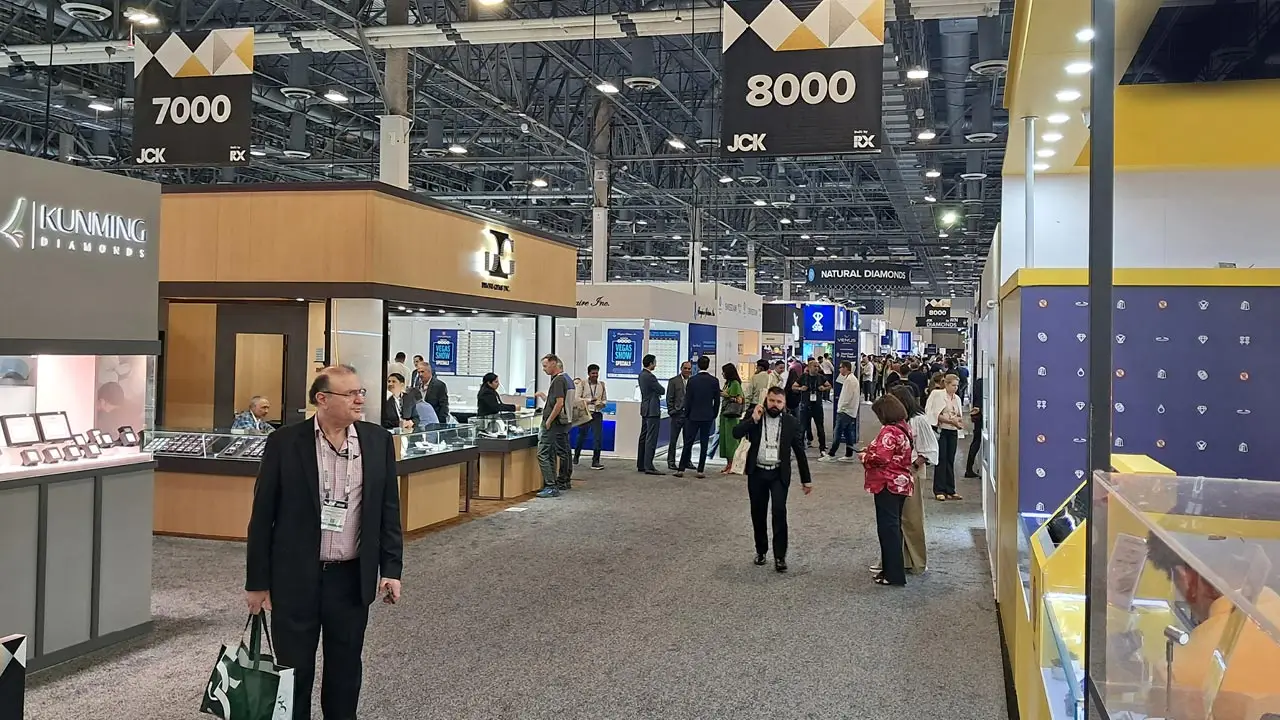
Image: The natural-diamond section at JCK Las Vegas. (Rapaport News)
This article was first published in the June 2025 edition of the Rapaport Research Report.