

The diamond industry is at a turning point. Consumer trust is harder to secure, provenance requirements are tightening, and competition from lab-grown stones is pushing every part of the value chain to demonstrate value more transparently. AI is emerging as a practical response to these pressures, not as a future promise, but as a tool already being used to analyze stones, verify origin, accelerate design, and improve customer experience.
This post explores the areas where AI is already delivering commercial results, from grading accuracy to customer conversion, and offers guidance to help diamond traders, retailers, and brands evaluate which technologies may strengthen their business.
AI in Grading, Provenance, and Compliance
One of the biggest challenges in the diamond industry is proving stones’ value and legitimacy. Consumer expectations, regulatory requirements, and competition from lab-grown diamonds are all pushing the trade toward greater transparency. AI is emerging as a practical way to deliver that transparency, offering objective grading, traceable provenance, and verifiable data that can be trusted across borders.
AI-Powered Grading: Bringing Consistency and Scalability to Diamond Evaluation
Diamond grading has always relied on expert human judgment, but even among professionals, assessments can vary across labs or regions. Bringing in AI to help with diamond grading can create consistency and minimize these discrepancies. AI-based systems identify inclusions and measure their size, location, and impact on brilliance using standardized criteria. For example, Sarine’s Galaxy system maps internal features in three dimensions, allowing manufacturers to understand a diamond’s full potential before cutting. Similarly, platforms like Gemtelligence can detect subtle variations in symmetry and proportions that influence light performance, details that may not be visible to the human eye but have a measurable impact on value. The result is a diamond grading process that is faster, more consistent, and supported by verifiable data.
AI for Provenance Verification and Ethical Compliance
As diamond grading becomes more data-driven, origin is being held to the same standard. The market – and regulators – is no longer satisfied with knowing what a diamond is, but increasingly where it came from and whether that journey can be independently verified.
AI technologies are enabling this shift. Tools that combine nano-laser inscription, chemical fingerprinting, and blockchain tracking give each stone a digital identity that cannot be altered once recorded. Systems such as Opsydia can etch a code beneath the surface of a diamond, imperceptible to the naked eye, that links to a verified record of origin, ownership, and movement across the supply chain.
Generative AI in Jewelry Design and Manufacturing
Design has traditionally been one of the most time-consuming phases of jewelry production. Concept development, client approvals, and CAD iterations often stretch timelines and increase costs. Jewelry designers can use generative AI to scale creativity, moving from initial idea to prototype more quickly, while improving alignment with consumer preferences and reducing wasted effort.
Faster Concept Development with AI-Assisted Jewelry Design
Generative AI allows designers to move from a verbal idea or rough concept to a visual rendering in minutes. Instead of starting with a blank page, they can generate multiple variations instantly, experimenting with stone cuts, metal types, and setting styles in real time. The designer still makes the aesthetic and technical decisions, but the early concept development stage becomes faster and more flexible. Tools like Midjourney and Firefly are being used in this way across the industry, not to replace creativity but to give it more room to expand.

[Source: ID 322654334 © BiancoBlue | Dreamstime.com]
Customization and Client Co-Creation
Personalization is becoming a defining factor in fine jewelry sales. AI tools make it possible to include the client directly in the jewelry design process, adjusting features during a consultation and immediately visualizing the results. For example, AI-enhanced CAD platforms such as MatrixGold now allow a designer to change stone shape, setting style, or band design in real time while the client watches their ideas take form. Similarly, interactive platforms like JWEEL let clients explore gemstone and metal combinations through an AI-guided interface. This reduces time spent on revisions and increases emotional investment in the final piece. For jewelry retailers and designers, this capability helps convert interest into commitment much earlier in the buying journey.
Forecasting Demand and Reducing Inventory Risk
Even before the jewelry design stage, AI is increasingly being used to predict what should be created in the first place. Trend analysis platforms can detect shifts in consumer interest by analyzing search data, fashion cycles, and regional buying behavior. For example, platforms such as Heuritech and Edited use machine learning to scan social media imagery, influencer content, and retail data to identify emerging preferences in gemstone shapes, metal colors, and design motifs. Brands can use these insights to design for actual demand rather than rely on instinct or seasonal guesswork. For jewelry manufacturers and wholesalers, this means less overproduction and better control of inventory costs.
AI in Jewelry Retail: Enhancing the Buying Experience Online and In-Store
Retail is where the emotional value of a diamond is tested against commercial reality. Whether a customer begins their journey online or steps straight into a jewelry boutique, they want clarity, reassurance and a sense of personal relevance. AI is reshaping retail by strengthening sales interactions, offering tools that help customers visualize, compare, and commit with greater confidence.
Online: Turning Browsing into Buying
One of the biggest barriers to online jewelry sales is uncertainty. Customers struggle to imagine how a stone will look on their hand or how a setting will sit against the skin. AI-driven virtual try-on tools, such as Perfect Corp and other augmented reality (AR) solutions built into e-commerce platforms, allow shoppers to see high-fidelity renderings of pieces on their own hand using just a phone camera. This reduces hesitation and helps customers make decisions without visiting a store.
At the same time, AI recommendation engines analyze browsing behavior to suggest pieces based on style preference, budget range, and even typical buying patterns. Instead of scrolling through hundreds of items, customers are guided toward options that genuinely match their intent. The effect is subtle but commercially significant, with shorter decision times and higher engagement rates.
In-Store: Supporting the Sales Conversation
AI can also enhance in-store experiences by giving sales professionals access to richer, real-time information. Clienteling tools such as Salesforce Einstein and The Edge Retail Academy’s AI platform can surface a customer’s previous purchases, style preferences, ring size, and even designs they explored online before their visit. Rather than starting from scratch, the conversation picks up where the customer last left off.

[Source: ID 322937392 © Justlight | Dreamstime.com]
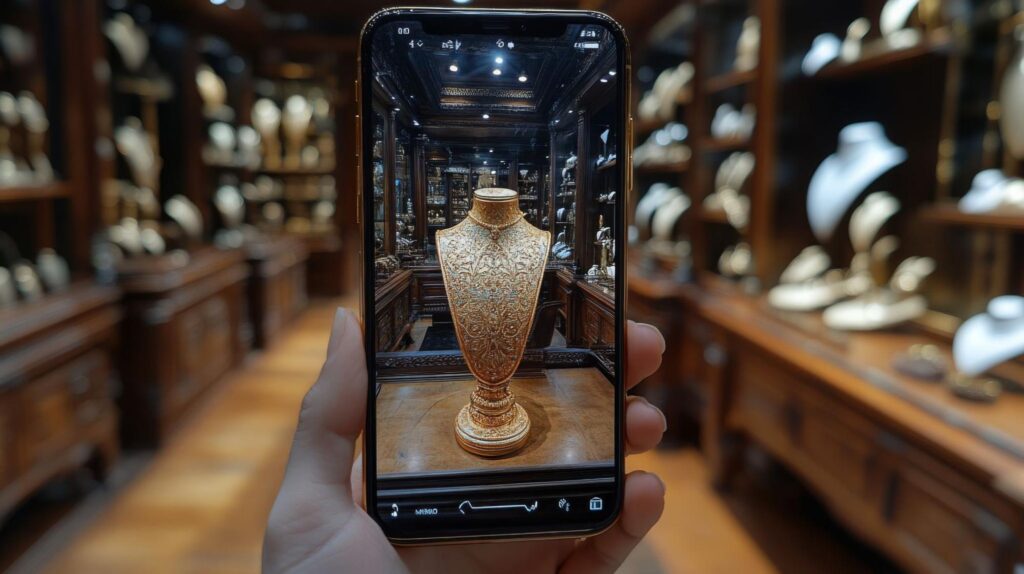
Augmented reality mirrors and tablet-based visualization systems allow customers to compare settings, diamond sizes, and shapes side by side, even if those pieces are not physically in stock. These tools enable more informed conversations and reduce friction in the buying journey. Instead of relying on descriptive language, retailers can show customers precise visualizations tailored to their preferences.
Evaluating AI Adoption: Strategic Considerations
With AI now present across diamond grading labs, jewelry design studios, and retail environments, the question becomes determining where it can deliver meaningful value within a business.
Start with the Business Problem, Not the Technology
Businesses that see the strongest returns from AI tend to begin with a defined pain point such as inconsistent grading results, rising inventory costs, low online conversion rates or pressure to prove provenance. From there, the technology becomes a tool to address a measurable objective.
Cost, Scale, and Return on Investment
AI adoption does not require full-scale transformation. Many tools operate on a modular basis and can be introduced incrementally. By choosing the specific goals first and then measuring the impact – changes in conversion rates, yield percentages, or time-to-approval, for example – companies can decide when to scale up the solutions that are working well or make changes to the ones that are less productive.
The Human Element
Across every segment of the industry, AI works best when it enhances human expertise rather than replaces it. Gemologists, jewelry designers, and sales professionals still set the standards of quality and customer experience. AI simply gives them the data and tools to execute their roles with greater precision and insight.

AI and the Future of Natural Diamond Luxury
The value of a natural diamond has always extended beyond its physical properties and lies in its rarity, origin, and the personal meaning attached to its purchase. AI does not – and should not – change this, but it can enhance it. By offering greater transparency, precise grading, and personalized customer journeys, AI helps elevate the diamond buying experience into something truly luxurious – where confidence, storytelling, and emotional connection are supported by data.
[Source: ID 356969082 © Emilyprofamily | Dreamstime.com]
As the industry moves forward, the brands that succeed will be those that combine the enduring value of natural diamonds with the intelligent use of technology to deepen trust and enrich the client experience. Rapaport’s role in promoting transparency, ethical standards, and informed pricing remains central to that future – providing the foundation on which AI can be applied with confidence.