
Digital tools are reshaping how luxury brands visualize and sell jewelry online — and what this shift reveals about the future of e-commerce.
Introduction
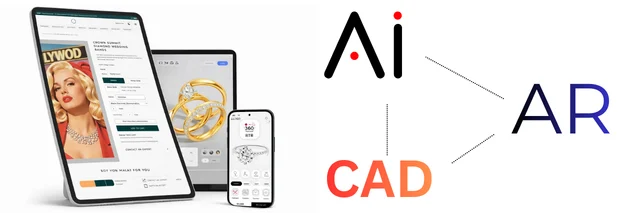
A digital revolution is sweeping through the jewelry industry, reshaping the way luxury pieces are designed, showcased, and experienced online. Advanced tech like computer-aided design (CAD), augmented reality (AR), and AI are streamlining workflows and transforming the consumer journey — motivating brands to reimagine how they present their fine collections to a tech-savvy marketplace.
Redefining The Convenience of Virtual Try-On with True 3D AR
Augmented reality’s role in jewelry marketing has evolved dramatically. Merchants integrating 3D and AR content report conversion rate increases of up to 94%, with return rates dropping by as much as 35% when customers preview items virtually.
The mechanics behind this shift involve fundamental changes in how consumers validate high-value purchases. Unlike fashion or beauty, where try-on was always feasible, jewelry required either visiting a store or making a purchasing decision based on static photography. This asymmetry created friction — particularly for online retailers competing against traditional brick-and-mortar experiences.
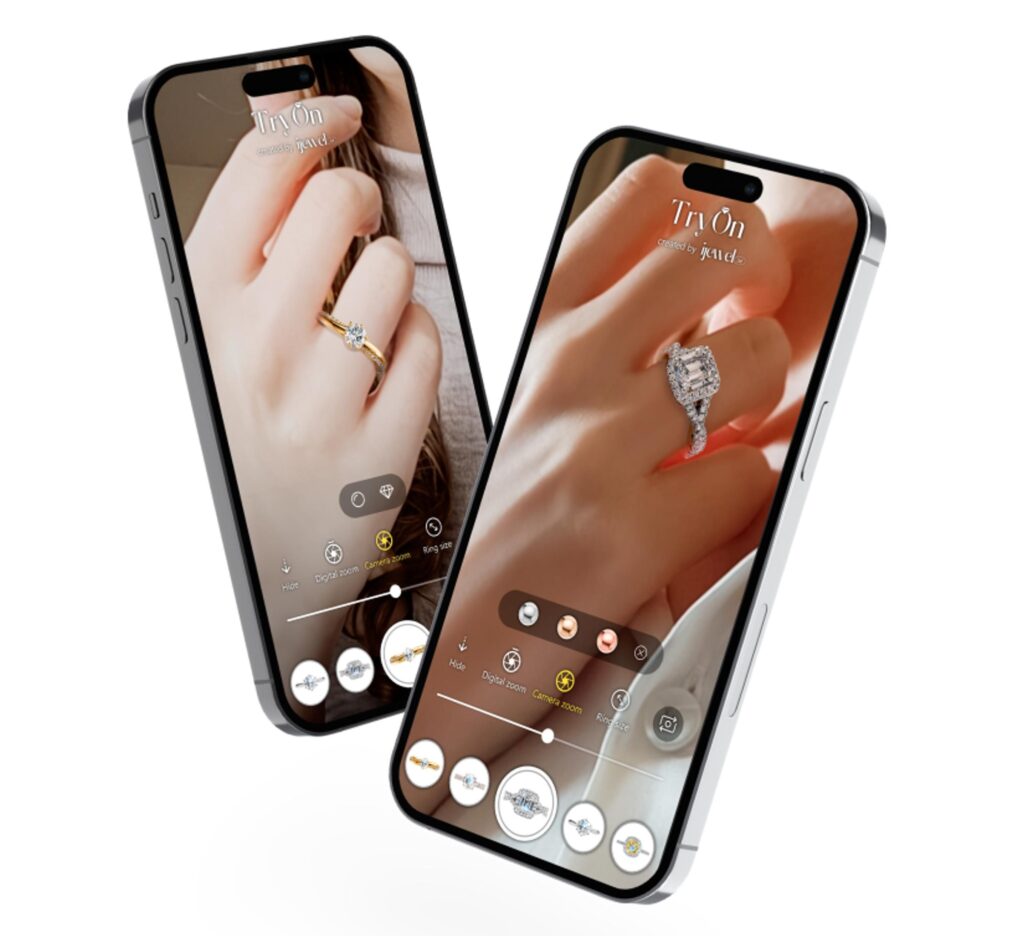
iJewel3d exemplifies how this friction is being addressed through true 3D visualization. The platform allows customers to rotate their hands freely and view jewelry from all angles, a technical distinction from static, 2D-overlaid imagery. Co-Founders Prashant Sharma & Palash Bansal explain: “The main difference is that many of our competitors use 2D-based imagery and place it live on hand using tools such as Google’s MediaPipe and others.
The latter is static, whereas iJewel3d (hence the name) is pure and true 3D visualization, allowing the user to freely move the hand and see the piece from all angles.” This capability extends to dynamic customization. Customers experimenting with different metals, gemstone types, and carat sizes in real time illustrate a broader market trend: consumers increasingly expect to co-create products before committing to purchase. Sharma notes: “That’s the true power of 3D, in being able to try multiple variations of a particular ring design instantly.”
What makes this trend significant is what it signals about customer expectations across the sector. Jewelry retailers have reported measurable satisfaction gains following AR implementation, with 70% of shoppers expected to be more loyal to brands offering AR interactions.
Now that Shopify sites can offer instant checkout within AI chats, 3D try‑on tools play a far more crucial role than simple engagement — they become an integral part of a seamless buying journey. Shoppers can preview a ring on their hand in 3D and purchase it directly in the same chat, eliminating two major barriers: uncertainty about how the piece looks and the inconvenience of leaving the conversation to visit another site.
Real-Time Rendering Technology: No CAD Files Needed
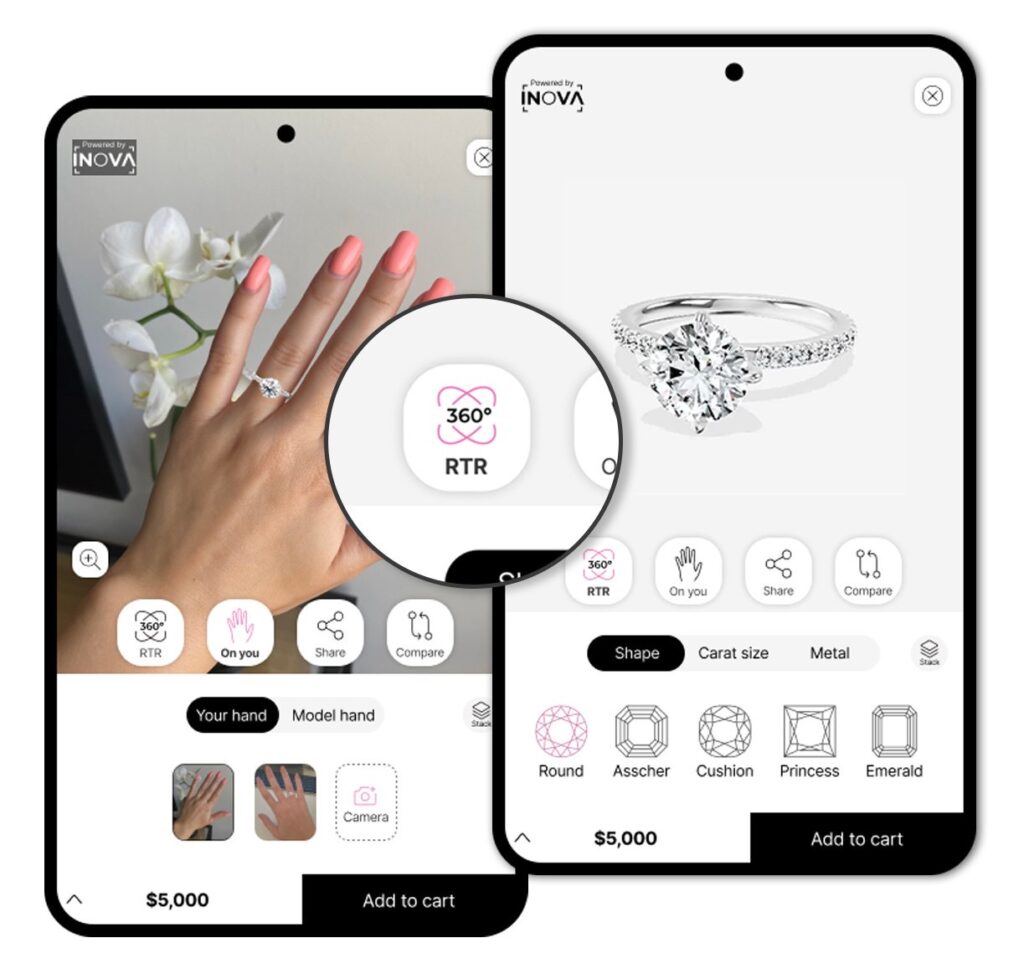
Inova Diamonds is revolutionizing jewelry visualization with its AI-Based Real-Time Rendering (RTR) technology, which redefines how customers closely examine and customize products online.
Artem Soundelzon, Co-Founder and CEO, explains that INOVA RTR entirely eliminates the traditional need for extensive 3D modeling or multiple CAD fi les. “Our approach is simple: No CAD fi les? No problem. Our unreplicated technology can generate a real-time 360° rendering from just a single STL fi le or 2–3 high-res or even average quality images snapped by a smartphone, allowing users to customize designs instantly,” he says.
This seamless generation not only accelerates time-to-market but also reduces costs for brands managing extensive and varied catalogs. Soundelzon embraces a “come as you are” philosophy: RTR transforms whatever digital assets a brand already has — whether simple still images or basic STL files — into immersive, interactive 360° views with click, zoom, and rotate functionality, unlocking unlimited customization possibilities.
Customers can switch metals, gemstones, modify shape, carat weight, and colors on the fly, expanding possibilities without the complexity of generating individual 3D assets for each design variant. This flexibility, combined with high-fidelity visuals, helps brands maintain superior digital asset quality while scaling efficiently.
Inova’s RTR solution also integrates smoothly with AR Try-On technology, enabling customers to virtually try pieces on themselves using their handheld device or view them on models via on-body rendering or animation, further enhancing engagement and purchase confidence.
The company takes a meticulous, tailored approach to brand visuals; during onboarding, they capture every nuance of materials, colors, engravings, and finishes to ensure renderings reflect brand craftsmanship authentically. “Integrating RTR into e-commerce platforms is pretty straightforward — easy as pasting a single line of code, making it accessible even for non-technical clients,” states Artem.
By blending AI innovation with rich visuals and a customer-centric customization experience, INOVA RTR enables e-commerce jewelry brands to deliver a more elevated, personalized, and enjoyable online shopping journey. The broader market reflects this shift: online jewelry sales are projected to reach 25% of total sales for 2026 — a trajectory closely tied to improved visualization capabilities and reduced return rates.
Hyper-Realistic AI Models: Rethinking Production Photography
Perhaps the most disruptive shift is in jewelry photography itself. Traditionally, creating on-model content required studio rental, professional photographers, stylists, hair and makeup specialists, and weeks of post-production. The cost structure — ranging from $10,000 to $25,000 per session for 50 images—has long created barriers for mid-market and emerging brands.
AI-generated model technology offers an alternative workflow. These tools use neural networks to create photorealistic human models, enabling brands to generate unlimited variations without hiring, scheduling, or studio logistics. The market for this technology is nascent but expanding rapidly as early adopters report tangible results.
Lux AI Models demonstrates the workflow. Founder Hamza Quenet describes the value proposition: “With AI Models, you get exactly what you pay for. If you wish to feature your jewelry with three different models with variable skin tones and ethnicities, the end result is bespoke.” This addresses a secondary market challenge: representational diversity. Traditional shoots require hiring multiple models; AI enables variant creation instantly.

The operational efficiency is measurable. Quenet highlights: “Instead of waiting weeks for edits, our turnaround is just 7–10 days; that’s a true game changer for creative directors.” According to industry reports, AI-assisted jewelry photography has reduced setup time while maintaining professional quality standards.
Critically, this shift reflects broader e-commerce trends that Rapaport Magazine and other industry publications have been tracking. As noted in recent coverage of the AI revolution in jewelry, AI can automate post-processing tasks, generate automatic product descriptions through image recognition, and deliver “consistency and efficiency in processing and presenting jewelry items online.” At the 2020 launch of virtual try-on features by major online jewelers, the industry began recognizing AI not as novelty technology but as essential infrastructure for competitive e-commerce operations.
By streamlining image creation, brands can produce stunning, lifelike content that elevates their visual storytelling, drives engagement, and strengthens their competitive edge in the digital luxury space — all without burdening the creative director with managing the numerous separate phases of a traditional photo shoot campaign.
As luxury marketing increasingly focuses on digital-first, AI-powered experiences, solutions like Lux AI Models position brands to meet evolving customer preferences for personalization and immersive visual quality.
Conclusion
As AR, AI, and CAD technologies become standard bearers in digital jewelry marketing, the distinction between “early adoption” and “industry standard” is blurring. The market data is unambiguous: brands implementing 3D visualization, AR try-on, and AI-powered production see measurable improvements in conversion rates, return reduction, and customer engagement.
For stakeholders — whether manufacturers, retailers, or technology providers — the strategic question is no longer whether these tools work, but how to implement them intelligently within existing workflows. The brands leading this transition demonstrate that adoption is not about replacing human expertise but augmenting it: faster customization enables better design iteration; realistic 3D visualization builds customer confidence; diverse AI-generated models expand market reach. These tools solve real problems in the jewelry e-commerce value chain and increase user engagement like never before.