

RAPAPORT… GGTL Laboratories has identified a necklace containing 50 large synthetic rubies, which a client submitted after being told the stones were natural.
The buyer sent the piece to the Liechtenstein-based lab with a request to identify the country of origin, as well as any treatments to the stones, GGTL said last week. The rubies appeared to be of high quality, with a deep, saturated color, but contained fingerprints and clouds, as well as other small, atypical inclusions.
“At first glance under the microscope, we noted that most of the stones resembled what one would normally call heat-treated, with some glassy residues, but that none of the inclusion scenarios gave away any possible country of origin, something highly unusual when an experienced analyst observes such stones,” GGTL noted. “This fact led immediately to the suspicion that the rubies were flux-grown synthetics.”
GGTL performed a number of tests on the stones to confirm they were synthetic, using microscopy, infrared spectroscopy, chemical analysis and digitized fluorescence imaging and spectroscopy. The results showed the stones were lacking gallium and vanadium, which are typical of natural rubies. Additionally, their main chemical characteristics were high chromium content and a low-to-moderate iron content, another indication they were lab-grown, GGTL explained.
A closer look showed tiny metallic inclusions such as platinum needles and hexagonal platinum platelets, both of which are residue from the growth process. The stones also had a few unusual inclusions made of flux and gas bubbles.
“Every once in a while a flux-grown synthetic ruby is identified at our laboratories, but this is the first time ever that we have seen a piece with that many large flux-grown synthetic rubies,” GGTL added. “Such synthetics are comparatively difficult to positively identify, and if tested only by microscopy, they can be easily misidentified as natural rubies.”
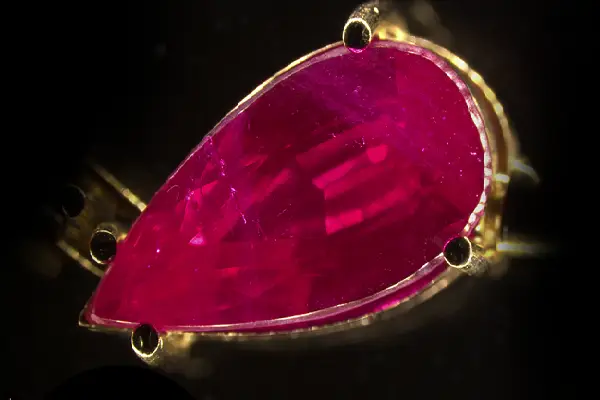
Image: One of the synthetic rubies. (GGTL Laboratories)
Rio Tinto Sells Argyle Pink Diamonds Brand to Luxury Jewelry Group
Boodles will acquire the remainder of the miner’s inventory.

FedEx Advantage Offers Member Shipping Discounts and Flexible Delivery Options
FedEx Advantage gives eligible members access to shipping discounts, flexible delivery options and more than 18,000 package drop-off locations.

AGTA President to Join CIBJO Board of Directors
Group elected Bruce Bridges to its executive committee to recognize his long-standing involvement in the trade.