
Israel has expressed opposition to Qatar’s candidacy for Kimberley Process (KP) chair, threatening the diamond certification scheme’s ability to find a new leader.
Qatar is currently the only country in the running for the position for 2026, sources told Rapaport News this week.
On May 11, Natalie Gutman Chen, Israel’s acting diamond controller and its focal point for the KP, raised the country’s concerns in a letter to KP chair Ahmed Bin Sulayem and Arnold Mukombachoto, who chairs its Committee on Participation and Chairmanship (CPC).
“Given the complex relationship between the State of Qatar and Israel, and Israel’s strong commitment to the Kimberley Process, Israel is not at ease with Qatar leading the [KP],” Gutman Chen said in the letter, seen by Rapaport News.
Israel has not publicly expanded on its reasons for the stance on the Arab country, with which it has no official diplomatic ties. Rapaport News understands it is worried Qatar would use the role as a platform to attack Israel, whereas the UAE has been an ally to Israel in the KP. Qatar is widely accused of funding Hamas, the Palestinian terrorist group that carried out the October 7, 2023, assault on Israel.
The KP chair would normally host two annual events — the intersessional meeting in May and the plenary in November — and steer discussions within the conflict-diamond watchdog.
Israel would be able to block Qatar’s appointment if it used its veto at the plenary in Dubai in November, since all KP decisions happen by consensus.
Hunt for a chair
The KP has struggled to find anyone to take over from the United Arab Emirates (UAE), which is currently in an unprecedented second consecutive year at the helm.
Usually, at the November plenary meeting, KP members pick a vice chair for the following year, with that country taking over as chair a year later.
However, the UAE, headed by Ahmed Bin Sulayem, executive chairman and CEO of the Dubai Multi Commodities Centre (DMCC), which took over the job in 2024, remained as “custodian chair” for 2025 after members were unable to reach a consensus on a replacement.
While the KP recently set up a permanent secretariat, being chair is a resource-heavy role that involves devoting part of government operations to running the process and organizing two international events across the year.
Belarus put itself forward, but Western countries rejected it over its connection to Russia.
Thailand was then appointed vice chair for 2025 at the KP plenary in November 2024. However, it withdrew earlier this year, leaving the 2025 vice chairmanship and the 2026 chairmanship open.
Bin Sulayem has tried to recruit other candidates to take over immediately as vice chair and in January 2026 as chair.
In a memo on the IDEX website in April, he identified three countries — the US, Brazil and Japan — that he believed would be apt contenders. He also highlighted Norway, Singapore and Sierra Leone as possibilities.
He cited Ghana and Turkey as additional options in his opening remarks at the KP intersessional meeting in Dubai last month.
Qatar comes forward
The World Diamond Council (WDC), which represents the industry at the KP, encouraged Qatar to run for the position.
Qatar, which joined the KP in 2021, has sought to carve a way into the diamond industry. Its rough imports and exports were zero in 2024, according to statistics the KP released this week. Observers believe the Gulf state is trying to compete with the UAE, which has had success turning Dubai into a trading hub for rough and polished.
Qatari investment funds are in the running to acquire De Beers or participate in a purchase of the company, according to a report earlier this month.
In January, the state held the first Doha International Diamond & Gem Conference, attracting attendees from across the industry.
The website of the 2026 edition of that event notes the country’s “quest to become an active and fully involved player in the diamond, gemstone and jewelry trade” — and reveals that it had submitted its candidacy for the KP chairmanship.
“When Thailand withdrew its candidacy, the risk of the KP being left without a chair became very real,” WDC president Feriel Zerouki told Rapaport News. “In response, the WDC approached Qatar and asked them to consider chairing as a way to support the continuity and sustainability of the process. We remain focused on constructive dialogue and practical solutions that protect the long-term credibility of the KP and the resilience of our industry.”
Israel would have preferred a more neutral choice given the geopolitical situation, a source close to the matter said.
Those sensitivities have only increased since Israel’s conflict with Iran sparked off last week. Israel would not be able to put itself forward as chair — a role it held in 2010 — for practical and security reasons. At present, its skies are closed to aircraft. Dealers can’t currently import or export diamonds, though there are processes in place to restart some shipments. (Update: Flights into and out of Israel resumed following the June 24 ceasefire with Iran.)
For the KP, however, the focus is on the November plenary in Dubai, where the group will need to reach a consensus on a candidate. It’s unclear what will happen if it doesn’t.
“It is unfortunate that we still do not have an incoming KP vice chair,” Bin Sulayem said in his closing speech at the intersessional on May 16. “This must change. I reiterate my call for a strong pipeline of future chairs, and I remind everyone that the chair must be selected by consensus among KP participants.”
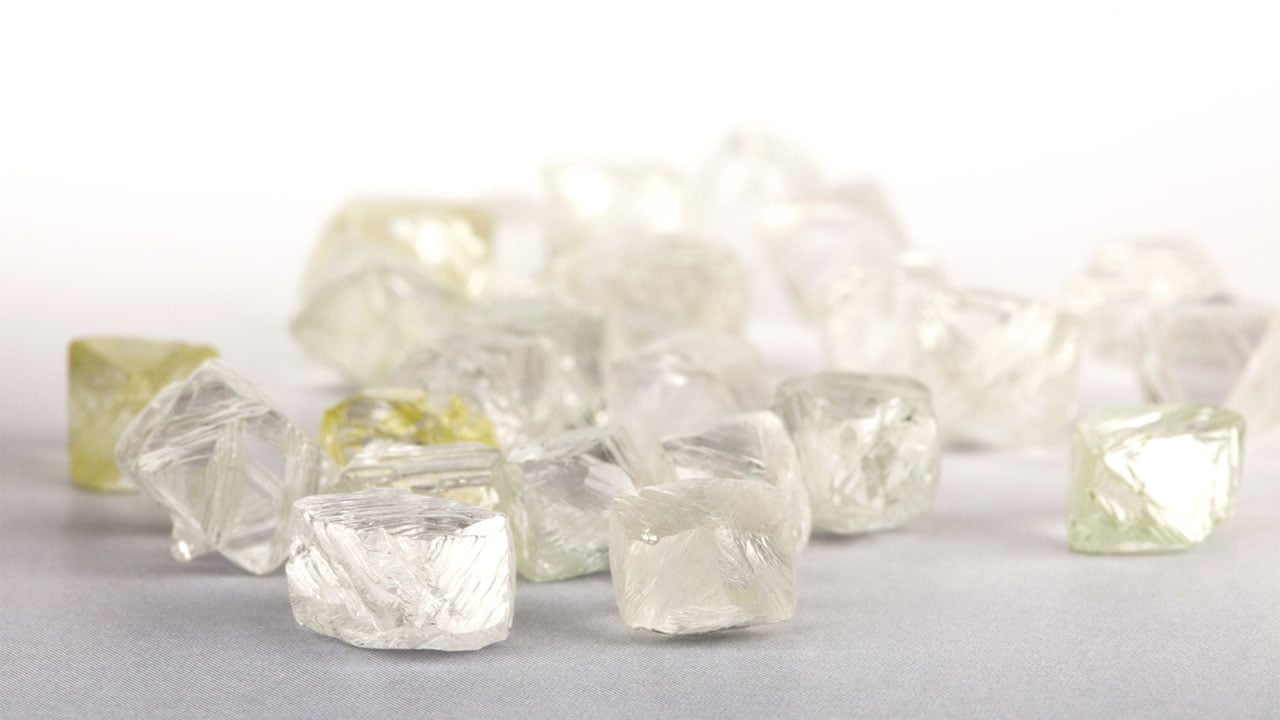
Image: Rough diamonds. (Shutterstock)