

RAPAPORT…
Attempts to upgrade the size and color of
gemstones using a layer of synthetic material have been around for decades, but
signs indicate the techniques are changing.
The Gemological Institute of America (GIA) recently received two loose, oval-shaped,
mixed-cut, red stones at its New York laboratory. On further inspection, they
turned out to be natural sapphires with a synthetic ruby “overgrowth” — a cover
of lab-grown stone that tinted the entire gems red, GIA staff gemologists Tyler
Smith and Hollie McBride wrote in the Winter 2017 edition of the institute’s
journal, Gems & Gemology.
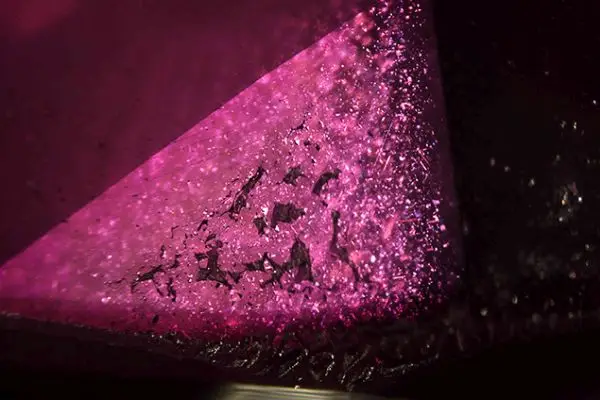
The stones had a
strong concentration of reddishness at the junctions of their facets. To the
naked eye, this appeared to come from a treatment called chromium diffusion, in
which someone adds extra chromium — the chemical element that gives ruby its
distinctive color — to make the gem redder.
However,
examinations under a microscope revealed the presence of the overgrowth, and
showed that the main part of the stones was, in fact, natural, almost-colorless
sapphire. In addition, the presence of platinum was consistent with previous
cases of synthetic ruby overgrowths.
The stones had certain visual features that resembled those with coatings created using a technique known as “Lechleitner” — named for its pioneer, Johann
Lechleitner — in which a synthetic emerald overgrowth gives greenness to a
near-colorless beryl. (By chance, the GIA’s Carlsbad lab received one of those
stones for identification at around the same time the red stones arrived at the
New York branch.)
Lechleitner, who was active in Austria in the 1960s, also experimented with
ruby overgrowths. However, the GIA had reason to believe the producers had
employed different growth conditions to coat the New York stone: Lechleitner’s overgrowth
rubies contained molybdenum, but that element was absent in this case.
“Although this is not the first report of synthetic ruby overgrowth on natural
sapphire seeds, it marks the first time the New York [or] Carlsbad laboratories
have had them submitted for identification,” according to Smith and McBride.
“The resurfacing of these vintage overgrowth synthetics shows that once a
material is in the trade, it is here to stay.”
Image: Hollie McBride

Rapaport Appoints Yosi Botzer as CTO to Lead AI Transformation
Rapaport has appointed Yosi Botzer, former Chief Technology Officer of Perion Network, as its new CTO.

Richemont and Signet Consider Participating in Bid for De Beers
Retailers are in discussions with GDC to join the group.
TAGS Tender Generates $27.1M in Revenue
94% of lots find buyers, including many special-sized and fancy-colored stones.