

Diamonds, rubies, sapphires and emeralds remain the pillars of high jewelry, but the Paris presentations during July’s Haute Couture Week revealed how dramatically the palette has expanded beyond these traditional “big four.” Paraiba tourmalines, spinels, alexandrites, mandarin garnets and multicolored sapphires had a conspicuous presence alongside ornamental materials like chrysoprase, turquoise, carnelian, lapis lazuli, malachite, tiger’s eye, coral, mother-of-pearl and onyx. Just as significant was the emphasis on chromatic compositions, with provenance, cut and unexpected pairings allowing multiple stones to work together rather than relying solely on one exceptional center gem.
Works of art
For Italian maison Damiani’s Arte Maestra collection, the starting point was not the gemstones, but the artwork: Eight masterpieces of the art world inspired the designs. In the Malìa necklace, which takes its cues from Caravaggio’s Medusa, a pear-cut, 6.11-carat Burmese pigeon’s-blood ruby and 13 additional pear-cut Burmese rubies totaling 29.03 carats sparkle alongside 36 carats of oval- and brilliant-cut alexandrites and brilliant-cut black and brown diamonds, evoking the painter’s use of chiaroscuro. Claude Monet’s Water Lilies inspired the En-plein-air necklace, which centers an emerald-cut, 10.23-carat, vivid-green Muzo emerald from Colombia and 51.72 carats of blue, green, violet and yellow sapphires.
“That meant our gem-sourcing became an act of interpretation rather than simply acquisition,” explains Damiani Group executive president Guido Damiani. “Every painting suggested its own chromatic palette, its own rhythm of light and shadow, and even its own emotional intensity. Our gemologists worked alongside the creative team to identify stones capable of expressing those qualities with precision. We looked first at color, because color is the emotional voice of every artwork. But color alone was never enough. The cut had to interact with light in a way that reinforced the composition, whether creating softness, movement, brilliance or dramatic contrast.”
Beyond those features, he continues, “we sought gemstones with a distinctive personality, capable of contributing to the narrative rather than simply standing out individually. Provenance naturally remained fundamental, because exceptional quality begins with exceptional origins. Throughout the collection, we selected gemstones from some of the world’s most renowned sources, from Colombian and Zambian emeralds to Burmese rubies, Ceylon sapphires and other rare gems – but always in service of the artistic vision.”
He sees this approach as an evolution of the maison’s identity: “For generations we have believed that gemstones should serve beauty, craftsmanship and creativity in equal measure. Arte Maestra takes that philosophy one step further: Gemstones become individual brushstrokes within a larger artistic composition, allowing high jewelry to engage directly with the language of great art.”
Paraiba in focus
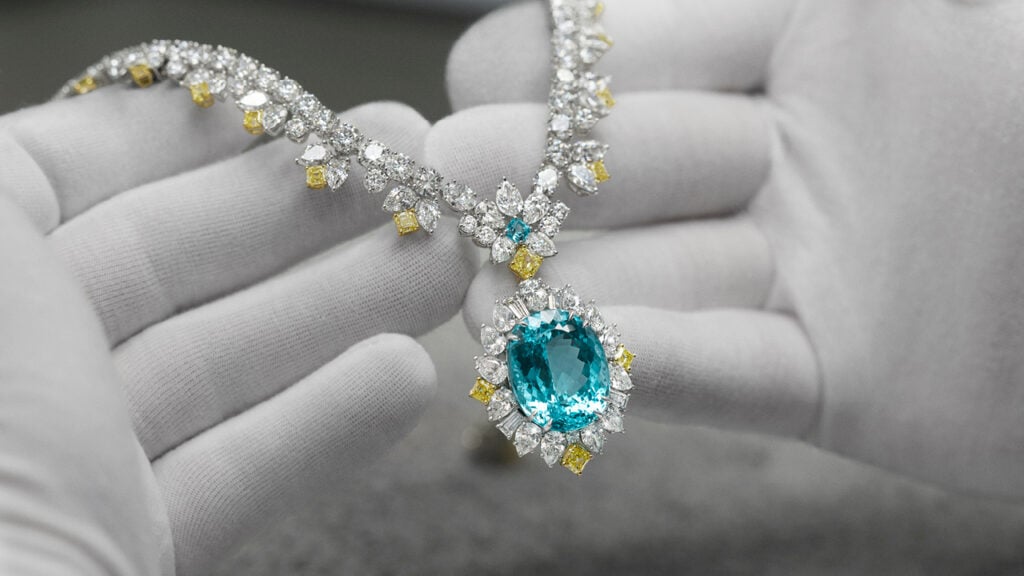
Paraiba tourmaline was one of the most recurrent stones in Paris. Harry Winston remained faithful to its tradition of placing an exceptional gemstone at the heart of a jewel. In the Talk to Me, Harry Winston collection, a 29.09-carat oval Paraiba tourmaline with an intense blue-green color takes center stage in a diamond necklace, surrounded by colorless diamonds and square emerald-cut yellow diamonds.
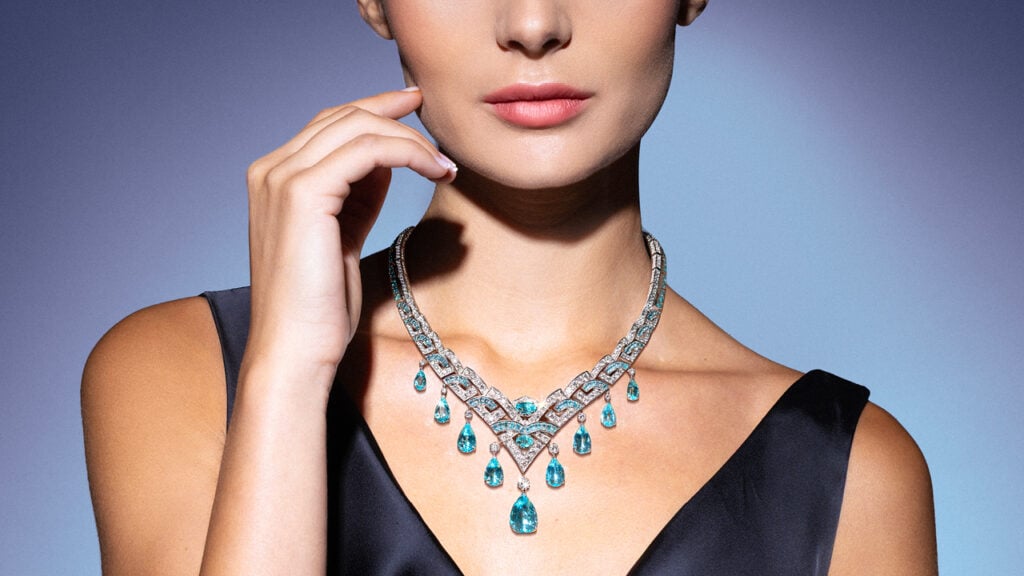
At David Morris, Paraiba is hardly new; the stone has been part of the London-based maison’s high jewelry for more than two decades. For Paris Haute Couture Week, the house’s Legacy of Colour: Volume II line explored three different ways of working with the gem. In the Indico ring, a 16.43-carat unheated oval Paraiba from Mozambique complements the intense blue of Vietnamese cobalt spinels. The Tetra ring pairs a 12.95-carat Brazilian Paraiba cabochon with invisibly-set purple sapphires and diamonds. And in the naiad-inspired Gemma necklace, white diamonds and Paraiba tourmalines form fluid lines across the neckline, ending in suspended pear-shaped Paraiba drops totaling more than 27 carats.
For Jeremy Morris, the house’s managing and creative director, recognizing a gemstone’s future collector potential “has always come down to instinct. You can spend a lifetime learning about gemstones, but there has to be a genuine feeling for stones that you simply can’t teach…. I’ve always loved pushing the boundaries by looking beyond what the market is focused on. That was true with Paraiba tourmalines and, more recently, with the cobalt-blue spinels coming out of Vietnam. There are only a handful of them, but the color is quite extraordinary.”
Morris sources the stones personally. “It can take years to find the right one,” he relates. “I’m always searching for gemstones with something special – exceptional color, rarity or hidden potential that can be revealed through careful cutting and polishing. Ultimately it comes down to passion and curiosity. Experience helps, but it is the love of gemstones that allows you to recognize something truly exceptional.”
Rainbow revolution
At Pomellato, the focus was different: not one dominant stone, but the construction of a chromatic composition.
“For Pomellato, color is a bold expression of freedom,” explains Stefano Cortecci, the Italian jeweler’s gem master. In the Pomellato Stile Libero high-jewelry line, “we began by embracing the natural individuality of gemstones and exploring how they could come together in chromatic harmony. We considered hue, saturation, transparency, cut and proportion, and above all, how each gem responds to light and enters into dialogue with the others. Assembling a suite is a meticulous process, with every gem selected for the role it plays within the composition.”
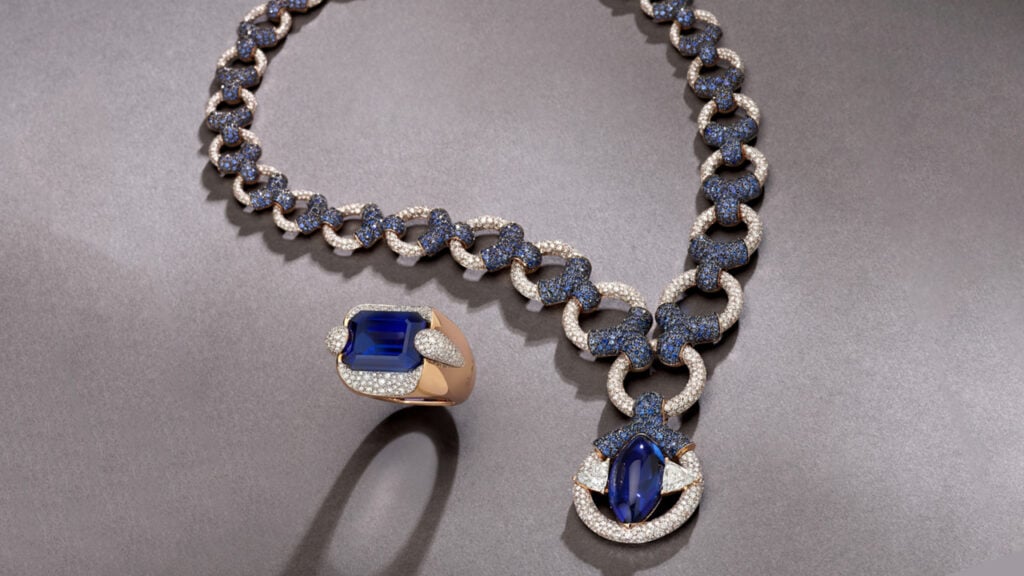
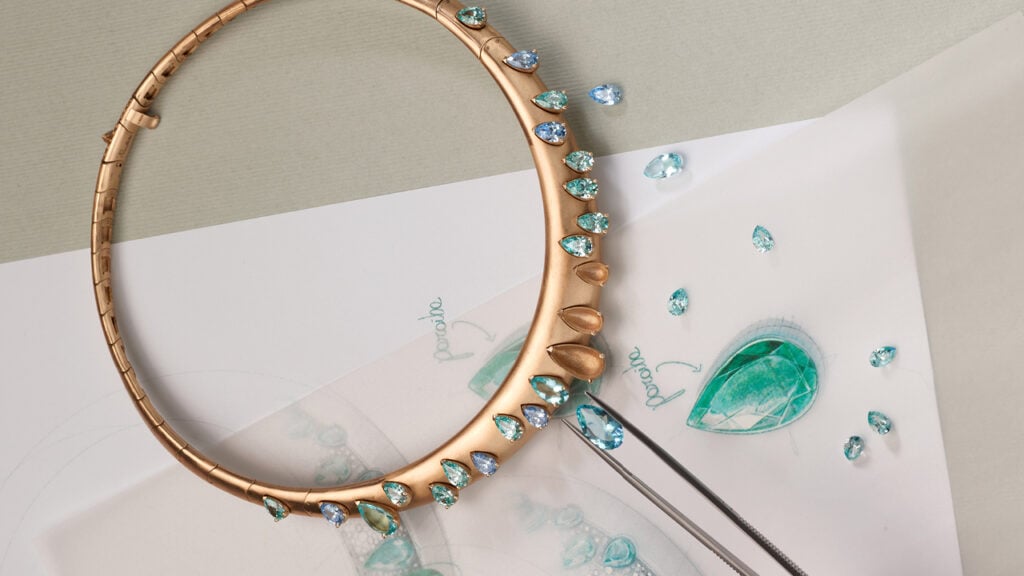
He points to the Rainbow Supreme necklace as one of the most demanding such compositions. “Creating a continuous dégradé with 68 tourmalines totaling more than 157 carats required an exceptional calibration of color, luminosity and scale. Each transition had to feel natural while preserving the singular beauty of every tourmaline. The Drops of Paraiba choker presented a different challenge: The 21 pear-shaped Paraiba tourmalines possess variations in shade and size that are integral to their extraordinary character. Our task was to create coherence while allowing those unique qualities to remain fully visible.”
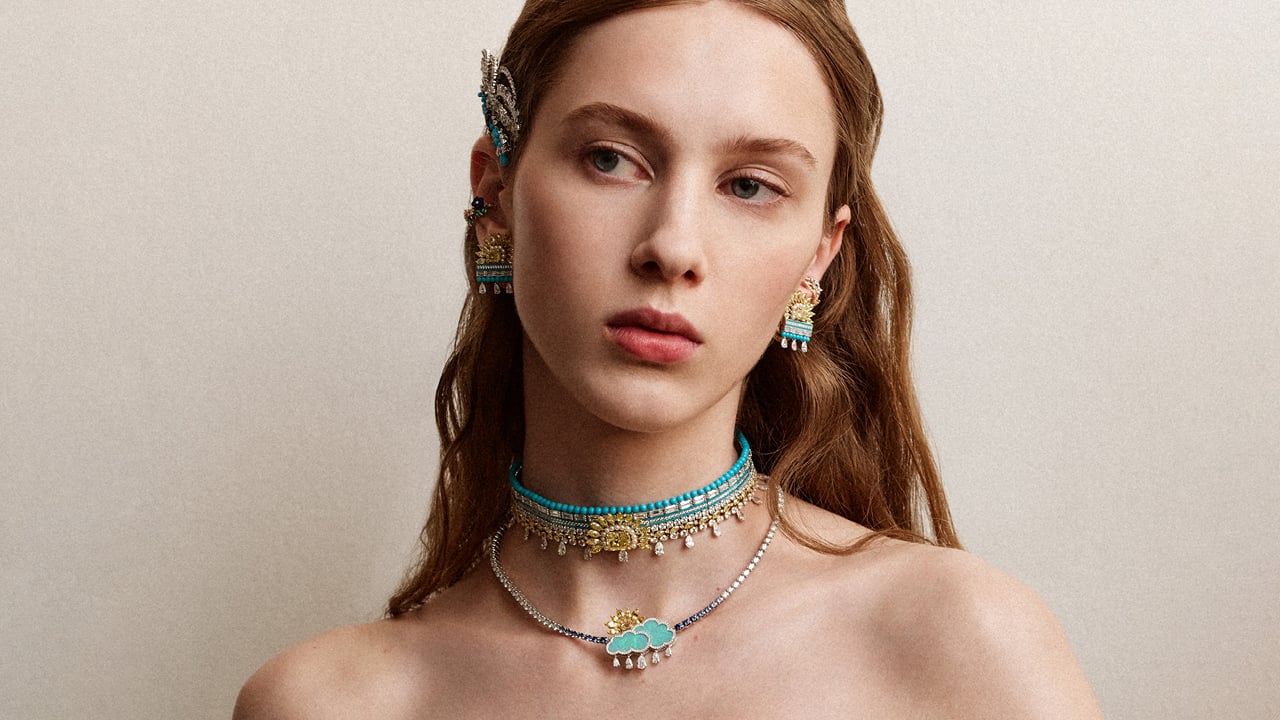
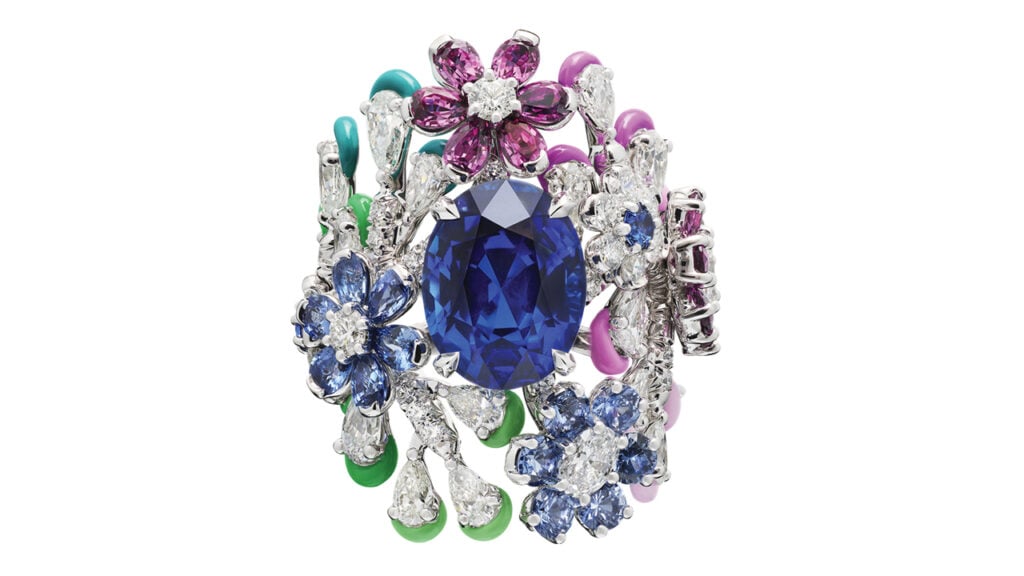
Dior explored color from yet another angle. In the Diorissima collection, artistic director Victoire de Castellane juxtaposes gemstones like elements of a collage, with traditional doublets – including opal layered over chrysoprase – creating subtle color gradations. Lacquer alternates from opacity to transparency, adding another dimension to the play of color.
Keeping the momentum going
The same appetite for color was already evident at GemGenève in May, where dealers reported strong demand for Paraiba tourmalines, spinels, Colombian emeralds and unheated sapphires, alongside unusual shapes and antique cuts. In March, Hong Kong offered a more selective commercial scenario, with buyers approaching the market with increasingly precise sourcing priorities.
Paris ultimately showed just how broad the palette of contemporary high jewelry has become. The big four remain fundamental, but they now coexist with a much wider range of colored gemstones and ornamental materials. Provenance and rarity remain essential, but the Paris collections also placed increasing emphasis on distinctive cuts, unusual pairings and the challenge of assembling perfectly balanced suites. More than the prominence of any single stone, it was the diversity of colors, origins and combinations that defined the season.
Main image: Model wearing pieces from the Diorissima collection. (Dior/Anaick Lejart)