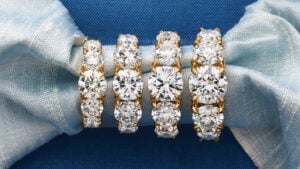

RAPAPORT… The Genesis Diamond was created by Hadar Yaskil. The prototype for this patented cut was introduced to a limited audience in June 2005. The goal was to create a diamond that had concave facets using precision laser technology to achieve the internal faceting.
PHYSICAL CHARACTERISTICS AND CUTTING ISSUES
The Genesis Diamond has a four-sided star shape with 77 facets that enhance its brilliance. It is cut from crystal material with a yield of 67 percent. The stone is available in D to G color, flawless through SI clarity, and in sizes of 0.50 carats to 10 carats. The average size is 1.5 carats.
MARKETS AND MARKETING
The Genesis Diamond is proprietary and is available in its own branded line of rings, necklaces, pendants, earrings and cufflinks and tiepins for men. It is marketed through retail partners throughout the world in a variety of markets from high-end to medium. An advertising program is scheduled for release this month. There is a website, www.genesisdiamonds.com. In-store product brochures, custom-shaped boxes and certificates are available.
PRICING AND SUPPLY
Price per carat for the Genesis is based on the brilliant rough prices. There are no supply issues.
WHAT BUYERS SHOULD LOOK FOR
The Genesis Diamond represents something unique in brilliance, shape and design. According to the company, the shape of the diamond makes it appear 18 percent larger than its actual weight.
Genesis Diamonds
10 West 46th Street, 3rd Floor
New York, NY 10036
Tel: US +1 2129979000 Call
Fax: 212.398.1409
email: info@genesisdiamonds.com
www.genesisdiamonds.com

To Market Natural Diamonds, The Entire Trade Must Do Its Part
No single company can carry the responsibility for reinvigorating interest in our product, nor should it.
What Can Diamond Marketers Learn from Other Sectors’ Campaigns?
Instead of rehashing the same old advertising that hasn’t worked in years, the industry needs to offer a real sense of connection, experts say.
The Luxury World’s Authenticity Crisis
As AI-generated content floods feeds and brand messaging becomes increasingly homogenized, jewelry marketers face a new challenge: proving what is real.