


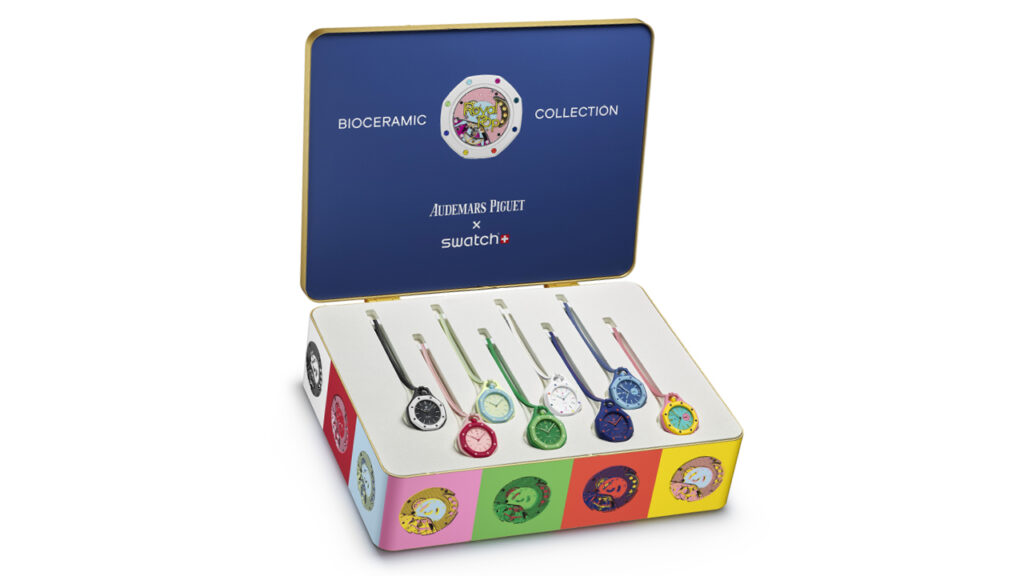
The recent launch of Royal Pop, a series of eight pocket watches by Swatch and Audemars Piguet, was deemed a “failure” by many publications due to the “chaos” that erupted in approximately 20 stores upon the collaboration’s debut.
Many blamed Swatch for not having the proper security to handle the crowds. Some cited language that made the product seem limited in quantity ahead of the launch, though it wasn’t. Still others pointed to aggressive social media marketing that showed long lines of people camping out overnight in front of stores, creating a false frenzy that didn’t need to exist; after all, the watches would be available for months at Swatch stores.
However, through a 20/20-hindsight lens, the real question is not “Did Swatch make a mistake?” or “Should Swatch have been more circumspect in its wording, marketing and security?” The real question, I believe, should be: “Was this all part of a master plan?”
After all, the tagline Swatch used for the collection was “Break the rules.” And yes, it meant breaking the rules of watchmaking by uniting the iconic colorful bioceramic Swatch aesthetic with the luxury silhouette and design language of Audemars Piguet’s popular Royal Oak, all for an accessible price of around $400.
But one can also take “breaking the rules” to mean something else. By using particular language such as “in-store purchases only,” “select locations” and “one per person,” the Swiss watch giant created the feel of an exclusive, limited-time collection without saying it outright.
This very incident is an example of why language is so important – why, for instance, the word “diamond” needs to have a descriptor if it’s not natural. When things are not spelled out, people make assumptions. My guess is, Swatch understood that very well when it put out its marketing. Understaffing security also played a part in creating hype. Images of police trying to hold excited watch purchasers back only created more frenzy for Royal Pop, to the point where Swatch had to close a number of its stores and halt some launches.
But is that a failure on the company’s part, or is it exactly what Swatch was hoping for when it set out its marketing plan? And more importantly, how can the natural-diamond industry replicate this strategy on a regular basis to reignite interest in its product?
Main image: Rapaport Managing Editor Leah Meirovich. (Leah Meirovich)

What Does Love Look Like? Not Out-of-Touch Lab-Grown Messaging
The natural-diamond industry won’t attract couples by telling them synthetics devalue their relationship.

Bridal Shopping in the Age of AI
Couples are researching online, but they still want to make the ring purchase personal – and that creates opportunities.
Six Brands Serving Fresh Engagement-Ring Designs
Whether it’s hand-sculpted organic gold or reimagined divorce jewels, these designers are setting trends that resonate with bridal shoppers.