
The store door bangs open. A middle-aged man
dressed in black comes out hurriedly toward an acquaintance he’s spotted on the
street, obviously needing to share his overload of frustration. Nervously
running his fingers through his sparse hair, he cries, “Business is dry. It’s
dry, it’s completely dry.”
The other man tries to calm him, but the dark-suited
diamantaire with the despairing face and doomsayer message is not to be swayed.
“I just want to sell my goods, put them into a house for two families and get
some cash.”
His interlocutor thinks he’s found a weak point in this
plan: “Tenants bring their own sort of problems.”
“Maybe,” says the diamantaire, “but at least the property
goes up $100,000 a year.”
On that note, he returns to his store, still agitated,
letting the door slam behind him, leaving his befuddled friend standing on 47th
Street. How many times have they had this exchange in recent years? How many
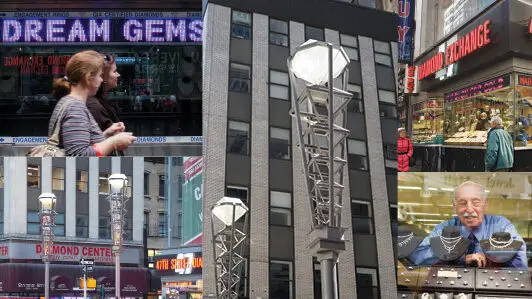
dealers in the Diamond District — this area between Fifth Avenue and Sixth
Avenue known as the center of the New York-based industry — share the feeling that
real estate is a far more secure occupation than dealing with the most precious
stone in the world?
‘It’s lost its soul’
The threats the US industry is facing are
well-known: competition from abroad, tighter margins, the increasing and
unstoppable reliance on the internet for diamond purchases. But even deeper
than the economic pressures most have to face is the feeling of disenchantment,
the painful realization that the heydays of 47th Street are over.
What’s particularly poignant is the disillusionment is
proportional to the high regard in which the district was once held.
“This street is a complete embarrassment. In the late
1970s, it was never a beautiful street, but it was a street full of promise,
full of excitement. You felt part of something big, part of the industry, and
you were never accosted. The excitement is gone,” says Donald A. Palmieri,
president at Gem Certification & Assurance Lab (GCAL).
Palmieri, who has been coming to New York from out of town
since the 1970s and has had an office in the city since 1999, feels that “the
street has lost its soul, its charm and its integrity.” A walk down 47th Street
confirms his bleak description: “Trash, broken furniture and hawkers litter the
sidewalks, when they should be open and clean. Crowds of people block the
walkways, and there is no sense of decorum,” he says.
The way we were
The district never rivaled its glamorous,
upscale neighbor, the legendary Fifth Avenue, but it was the by-word for
quality goods made in the US. This image, too, has taken a hit, long-standing
residents note.
Fred Knobloch, CEO at Aron Knobloch Inc – Knobloch
Diamonds, and vice president at the Diamond Manufacturers and Importers
Association of America (DMIA), arrived in the US from Antwerp with his family
in 1950, when he was 11 years old. He grew up in the early days of 47th Street,
when those working in the trade moved there from Canal Street following an
influx of refugees from Europe. Most of these new arrivals were Holocaust
survivors, coming to the US with nothing but their skills as cutters and
polishers.
“The US in those days was where the finest goods in the
world could be found…. My father supplied Tiffany, Harry Winston and other
manufacturers that made high-quality jewelry,” the second-generation diamantaire
recalls. He laments the declining production standards of the mainstream goods
on offer. “It’s a sad thing to witness, but today, the US is a market for junk.
Diamonds that are used for some refined products at chain stores would be
better kept for industrial use.”
RIP ‘mazl un brokhe’
Although the street is an apparent bustle of
activity during the day, industry insiders all concur that business is not what
it used to be. They point to the competitive international marketplace as a
reason for the challenges American dealers are facing.
“The diamond business has become a very difficult business
run over by foreign vendors from Antwerp, Israel and India,” says Knobloch.
“They don’t have the same expenses that we have. We have to pay tax and high rents.
They can come here with satchels of goods and offer lower prices than us, who
have to break even. In the globalist world, many go out of business.”
Recalling better days, he recounts that “in the 1960s and
1970s, 47th Street was very similar to Antwerp. ‘Mazal’ was a bond stronger
than a written contract. The whole society in the US has disintegrated and has
become much more legally oriented. Before, there was no signed memo, no
contract, but today a word is not as strong.”
David Ebrani, president of Color Diamond Trading Co.,
agrees, having experienced many changes firsthand over the past 25 years.
“When I began, a majority of opportunities came to me
through brokers, and the owners were anonymous. A broker would work for a
commission of 2%, and a handshake would seal the deal. Often terms were 30, 60,
90 days for payment, which gave you some flexibility to finance a purchase.
There was also a greater trust factor that your word was your bond.”
Today, Ebrani does most of his business directly with the
rough buyer and manufacturer. “Because of all these adjustments, I see that the
industry on 47th Street has shrunk dramatically and is not as robust as when I
began my business.”
Better standards
However, in the upper echelons of the cutting
world, the new era has brought higher standards. Harvey Lieberman, a diamond
cutter specializing in colored diamonds, has been in the industry for 45 years,
learning his trade from his father. At the beginning of his career, the
district was home to 2,000 or 3,000 diamond cutters, of whom Lieberman
estimates hardly a tenth are still active. But advances such as stricter
certification levels from the Gemological Institute of America (GIA) have
contributed to the quality of their jewelry-making.
“The advent of the GIA has played such a big part in the
way we work. The standards to make the stone are higher,” he says. “The portion
of people on 47th Street today is much smaller than what it was, but the
expertise here is and has to be of a greater degree than it was. People who
stayed [in business] know more and are able to do more.”
A fresh face for the neighborhood
Meanwhile, the Diamond Dealers Club (DDC) is
hoping to reverse the district’s disintegration through a large-scale
revitalization project.
In early January 2018, the DDC will welcome its members to
the new state-of-the-art facility and trading floor it is opening in the
International Gem Tower at 50 West 47th Street. Its president, Reuven Kaufman,
sees the move as an opportunity for New York to regain its place as the
epicenter of the diamond world.
“With the overheads, and [with] profit margins being so
small, many companies have to close their offices. It pains me to see that,” he
says. “But we are now offering them a tremendous deal. They can sit in the
bourse the whole day, make use of the full office and full security offered to
the members, as well as private rooms.”
The design of the new club is spacious, modern and
inviting, with its floor-to-ceiling windows overlooking Midtown. Kaufman is
convinced that the premises “will give an aura of vitality to the bourse and
bring back its luster to New York.”
The new venue, in Kaufman’s vision, will be a good place to
showcase outstanding diamonds such as Alrosa’s Dynasty collection, which went
on display at the club in November. “We want to reinvent the idea that New York
is the main supply to the US by developing relationships with manufacturers and
bringing more retailers in.”
Lieberman, too, believes New York can keep its standing —
especially now, as many local cutters retain a natural creativity that he
suggests others in the industry have lost in the digital era.
“You can’t put everything in a computer for it to tell you
what to do,” he says. “New York has an advantage over the rest of the world.
Important stones come to us because we know how to think out of the box.”
Photo: Alamy Stock Photo


What Does Love Look Like? Not Out-of-Touch Lab-Grown Messaging
The natural-diamond industry won’t attract couples by telling them synthetics devalue their relationship.

Bridal Shopping in the Age of AI
Couples are researching online, but they still want to make the ring purchase personal – and that creates opportunities.

Six Brands Serving Fresh Engagement-Ring Designs
Whether it’s hand-sculpted organic gold or reimagined divorce jewels, these designers are setting trends that resonate with bridal shoppers.