

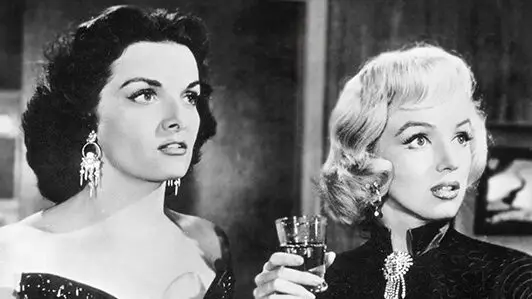
Marilyn Monroe and Jane Russell in a scene from the movie, “Gentlemen Prefer Blondes.”
Photo by ullstein bild/ullstein bild via Getty Images.
From the 1900s through the 1960s, jewelry designers took major creative leaps, shedding the traditions of one period for something radically different, only to return a decade later to address older styles with a fresh eye. Art Nouveau, Art Deco, Retro Modern and Mid-Century jewelry took their cues from the dramatic sea changes the world was going through in the twentieth century. The thematic through line was a reaction to the major upheavals caused by two World Wars and the blurring of boundaries both within and among countries as planes, trains and automobiles heralded in a modern age of limitless potential and societal restructuring.
Art Nouveau
The Art Nouveau movement was espoused by a group of French designers who wanted to take a more artful approach to design than the more traditional platinum and diamond jewelry popular at the time. According to Yvonne Markowitz, the Rita J. Kaplan and Susan B. Kaplan curator emerita of jewelry at the Museum of Fine Arts, Boston, the seminal figure of this movement was René Lalique. After studying in Britain for two years in the 1880s, he came under the influence of John Ruskin and William Morris and other proponents of the Arts and Crafts movement. “And what he took from their philosophy was an appreciation for unique, one-of-a-kind objects, an interest in nature and an abandonment of the diamond.”
Along with the natural world, the female figure is another important subject of Art Nouveau jewelry, Markowitz points out. But whereas in England, women were working as jewelers and beginning their fight for the right to vote, in France, women were still playing a more traditional role in society. In the French Art Nouveau jewelry, the female form was objectified, with many examples presenting it as a hybrid, such as a mermaid or a half butterfly, half woman or even as a Medusa-type “monster.”
According to Markowitz, there is an element of surrealism in the Art Nouveau motifs. Lalique, for instance, didn’t just show a flower, but presented a grouping of peonies that included both young buds in full bloom and wilting, fading blossoms, which creates a sense of movement through time.
The Art Nouveau movement came in quickly and just as quickly was done. “A lot of people give World War I as the date of its swan song,” says Markowitz, “but by 1910, it’s on its way out. Lalique only spent a decade of his life making jewelry. It was a very, very small part of his career and a lot of the experiments that he did with glass were done during those jewelry years, where he worked primarily in gold and enamel, which is basically powdered glass.” Several other Art Nouveau designers, such as Gérard Sandoz and Henri Vever, transitioned into the Art Deco movement that followed, which had an entirely different aesthetic.
Stylistic Elements
- Whiplash curves, interest in the natural world, asymmetry and a dreamy, soft-hued palette.
- Images included flowers and birds as well as fantastical metamorphoses that combine a woman’s head with an insect’s body and a woman’s body with butterfly wings.
- Emphasis on artistry and complex construction, where backs of pieces are as aesthetically pleasing as the fronts.
- Arts and Crafts movement in Britain that eschewed mass-produced pieces in favor of unique, one-of-a-kind objects, with emphasis on the natural world.
- The beginnings of the concept of art jewelry sold in Parisian galleries, such as Siegfried Bing’s Maison de l’Art Nouveau, from which the movement takes its name.
- Strong tradition in France of training jewelers in goldsmithing techniques such as casting, plating, chasing, engraving and repoussé.
- Japanese art forms, including wood-block prints and mixed-metal sword guards.
- Resurgence of enameling techniques such as plique-a-jour, where the enamels have no metal backing and are open to light, and cloisonné enamel, where the design is outlined in compartments that can be filled with colored enamels.
- Emphasis on colored gemstones in soft pastel hues, chosen for their coloration and transparency rather than value, mostly cabochons with some rose cuts and old Euro diamonds used as accents.
- The use of unusual objects such as horn and wood and nonprecious opals and enamel.
- Gold rather than platinum.
- Georges Fouquet, Lucien Gaillard, René Lalique, Louis Comfort Tiffany, Henri Vever.
- Stepped designs of concentric circles or squares provided dramatic dimension. Domes, circles, baguettes, triangles, squares and other geometric shapes were juxtaposed to create strikingly powerful designs.
- Naturalistic-themed Art Deco jewelry depicted birds, flowers and animals in geometrically stylized versions.
- Long pendant earrings in black enamel, onyx and diamonds were fashionable as were rings with a round diamond set on an onyx plaque. Long chains or sautoirs of pearls or rock crystal had black-enameled borders that accentuated the design.
- Pavé-set and calibré-cut colored stones and diamonds set in platinum turned up in ribbon bracelets, the flat links of which were seamlessly integrated to appear as one surface so that pictorial images inspired by exotic influences could be depicted.
- Cubist movement, which began in 1907, and its geometric elements provided the starting point for the Art Deco jewelers, who took it to their own levels.
- Silhouettes of post-World War I cars, trains, planes and automobiles were presented as streamlined geometric forms expressed in highly polished white surfaces.
- The inherently sculptural qualities of Machine Age images of cogs and wheels and gears led to a new jewelry vocabulary that was whittled down to the very pure and minimalist images. In the style’s most avant-garde form, color was rejected in favor of the stark drama of black-and-white combinations.
- The colorful sets and costumes of the Ballets Russes presented bold combinations of reds and purples, greens and oranges to the public eye, a departure from the softness of Art Nouveau jewelry and the whiteness of Edwardian and Belle Epoque pieces, inspiring a more colorful side of Art Deco jewelry.
- World travel opened up new imagery for designers, from the exotic red and black Chinese lacquer work and the motifs of Islamic art to the sarpech, the feathered and jeweled piece worn by Indian noblemen on their turbans and the Egyptian hieroglyphics found in the tomb of Tutankhamun. Stylized representations were worked in precious gemstones and diamonds, as shown opposite.
- The black-and-white jewelry focused on onyx, black enamel, pale chalcedony, rock crystal and diamonds set in silver, white gold or platinum.
- White metals — both silver and white gold — were used to provide metallic sheen.
- New diamond cutting techniques created baguettes, squares, rectangles, triangles and half-rounds that worked into the various geometric configurations and could be contrasted with black onyx.
- Precious stones such as rubies, emeralds and sapphires were used in new and startling combinations with less costly amethyst, citrine, aquamarine and tourmaline, valued for their translucency and delicate colors. Diamonds were used as accents to add light and sparkle and texture without adding color.
- Strongly hued opaque hard stones such as coral, jade, turquoise and lapis lazuli created large areas of color and texture.
- Enamels in red, blue and green provided contrast or echoed the colors of stones used in the jewelry. Black enamel was especially important.
- Cartier, Jean Després, Jean Fouquet, Gérard Sandoz and Raymond Templier.
- Big, bold look.
- Curved forms that look like ribbons.
- Prominent brooches, rings that sit high on the finger.
- Highly polished scroll motifs.
- During World War II, platinum was declared a strategic material to be used by the military. But gold was available and a lot of copper, which led to the mixing of alloys of rose and pink and other shadings of gold.
- Wartime fashions were more masculine, broad-shouldered with wide lapels, which was perfect for wearing brooches. Women wore heavier fabrics that could be softened with more feminine Retro motifs of ribbons and bows.
- The Reflection series, an innovative design concept introduced by Trabert & Hoeffer-Mauboussin in the 1930s, offered women a personalized line of jewelry at a reasonable price by allowing them to choose from premanufactured elements. The Reflection line remained popular until the 1950s.
- “Going to Rio” was depicted in the movies and fashion picked up on what was fashionable in the Americas during that period. Colored stones became popular, not just rubies, sapphires and diamonds, but topaz, a lot of citrine and a lot of the gems in South America, which was what was available at the time.
- Hollywood was in its heyday and the glamourous jewelry worn on film became the look women wanted to wear.
- Less costly stones — aquamarine, citrine, amethyst and tourmaline — were used to compensate for the scarcity of precious ones.
- Gold was the metal of choice, with rose and pink gold especially popular. Tricolor — green, yellow and rose — gold also could be seen in Retro jewelry, especially bracelets.
- Some designs were geometric and modern, while others were more romantic in style, featuring bold reinterpretations of the floral motifs of the Victorian era.
- Boucheron, Cartier, Paul Flato, Gübelin, Tiffany & Co., Trabert & Hoeffer-Mauboussin, Van Cleef & Arpels, Fulco di Verdura, Raymond Yard.
- Floral styles from the nineteenth century are reinterpreted for the 1950s, as are jewelry parures and suites.
- Big, bold looks from brooches to cocktail rings.
- 1960s showcased mini skirts and big, in-your-face jewelry.
- Diamonds adorned everything from cocktail rings to dress watches.
- The war ended and the soldiers were home. There was a sense of returning to “normal.”
- Fun, gem-encrusted animal jewelry was popular.
- Cocktail parties were the era’s “in” social gatherings and women wanted jewelry they could show off while entertaining.
- Marquise diamonds were back in fashion; ballerina rings featured diamond baguette skirts.
- Yellow gold in textured and hammered variations.
- Aquamarine, citrine, turquoise showed up in cocktail rings, as accents for diamonds or as big center stones on their own.
- Bulgari, Cartier, Paul Flato, Jean Schlumberger, Pierre Sterlé, Van Cleef & Arpels, Fulco di Verdura, David Webb, Harry Winston.