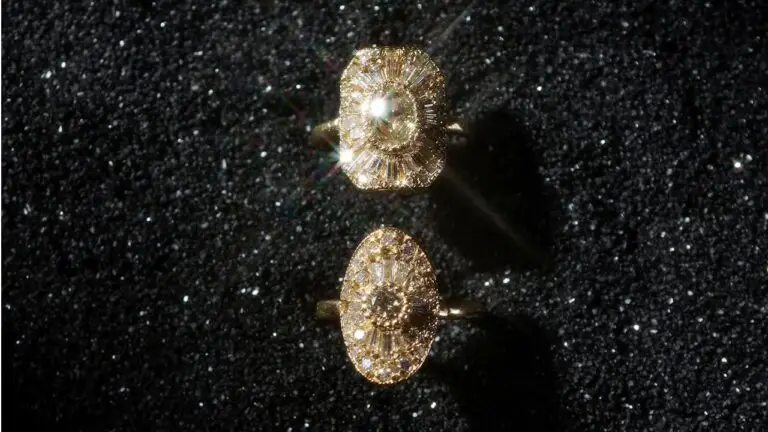



| Jordan Alexander |
Finding a Niche While very successful in apparel, the Hartingtons did not carry jewelry in the store until 2008. In the 2000s, they held trunk shows to gauge interest. Based upon the positive response, they decided to carry select lines that would accessorize both the designer and contemporary apparel. The timing, at the start of the recession, was not favorable. “We had to be as risk averse as possible,” says Jay, who left a career on Wall Street to join the family business. “We started small, trying to develop our own niche, always making a concerted effort not to cannibalize any other designers.” Their guiding principle, Jay elaborates, which continues to this day, is to “add great, unique designers who represent the best of that niche, for example, Yossi Harari in 24-karat gold jewelry.” He emphasizes the importance of this strategy, given their clientele. “It’s a departure from buying the traditional — they already own the big canary diamond ring or cultured pearls. They want what they see in fashion jewelry — but they want it to be real.” Today the store carries jewelry at different price points, from designers that range from Irene Neuwirth and Todd Reed to Jordan Alexander and Miriam Salat. According to Jennifer McCurry, the jewelry buyer, “We constantly have a customer in mind when we buy. Like our clothes, our jewelry selections are very, very well edited.”
Creating a Jewelry Gallery Given their successful sales, the Hartingtons decided to carve out a distinctive space to display the jewelry. “Since we are not a department store, we wanted to create a fantasy environment and decided to brand it as a ‘Jewelry Gallery’ because so many of the pieces that we buy are one of a kind,” says Jay. Many of their customers are art collectors and the jewelry resembles pieces of art. “The Jewelry Gallery lent itself to that idea,” he notes. The Hartingtons commissioned a Swiss company to design wallpaper that looks like a mural, with holographs illuminating a garden motif. Custom-made display cases, curved pink couches and green carpet complete the look. McCurry explains that jewelry is merchandised by genre, not price point. “If we had a traditional format, the jewelry wouldn’t explode out of the cases,” says Jay.
A Stylist’s Touch Salespeople do not stand behind a case waiting to show the jewelry. In fact, the staff at Marissa Collections are called stylists, which more appropriately describes their role. They are familiar with all the merchandise and try on the jewelry with different outfits to see how they enhance the clothing and flatter a woman’s best features. “It is all about preparing before the big game,” Jay emphasizes. All of the staff is required to take online courses from the Gemological Institute of America (GIA). Jay is adamant about the need for “accountability” with the client, who generally knows a lot about jewelry or can pick up an iPhone to find out. “If you can’t explain the stone or where the designer got the design inspiration, you’re making yourself obsolete,” he cautions. One of the store’s special features is its VIP dressing room, complete with couch, bar and television, where the stylists lay out the outfits and display the jewelry next to them. Clients can also bring their own clothes to the store to be accessorized with jewelry. The stylists will even photograph the accessorized outfit. Educating the client and making it easy for her to decide is all part of the “dynamic package” that distinguishes Marissa Collections, according to Jay. “We don’t want the client to come in and think that we will only show her a $50,000 necklace,” Jay says. “Whether the piece is $1,000 or $100,000, we show the client how to wear it 20 different ways so it is not as big a price to swallow. The jewelry becomes her second skin.” “At the end of the day, we are matchmakers between clients and designers,” concludes Jay. “And the reason that we buy so many one-of-a-kind pieces is that our clients really want to be different. ‘You have it and no one else has it.’ That is true luxury.”