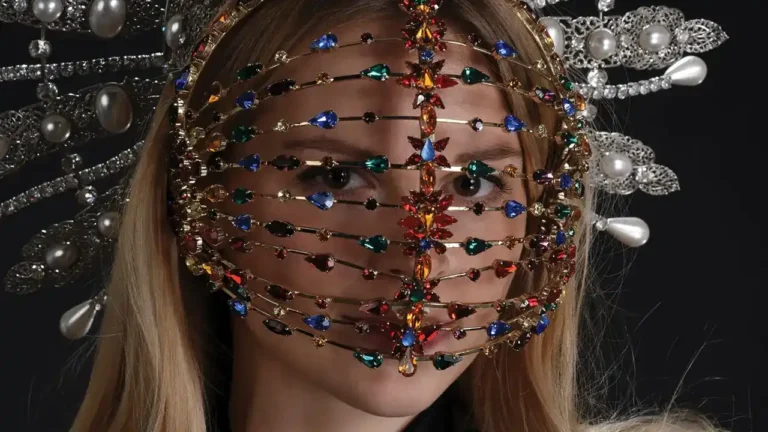


| Hammasa Kohistani, Afghanistan’s only female model — and former Miss England — models Aayenda jewelry. |
Launched in 2012, the nonprofit NGO’s mission is explained by its founder and chief executive officer (CEO) Sophia Swire as “enterprise and workforce development for stability, particularly to get Afghan women into the workforce.” This is not an easy task since traditionally women in Afghanistan have virtually no rights and usually do not work outside the home. But, says Swire, “This is a good skill for Afghan women as they can do the work from home.” She notes that there are some 300 war widows from the Badakshan Province in the northeastern region of Afghanistan who are carving lapis beads for the project, two female designers from Ishkashim on the border with Tajikistan and one from Mazar-e-Sharif and another seven women manufacturing jewelry in the capital city of Kabul. Eleven women attended a six-month training course in Jaipur, India, delivered by Future Brilliance at the Indian Institute of Gems & Jewellery, studying the craft, design and business of jewelry making. This is a big accomplishment in a war-torn country that is, according to a June 2011 global survey by the U.K. newspaper, The Guardian, “the world’s most dangerous country in which to be born a woman.”
YOU MUST HAVE JAVASCRIPT ENABLED TO VIEW THE SLIDESHOW
Roya Hayat, gender manager for Future Brilliance and a protégé of Swire’s, who sponsored Hayat’s education, explains some of the reasons why Afghanistan is such a tough place for women. “Religion has always played a very important role in the daily life and social customs of Afghanistan. Historically, Afghan women have always been given a subordinate status. Their position in the family is shaped by many factors and there are strong cultural and historical roots of gender discrimination. Also, the long years of war and violence, an unstable political and economic situation and the Taliban takeover in 1996 have had a particularly severe impact on women and their position even took a retrogressive turn.”
| Radiance pendant, lapis and turquoise necklace, gold-plated base metal, in development. |
WOMEN IN AFGHANISTAN
|
| Khala Zada puts the finishing touches to her collection for Aayenda. |
Vision
Despite a seemingly impossible situation, Swire sees hope. This is not her first venture in the area. Swire left her banking job in London to start a school on the border of Afghanistan and Pakistan 25 years ago and “fell in love with the region.” She is also widely credited with bringing the now ubiquitous pashmina shawl to the Western world after seeing it worn by movie stars in Pakistan. She tracked down the source in Nepal and the rest is fashion history.
For three years, Swire served as Senior Advisor on Gemstones to the Afghan Ministry of Mines, a job that entailed inspecting gem mines to ensure their safety for workers, finding ways to bring more women into the value chain and generally to modernize the industry. Noting that some of the world’s oldest gem mines are in the northern regions of Afghanistan, and that fine jewelry had been fabricated in Afghanistan for thousands of years, Swire decided to revive the jewelry industry in gemstone-rich areas of the country. Many gems are found in Afghanistan, including lapis, tourmaline, ruby, spinel, emerald and kunzite. “I started Future Brilliance in 2012 to develop the jewelry industry in Afghanistan using gemstones and natural resources found in the country,” Swire says. “The lapis mines in Badakshan, in the north, at 7,000 years old, are the world’s oldest. The Bactrian Gold jewelry collection, which toured museums in the U.S. two years ago, is 3,000 years old. We are trying to rehabilitate skills that are already indigenous to the Afghan culture.”
| Female student learning to facet lapis. |
With the goal of selling the Aayenda collection into an international market, designers Paul Spurgeon, Anna Ruth Henriques and Annie Fensterstock were brought to Jaipur to work with the students from Afghanistan.
Each of the designers created collections in different price points to appeal to various consumers. “Our target market is fashion jewelry people who are open to a product that has good design and is for a good cause,” explains Swire. “Aayenda jewelry has different lines featuring retail price points between $100 and $4,000, most at the lower end of that range.” According to Swire, that is the sweet spot for women who want to buy for themselves.
Design
| Khala Zada, an illiterate 50-year-old artisan, learns how to facet gemstones. |
According to Hayat, the program is beginning to pay off for some of the participants. Five months after the students returned from Jaipur, a study was conducted to assess the progress and the current employment status of the students. Thirty-nine percent of the graduates are currently working in their own gem-cutting/jewelry workshops and 38 percent are employed as gem cutters and jewelry designers, half of them in their family businesses and half of them outside of the family business. Only two of the women aren’t working, due to family reasons.
“However, Khala Zada, who is an illiterate war widow, has doubled the sales of her fine beads after returning to Afghanistan,” says Hayat. “When I visited her in Mazar-e-Sharif last November, she showed us a workshop space where she is planning to take on 30 more artisans, both men and women. Almost all of our students are earning better incomes than before, making them more confident with their work and helping their families to have a better life. Some of the students are also designing for the Aayenda collection and they are so proud so see their drawings and work being recognized and appreciated in the international market. Aayenda means ‘future’ in Dari, the local language. The students liked this name because it represents the hope of a better future for them and for Afghanistan.”
Up next on the agenda is to move more of the jewelry-making operations to Afghanistan by supplying local workshops with better equipment and a quality control expert who will be delivering ongoing training. “The perfect combination for long-term stability and economic development is tapping locally available resources and enhancing local skills. When you marry the two together, you have the crown jewels of international development,” concludes Swire.
Blocks to Education
|