

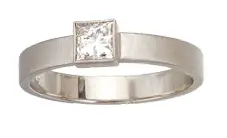
Over the years, as fashion and society have changed, so have the styles of engagement rings.The one constant has been the diamond center stone. The past two years have brought about some big changes in engagement rings as social shifts have influenced the market. The recession and rising metal costs have impacted center stone size: As the cost of the mounting has risen, the stone has gotten smaller. Additionally, the upcoming generation is opting for either a smaller diamond, a colored gemstone center or a simple band. It is noteworthy that, according to research released by the National Vital Statistics System, there were 2.23 million weddings in 2005 and there has been a decrease in nuptials each year since. In 2009, the most recent year for which figures are available, there were 2.077 million marriages.
From the first-time bridal perspective, in the past two years, we have seen that the price point has trended down,” says Joshua Kaufman, chief executive officer (CEO)and designer for New York–based Martin Flyer. “It used to be the setting was $2,500 to $5,000; now it’s $1,200 to $2,500. The average sale now, including the diamond, is about $5,000. There has to be enough of a diamond to feel good about and this has led to simpler styles.”
Jay Gilbert, owner of Coast, a Los Angeles firm specializing in engagement rings, agrees. “Millegrain, halo settings and some engraving are still strong, but people are more value oriented. It’s about lighter settings for smaller diamonds, .02 and below,” explains Gilbert. “With rising metal prices, lightweight and delicate is the trend.” Gilbert has found that .50-carat to .75-carat center stones have been popular over the past couple of years, but the size is trending back up to the 1-carat to 1.25-carat sizes.
In Austin, Texas, designer Shaesby Scott, who wholesales a line and has his own eponymous retail store Shaesby, also finds that delicate, feminine, textured styles are popular. He notes that until recently his sales were usually in carat-and-above sizes, but now there is demand for .50-carat to .75-carat center stones, with $3,000 to $4,000 rings hitting the price-point sweet spot, although he is finding that 1-carat to 2-carat sizes remain most popular. “Being design oriented, we have a lot of demand from customers wanting to do something unique and different,” explains Scott. “Many rings are specifically designed to meet a price point that is in demand now.”
It’s a different customer than it was ten years ago,” comments Mark Schneider, who has a store in Long Beach, California, and wholesales a line Mark Schneider Design. “It’s a more conservative customer. A lot of couples already live together and have a house. She’s making half the mortgage payment. The question is does she want furniture or a ring? There is not as much disposable income and people are on edge about whether or not they will have a job. It’s having an impact. ”
Like his counterparts, Schneider has also noticed that center stone sizes have dropped from the ever-popular 1-carat to 1.50-carat range to a .50-carat or .75-carat center, with color and clarity also dropping. To compensate, Martin Flyer’s Kaufman notes, cut has become more important to customers as they realize that a well-faceted stone may have the appearance of a higher color grade.
Whether it is a cost-savings measure or a design element, Angela Karaguezian, director of public relations for Kirk Kara in Los Angeles, has found that colored gems are an important trend in bridal today, whether for the center stone, or as accents on the shank. It is a movement that has also been noticed by Schneider, who reports getting more requests for sapphire and aquamarine center stones.
“Celebrities have an influence on setting trends. Princess Diana had a sapphire and now Kate Middleton has a sapphire,” remarks Karaguezian. “Now women want that. It allows them to stand apart from others and it reflects their personality. Colored stones provide a unique look that women want.”
The good news is that engagement ring manufacturers are noticing that brides on second or third marriages are still buying rings with bigger center stones and larger mountings and as we begin to pull out of the economic slump, diamond sizes are leaping up as well.
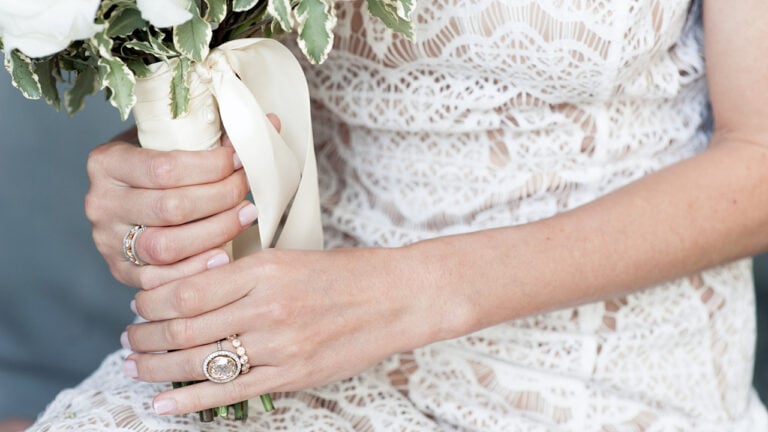
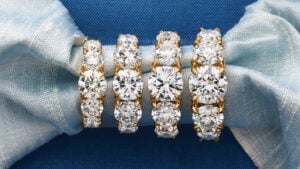
* Pictured from top: Engagement rings by – Gemucchian; Saundra Messenger; Alishan; Tycoon; Coast; Shaesby; Maija Neimanis; Allison-Kaufman;Martin Flyer; Kirk Kara; Gelin Abaci; Harry Kotlar; Stephani Albertson; Dawes Design