
Lab-grown diamonds are in fashion at Signet Jewelers. (Yes, we’ve used that one before.)
The US’s largest retailer of diamond jewelry reported better results than it expected for the second fiscal quarter, which ended August 2. Sales grew 3% year on year to $1.54 billion, while same-store sales increased 2%. Operating profit came to $2.8 million, compared with a loss of $100.9 million a year earlier. It still incurred a net loss of $9.1 million, but this was down from last year’s deficit of $98.5 million. Its share price rose just under 3% on Tuesday, the day of the announcement.
Central to this success was a shift toward synthetics in fashion jewelry. Fashion overall saw a 2% increase in same-store sales, “driven by continued acceleration of lab-grown diamond product performance, particularly at key gifting price points,” said Joan Hilson, Signet’s chief financial and operating officer, on an analyst call on Tuesday. The average product selling price, also known as average unit retail (AUR), grew 12% in fashion, compared with 4% in bridal. Lab-grown fashion pieces carry a threefold AUR premium over other fashion jewelry, Hilson elaborated. Synthetics expanded to 14% of fashion sales for the quarter — double what they were a year earlier.
“Fashion is important to us, both due to the size of the category as well as building customer relevance across categories,” said Signet CEO J.K. Symancyk on the call. “We are focused on delivering fashion pieces across key price points to reach more customers, including an expanded assortment of lab-grown diamond…fashion pieces.”
The emphasis on everyday wear is a central plank of Signet’s “Grow Brand Love” strategy, which Symancyk introduced after taking over the reins in November 2024. The owner of Kay Jewelers, Jared and Zales lacked the inventory to meet strong demand for lab-grown fashion jewelry in last year’s holiday season. It has since tripled its ownership of pieces below $1,000 in that category, especially under $500 and with a particular focus on $250 to $500, he revealed this week.
Signet has faced many challenges over the years, from difficulties embedding its acquisitions to a highly volatile share price. One of its biggest problems since Covid-19 was its reliance on an expected post-pandemic engagement boom, which did not fully materialize. Bridal sales slid 8% to $2.87 billion in the last full fiscal year, which ended February 1, 2025.
Going big on sub-$400 lab-grown pendants in sterling silver makes the business less seasonal and not as reliant on bridal and pricing trends. It also gets Signet’s brands onto more necks, fingers and wrists without eating natural’s lunch, according to Symancyk.
“The customer that is buying something like a lab-grown diamond tennis bracelet, for example, is not a core traditionalist that is choosing between a natural diamond or a lab-grown diamond,” the executive said. “This is really about expansion of consumption overall.”
However, despite what Symancyk said, natural suppliers are feeling a sharp pinch from the lack of demand for small stones that feed into fashion jewelry. They see the major US retailers — Signet included — purchasing later than usual for the holiday season. This is partly because of uncertainty over tariffs, but it’s also because they have fewer needs for natural goods in that size.
Not that Signet is abandoning the engagement segment. Bridal same-store sales were flat in the second fiscal quarter, with “positive signs” ahead of the holiday. “If you kind of look at that sweet spot between $2,000 and $5,000, we see opportunity,” Hilson noted. The company has upgraded its bridal assortment to support AUR. Prices of lab-grown have stabilized, while some natural goods have gone up in price, it reported. The company continues to collaborate with De Beers on a promotional campaign for the mined product, targeting couples that are about to get engaged.
“Natural diamonds are rare and unique and tend to keep their value over time,” a company spokesperson told Rapaport News. “To celebrate milestone moments, consumers still prefer natural diamonds for things like bridal engagement rings.”
Signet wants to remain America’s top seller of engagement rings and expand its fashion business. It’s trying to differentiate those segments more with the materials it uses. So far, this appears to be working.
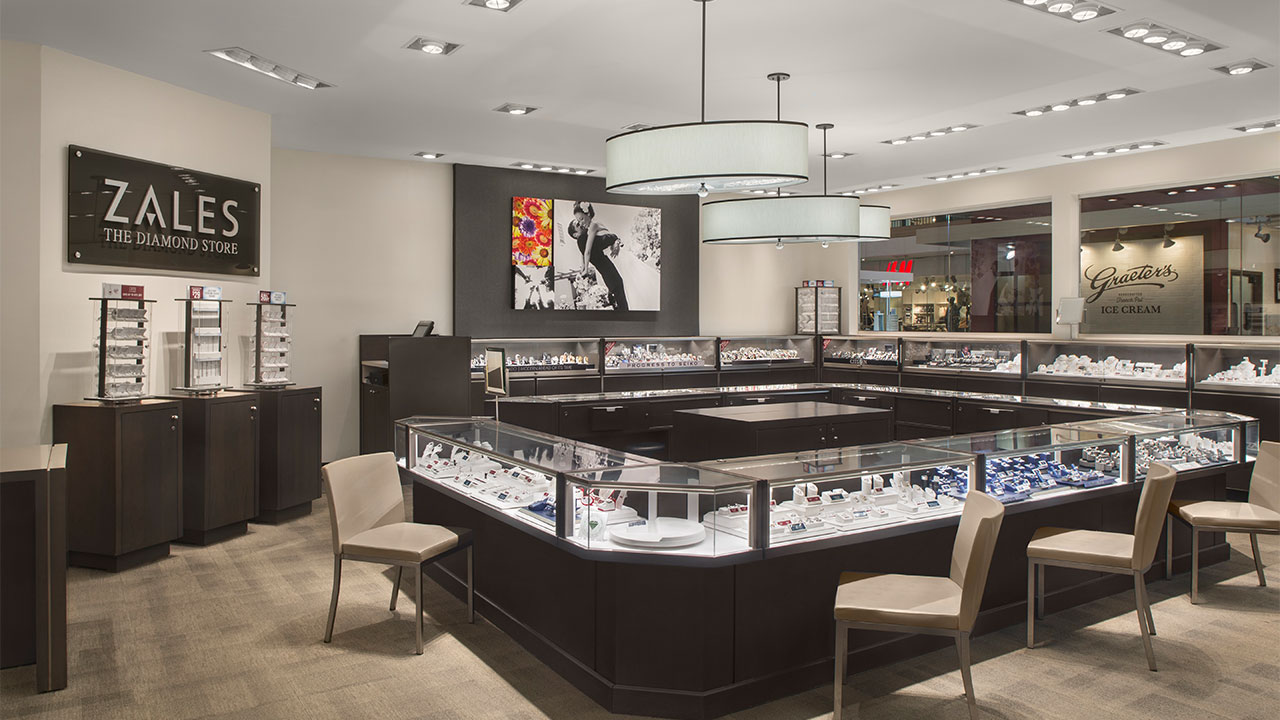
Image: Inside a Zales store. (Signet Jewelers)