
Speculation has been building over the past month and a half that De Beers had been offering discounts to selected sightholders since early this year. It was unclear how many of them were getting these special prices, what the terms were, and whether this was substantially different from past practices.
Sources that spoke to Rapaport News in recent days believed it started off as a very small number of clients getting reductions of around 10% to 20% for 4- to 6-grainer (1- to 1.5-carat) and 2- to 4-carat rough. It then expanded to more sightholders, some of them said, though none had direct proof. De Beers declined to comment last week and again on Tuesday, after Bloomberg published a report about it. Rapaport News has not been able to obtain verifying evidence.
According to the Bloomberg report, the cut-rate sales were in the hundreds of millions of dollars and went to a “small handful” of customers. This, the report continued, reflected pressure from owner Anglo American on De Beers to reduce costs and stop building inventories of unsold goods. Customers that haven’t been offered the deals are complaining about a lack of transparency, Bloomberg said.
The implications of these apparent deals are significant. De Beers had not openly reduced prices since December 2024, and even after that, sightholders complained most goods were too expensive to turn a profit. On the surface, De Beers was refusing to budge on prices, instead offering 20% buybacks and implementing policies to encourage a more even spread of purchases throughout the year.
Rough estimates
Two key data points also fueled the speculation.
One was De Beers’ surprisingly high sales in the first quarter of this year. Anglo American reported consolidated rough sales of $520 million for the diamond miner during the period, which comprised two quiet sights in January and February, when the market was slow. While this was 44% down on 2024, some insiders estimated that sightholders bought little more than half that amount through the normal channels.
The other was a sharp spike in India’s rough imports to $1.3 billion in March and $1.2 billion in April, compared with $735.4 million in January and $756.9 million in February. There are a number of reasons for this increase: The market started to pick up amid shortages of popular items and a better-than-expected Hong Kong show. Observers believe a large chunk of the rough came from the supposed De Beers special deals.
Transparency in doubt
Why would De Beers do this? The company is under pressure from Anglo American to increase cash flow as the conglomerate prepares to the sell the famed diamond producer. De Beers’ policy of freezing prices in market slowdowns has become harder to maintain, as it leads to a buildup of stockpiles and encourages customers to shop at cheaper tenders. Buyers had been deferring purchases since the start of 2025, because De Beers’ standard prices were around 10% to 15% higher than for rough on the open market.
But the miner’s selling system is based on price transparency: Every sightholder knows, in theory, that it is buying a box of rough at the same price as its competitors. This gives them confidence to make purchases. If De Beers has broken from this policy, it’s a risky move — although not unprecedented, according to some sightholders.
To be fair to De Beers, one could say the industry holds it to higher standards than it does competitors. It has long been rumored that Alrosa has been selling large volumes of rough at low prices to the Indian market since the sanctions on the Russian miner began in 2022. Cheap Angolan rough hit the market in late 2024, damaging market sentiment and prices. De Beers’ apparent move is garnering attention because it’s De Beers.
Help or hinder?
The policy might also have come from a preference to give sightholders what they wanted — profitable rough — without the reputational impact on the industry that comes from conspicuous price drops.
While De Beers provides price information each quarter in the form of its price index, the mainstream media — as well as this publication — report changes to De Beers’ official prices at each sight, based on market intelligence.
Consumers see these headlines and assume engagement rings should also go down in price. This has led some clients to tell De Beers that if they made any price decreases, they should “do it quietly,” a sightholder said Wednesday on condition of anonymity. “The consumer doesn’t get it that if the diamond prices come down, it doesn’t mean the jewelry prices should come down.”
The apparent policy, however, has conjured up a different problem: A belief that De Beers has created an opaque, two-tier system. This is an especially sensitive topic given that De Beers has announced it would be trimming its sightholder list from January 2026, leaving many unsure if they would make the cut.
Some clients that didn’t get the apparent deals found out about them because boxes of De Beers rough were appearing on the secondary market at prices some 15% below the miner’s list price.
“They are not stupid, and [they ask,] ‘How does it happen?’” the same sightholder noted. “So when the club gets exclusive…the world starts pointing fingers, because [they were] not invited and somebody else was invited.”
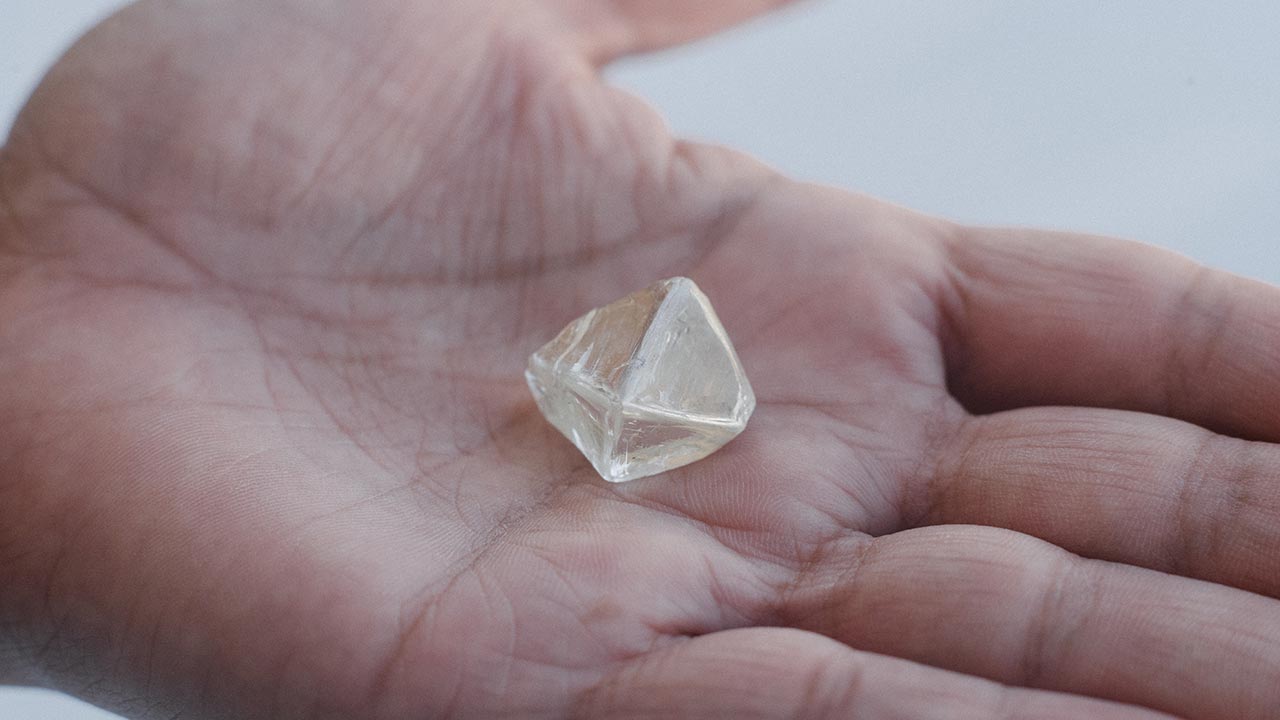
Image: An employee holding a rough diamond at De Beers’ premises in Kimberley, South Africa. (Ben Perry/Armoury Films/De Beers)