 WhatsApp
 Email
Email
 Facebook
 Twitter
 LinkedIn

Long gone are the days when kids were out in the street playing kickball after school, the malt shop had chocolate and vanilla on tap, and moms who needed to buy gifts would pop around the corner to the local store – or, for those more important gifts, check the most recent Sears catalog. Retail has evolved in major ways since those idyllic days. In the last five years alone, Covid-19, a depressed economy, and the US-Iran war have shifted how people shop, how much they spend and what they purchase. For jewelers, the advent of lab-grown diamonds and a younger generation that thrives more on experience than on physical luxury goods has meant having to reevaluate what was previously a well-oiled machine and find a way to retain old customers while reeling in new ones.
The Covid effect
Covid-19 has probably had the biggest impact on US consumers. Between lockdowns, health issues, job losses for some, and more discretionary funds for others, online shopping grew substantially during the pandemic years.
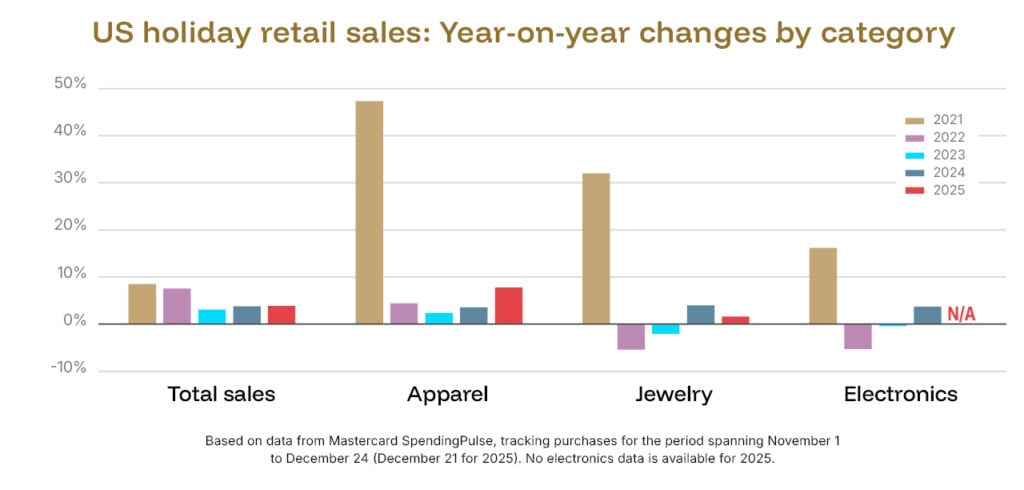
In 2018, online shopping ahead of Christmas increased 19% year on year, and 2019 saw the same growth rate, according to reports by Mastercard SpendingPulse. However, in 2020, e-commerce for the period spanning November 1 to December 24 shot up by 47%. The segment has continued to see positive growth in the years since, albeit in smaller increments.
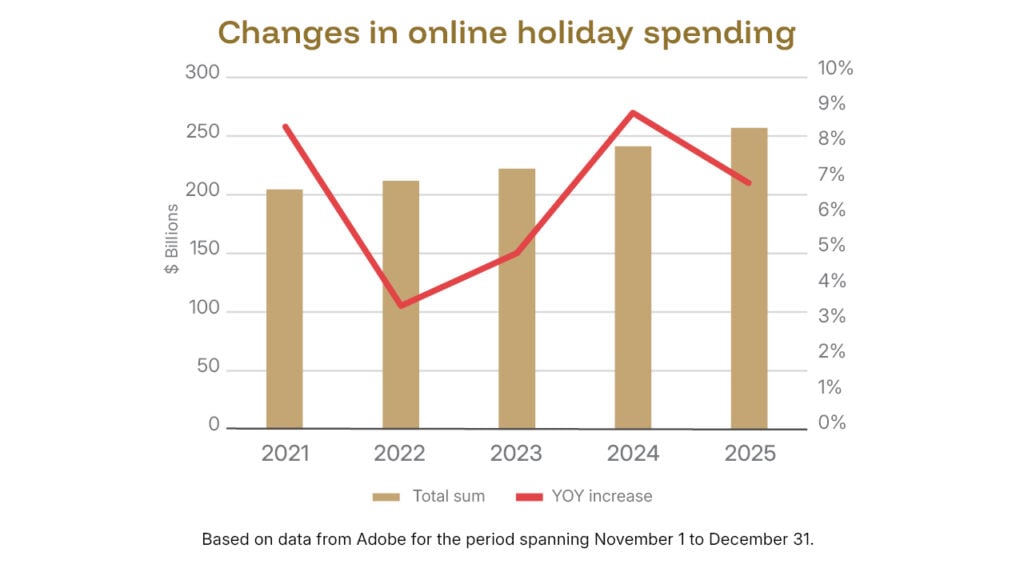
“Covid accelerated customers’ comfort with researching and buying higher-value items online,” says Joan Hilson, chief operating and financial officer at Signet Jewelers. “Online has grown from roughly 5% of Signet sales in 2017 to more than 20% today.”
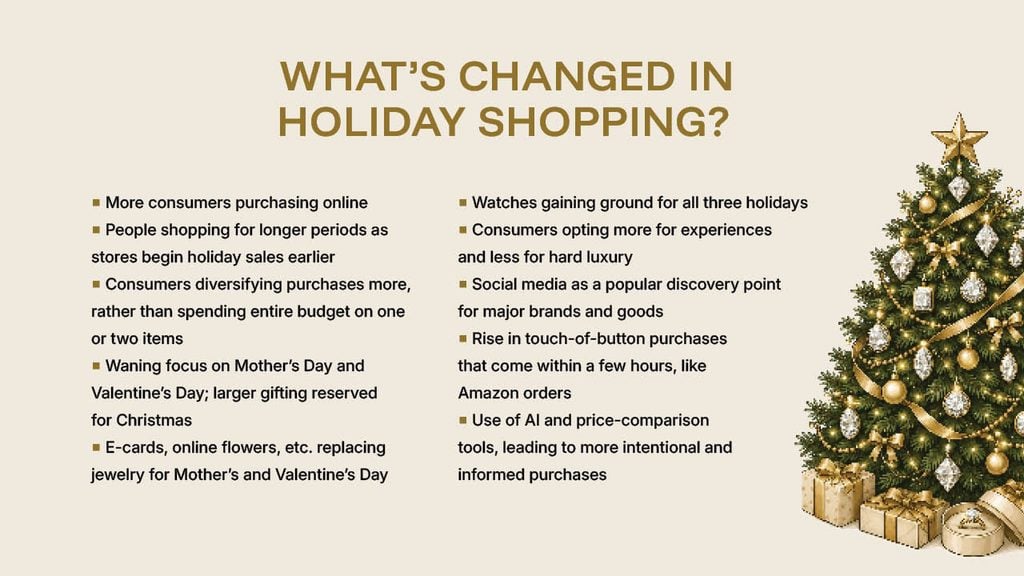
“Online has grown from roughly 5% of Signet sales in 2017 to more than 20% today.” The pandemic also led to the rise of earlier holiday shopping and a longer discounting season. “Consumers have continued to face uncertainty in the form of supply-chain disruptions, heightened inflation, tariffs and more,” says Lea Grgich, senior research analyst at the National Retail Federation (NRF). “A trend that emerged [was that] consumers began shopping further in advance of the holidays to have everything they needed in time and to make the holidays less stressful. That trend has persisted.”
Dave Marcotte agrees, but says it’s not just consumers who are starting earlier; it’s retailers as well. “People start seeing Christmas decorations in July or August, [and] you start seeing Christmas sales in September,” notes the senior vice president of global retail and technology at Kantar Consulting. “Every retailer has been moving up their holiday campaigns for selling.”
The pandemic also made it clear what jewelers’ main competition was, according to Chad Berg, copresident of Lee Michaels Fine Jewelry. “We always thought it was other jewelry stores, but really, our biggest competitor is travel, it’s experiences.”
Christmas or bust
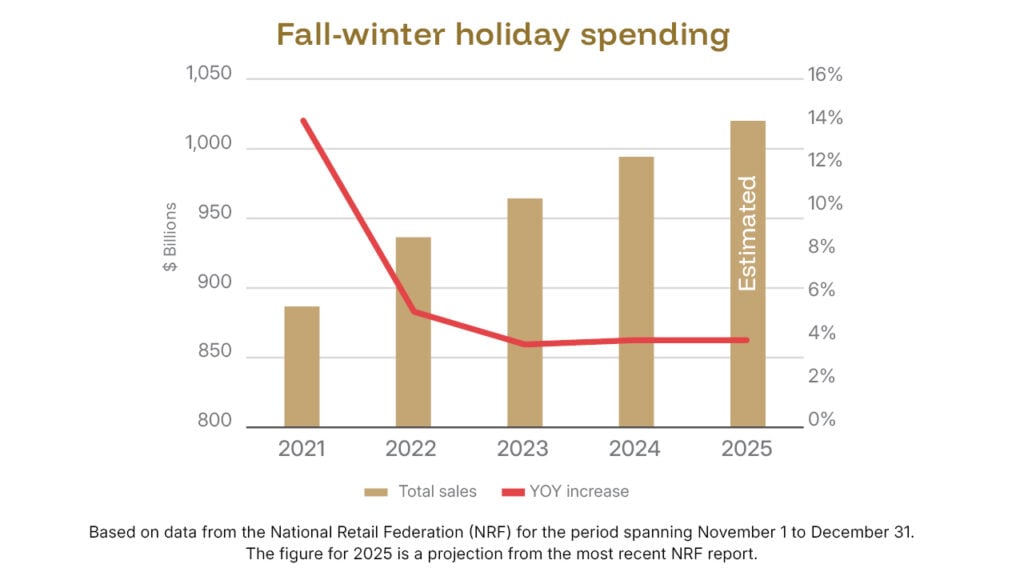
Among retailers, and especially jewelers, Christmas, Mother’s Day and Valentine’s Day were once “the big three” – the holidays when consumers regularly pulled out their wallets and turned over bundles of cash for their loved ones. But over the last couple of years, Mother’s Day and Valentine’s have taken a back seat in terms of spending, with buyers focusing more on Christmas for their big purchases.
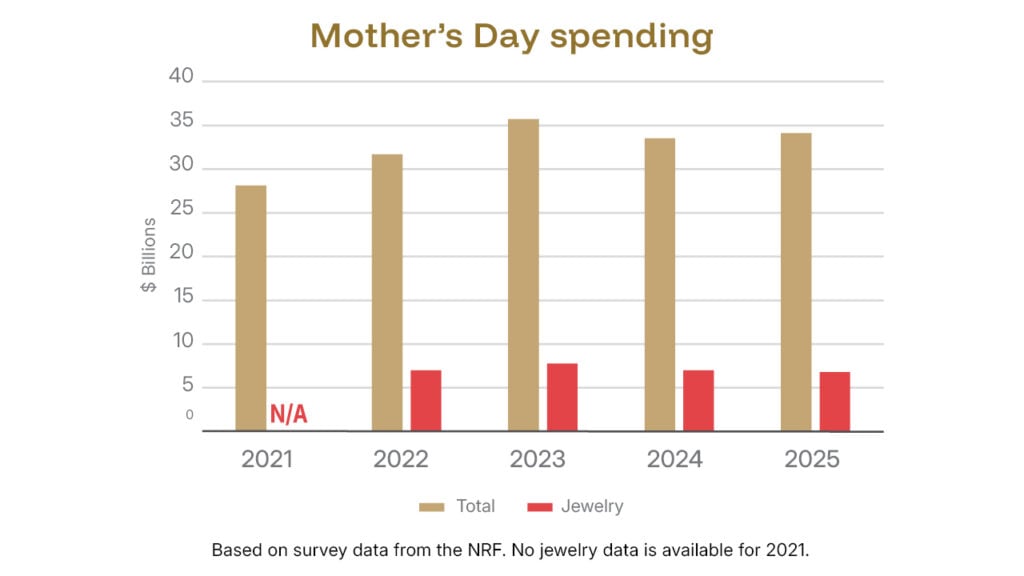
Valentine’s Day saw steady consumer sales between 2021 and 2023, but in 2024, those took a sharp 45% nosedive, according to NRF data. Mother’s Day spending rose from $28.1 billion in 2021 to $35.7 billion in 2023, only to fall to $33.5 billion the following year. While both went up again in 2025 – the former to a five-year high of $27.5 billion, and the latter less dramatically to $34.1 billion – this was still a marked contrast with winter-holiday sales, which neared and then crested $1 trillion.
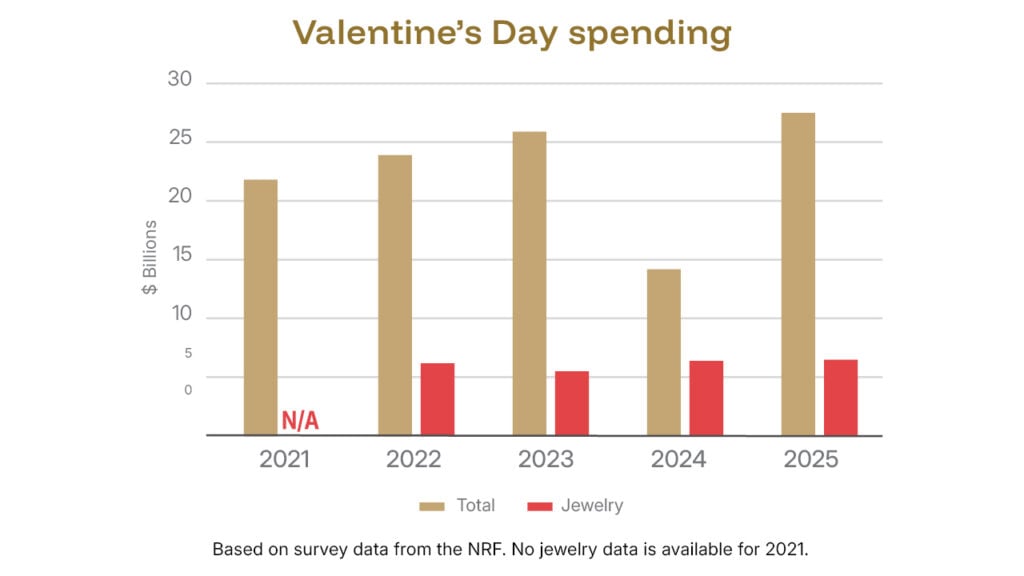
“There seems to be a lot less focus on Valentine’s and Mother’s Day than we saw a few years ago, and I don’t know if that’s just directly because of changes in the economy and people’s spending power, or a shift to more of an experiential gift, like a nice dinner or going away for the weekend, versus a piece of jewelry,” comments luxury sales and brand consultant Katherine Whitacre.
However, Marcotte suggests there may be an entirely different reason. “The electronic greeting card business is doing quite well, and even the flower business is online,” he points out. “You can pick up chocolates at your local drug store. Those are easy last-minute gifts and are much more suitable for the occasion. People are saving to buy more valuable gifts at Christmas.”
Influencer clout
Social media is another force that’s changed the retail market – among other things, because it has provided a new outlet for discovering brands and jewelry trends.
“Everyone is using Instagram, TikTok, and even Pinterest is popular again, which gives them more access to information and knowledge of designers they wouldn’t have been aware of before,” says Whitacre. “It’s made it easier for people to market; it’s made brands more identifiable. It’s had a huge impact in terms of awareness and discovery of brands, but also a huge sway from influencers and celebrities in terms of what’s cool and what you should buy. It’s also given a great platform to smaller companies and independent designers to market themselves.”
High-ticket jewelry
For diamonds and jewelry, the most notable change in the last five years is the concurrence of a spike in sales value and a drop in sales volume, says Michael Springs, data and marketing specialist at Edge Retail Academy. The reason, in his opinion, is unclear. Is the shift a natural progression from the rising price of gold, inflation, and other external factors, or are people buying less jewelry but focusing on higher-value items?
Berg at Lee Michaels wonders the same. “People are spending more than they’ve ever spent, but it’s hard for us to quantify which it is,” he says. “Can I tell you that things are much more expensive today? Absolutely. Can I also tell you that this past year, we’ve had fewer customers, we’ve had fewer tickets, but we had more spend, more high-value tickets? Yes.”
Marcotte has pegged the trend as well. “Consumer spending has not declined,” he asserts. “It’s shifted, and it’s shifted in ways that most people in retail are still trying to understand. There was an assumption that consumers would trade downward, so they would still buy, but they wouldn’t buy what they wanted. But that’s not quite what’s happening. They are buying what they want, but instead of buying four things, they’ll buy three at a higher value, so the overall dollar figure will be the same.”
Other evolving jewelry trends Berg has noted over the last few years include a movement toward yellow gold, different diamond shapes, and luxury as everyday wear.
“Five years ago, we would have very little in yellow gold. You practically couldn’t give it away,” he recalls. “Today, we cannot move fast enough from white to yellow gold to accommodate the consumer.” The appeal of rose gold petered out quickly, he adds.
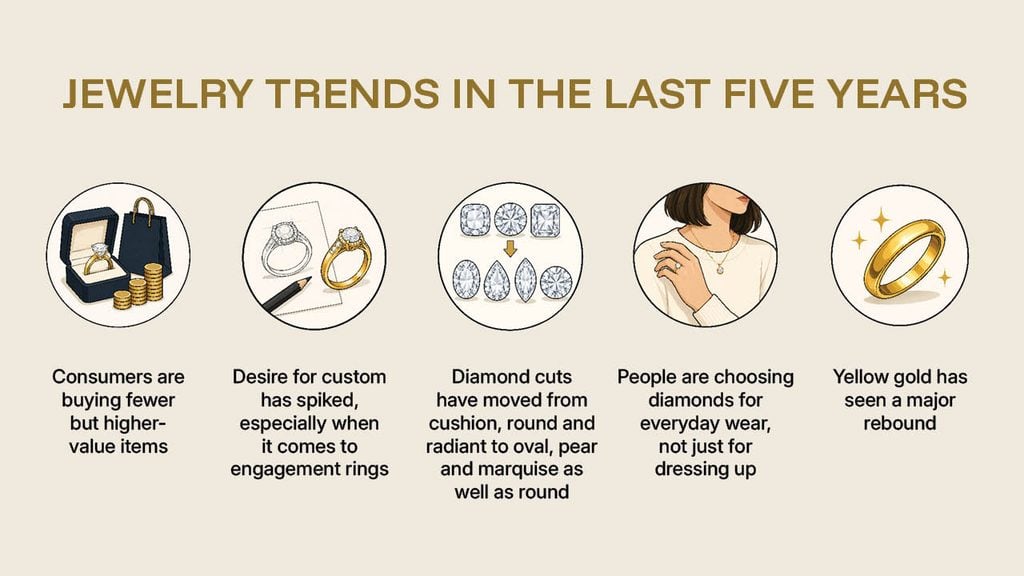
As for diamond shapes, “five years ago, customers wanted cushion, round and radiant [diamonds for their engagement rings],” he continues. “Today they want ovals, pears and marquises, and they still want rounds. Meanwhile, it used to be that a woman would only wear a diamond line necklace when she dressed up, and today, she’s wearing one every day.”
He’s also noticed a “massive” increase in demand for luxury timepieces, and a yen for customization. “The importance of watches has just exploded over the past five years, and I think that’s been a surprise.”
Springs agrees, pointing to Edge Retail Academy data that shows major growth in watches, especially for Mother’s Day and Valentine’s Day.
Gifts aside
The phrase “time is a luxury” has traditionally meant that people tend to be in a hurry and have little time to do what they want. However, the saying has taken on new meaning post-Covid, and time has become an actual category of luxury gifting. Whereas people used to give jewelry, flowers and other items for the holidays, now it’s all about spending precious moments with loved ones, whether that means going away together, seeing a show, or having a nice dinner out. It’s become more about the experience than about having a physical memento.
“This year, about one-third of Mother’s Day…celebrants [are planning] to gift an experience, up from 23% in 2021,” says Grgich. For the winter holidays, that figure is one-quarter of celebrants, compared with 19% five years ago. “We are seeing these trends across all holidays, as consumers prioritize these spending events to celebrate family, friends and loved ones.”
Whitacre has noticed the change as well. “I’m not saying Mother’s Day is not important, but I don’t think of high-ticket gifts for that anymore. It’s more about spending quality time.”
Signet’s Hilson is still seeing customers buying for Mother’s Day and Valentine’s, just in a different way. “Each holiday has its own shopping pattern,” she says. “Valentine’s Day and Mother’s Day tend to be more focused gifting occasions, while December is broader and often involves buying gifts for more people.”
Going ape for diamonds?
The drastic changes in spending over the past five years don’t rule out a swing back to traditional gifting in the coming five.
“Every event in the United States is easily 500% more expensive than it was five years ago, so people might very well go back to spending more on physical gifts rather than experiences,” says Marcotte.
If they do, Berg has just the gift for them to buy: “People may sway toward this thing or that, but when it comes to the holidays, the diamond business is still the 900-pound gorilla.”
Main image: David Polak