

Watches have stood the test of time for many years, but over the last decade, they have seen increased interest as younger consumers and women enter the category. Just 10 years ago, timepieces accounted for 11% of global luxury sales by value at Christie’s, with an average sell-through rate of 80%. In 2025, those figures stood at 20% and 93% respectively, beating out jewelry, art and other items to make watches the auction house’s best-selling division.
Meanwhile, insurance company Jewelers Mutual has seen a 10% increase in the number of watches insured over the last five years, and the number of policies that include watches has grown by about 64%.
For secondhand seller reDollar, the last five to 10 years have exhibited steady annual growth in the category. Demand accelerated during the Covid-19 years, when supply-chain disruptions and the limited availability of new timepieces pushed consumers toward the secondary market, says Mike Robinson, the company’s head of watches.
“The market is going in the right direction,” states Remi Guillemin, head of watches for Europe and the Americas at Christie’s. “Watches are very trendy. Every auction that the watch department holds, we have one of the biggest numbers of new buyers. We also have collectors who are so passionate about watches. They always think they’re buying their last watch, but there’s always something that lures them back in.”
While some of the growth statistics are attributable to hardcore collectors who purchase multiple pieces, much is due to generational and gender shifts in the market. Which brands and styles are younger buyers choosing compared with their more senior counterparts? Do women tend to go more for jewelry watches, or do they care more about brand heritage and the technical side? Here’s what the data has to say.
Venus rising
What was once very much a boys’ club has morphed into an open playing field as women become more interested in collecting. Over the past few years, the number of female buyers at reDollar has grown rapidly, according to Robinson.
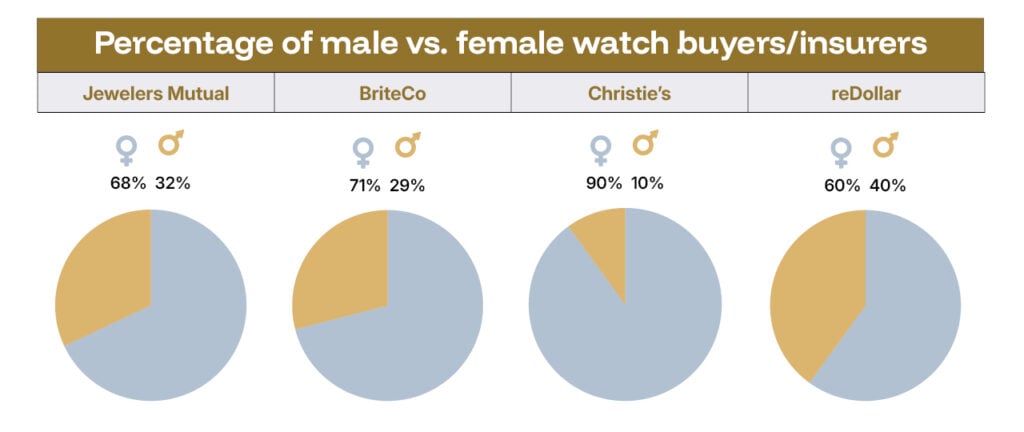
“Historically, about 80% of [our] luxury watch buyers were male, but this has shifted significantly,” he says. “Today, the market is closer to 60% male and 40% female.” He attributes that shift to targeted marketing, evolving design trends, and the influence of jewelry-focused brands such as Cartier, Tiffany & Co., and Hermès.
At Christie’s, the breakdown is more polarized, with nine male watch buyers for every female one – a figure that’s remained steady over the last five years, even with the number of overall watch buyers continuing to rise.
Jewelers Mutual has seen steady growth in women’s watches over the last decade. The category now comprises approximately 32% of insured timepieces at the company, reports David McDonald, its vice president of product management.
However, fellow jewelry insurer BriteCo has noted only the barest upward nudge in women insuring their watches. Women account for 29% of insured watches at the company so far in 2026, versus 28% in 2022 – though CEO Dustin Lemick points out that the higher the watch value, the lower that percentage becomes.
What’s in a name?
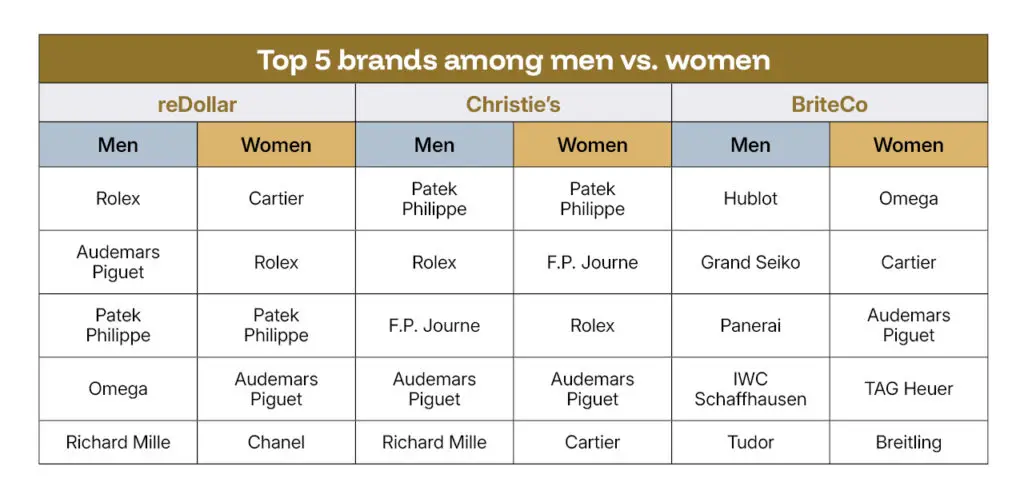
While many of the brands overlap, there are subtle differences in what appeals to women purchasers compared with their male counterparts. At reDollar, the top five brands men choose are typically Rolex, Audemars Piguet, Patek Philippe, Omega and Richard Mille, reflecting a preference for strong-selling models with heritage and investment value, Robinson reports. Meanwhile, Cartier tops the list for women, followed by Rolex, Patek Philippe, Audemars Piguet and Chanel – indicating that design, brand identity and jewelry history play a more prominent role in their purchasing decisions.
A similar trend carries over to BriteCo. The insurer notes that three out of the five brands for which men buy coverage the most – Hublot, Grand Seiko and Panerai – are primarily known for their sport and tool watches. IWC Schaffhausen and Tudor are the other two. Among women’s top picks – Omega, Cartier, Audemars Piguet, TAG Heuer and Breitling – the first two contain many dress and fashion-oriented timepieces.
Christie’s has more of an overlap, with slight differences in the order of popularity. Men’s top five brand purchases are Patek Philippe, Rolex, F.P. Journe, Audemars Piguet and Richard Mille, while women go for Patek Philippe, F.P. Journe, Rolex, Audemars Piguet and Cartier.
However, the lines between what most would consider a “man’s watch” versus a “woman’s watch” are blurring as women grow more interested in the technical aspects and brand history of their timepieces, and pursue larger, bolder designs.
“There are a lot more watches now that are accepted as being unisex,” says Guillemin. “Cartier wristwatches like the Cartier Crash, for example, can be worn by both men and women. Rolex vintage pieces are worn by both as well, so the borders aren’t as clear as they used to be.”
Still, he concedes that the predominance of male buyers at Christie’s may be because the majority of watches the auction house offers are traditionally considered men’s timepieces. He also notes that women’s criteria for buying a watch change as they get more into horology.
“A wristwatch with a jewel isn’t necessarily what ladies are going to be looking for at auction,” he explains. They’ll usually be seeking “more of an iconic design, or an incredibly rare creation. [The consideration] transcends fashion. It’s about the technicity of the movements, [and] it’s also about the rarity, but there are so many other factors for ladies, [only] one of which is aesthetics.”
The generation gap
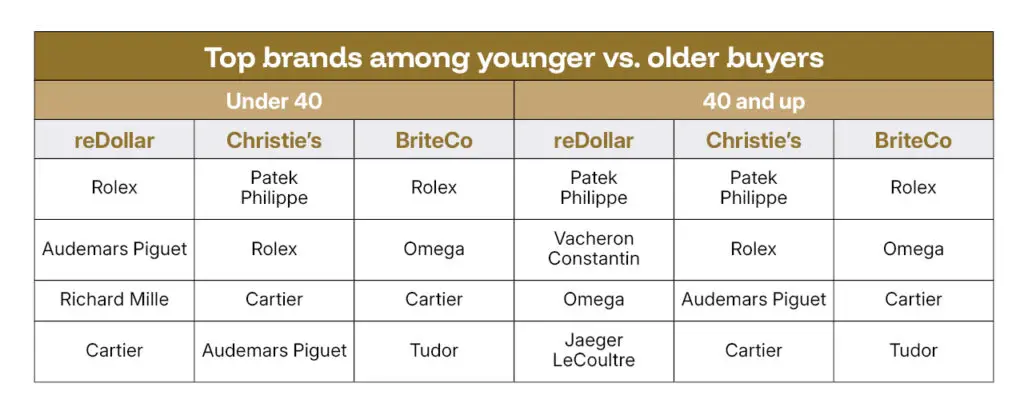
As for the age breakdown in luxury-watch purchases, customers in their 20s and 30s tend to favor sporty, high-visibility models and hype-driven brands such as Rolex, Audemars Piguet, Richard Mille and Cartier, according to Robinson. These buyers often place an emphasis on resale value, brand prestige and social signaling, he adds. Meanwhile, reDollar customers age 40 and above typically prefer classic, understated brands such as Patek Philippe, Vacheron Constantin, Omega, and Jaeger-LeCoultre, which have a stronger focus on craftsmanship, heritage and long-term appreciation.
Another major difference between the generations is the value and number of watches they own. Both of those figures tend to grow as the customer gets older, according to Jewelers Mutual, which notes that many younger collectors start with a single luxury watch – often from a well-known brand such as Rolex or Audemars Piguet – and expand their collections and taste over time. As they become more knowledgeable about the market, they often shift toward more niche brands.
BriteCo backs up that data, reporting that clients under 45 tend to take out policies on one to two watches at an average price of $12,929 per watch. Those above 45 generally get coverage for between two and three watches, averaging $16,014 apiece.
At Christie’s, where the proportion of millennial watch buyers boomed from 28% in 2020 to 50% in 2025, the generational difference lies not so much in the brand as in the style.
“Clients today, especially younger buyers, are highly interested, and they have a thirst to learn,” says Guillemin. “They discuss within the community of collectors. You have young buyers who start with modern watches, for example, or new vintage watches, and then go toward older vintage later in their collecting journey. I think the fact that new vintage watches are doing so well right now, which are watches between the 1980s and early 2000s, is because of the generational shift that has occurred. New participants who have entered the market are looking for watches that have a vintage feel [but are from] a more modern production era [with improved] reliability, which for many is the best of both worlds.”
The further buyers go in their collecting journey, the greater their interest in true vintage watches, he’s found. For example, older clients tend to go for authentic vintage Patek Philippes or Rolexes, and may later delve into niche segments like pocket watches.
Also notable is how the generations approach buying. Watches that Christie’s sells online are slightly more commercial than those in its live sales, and therefore have a more approachable price range. Younger buyers are more likely to purchase online, according to Guillemin, as they’re more tech-savvy. “They’re comfortable transacting online, visualizing wristwatches offered digitally.”
Watches are often an entry point for new buyers, he adds. “Historically, this department has been where younger people start interacting with Christie’s.”
Popular movement
If you asked a random person to name three luxury watch brands, they’d probably choose Rolex, Patek Philippe and Cartier, with maybe the odd Omega or Richard Mille thrown in. But which brands are actually the most popular, and which have seen interest wane over the last five to 10 years?
Unsurprisingly, the major brands make an appearance on every list. More surprising is the diversity of niche brands that make up the remainder.
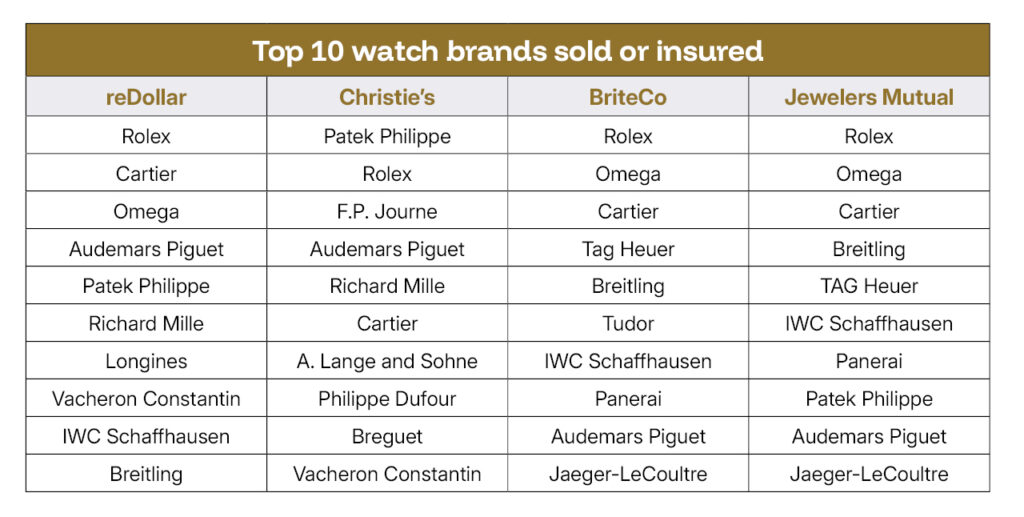
The top 10 best-selling luxury watch brands among reDollar’s customers are Rolex, Cartier, Omega, Audemars Piguet, Patek Philippe, Richard Mille, Longines, Vacheron Constantin, IWC Schaffhausen and Breitling. These consistently come out on top due to “a combination of heritage, strong global demand, high resale value, and brand recognition,” comments Robinson.
At Christie’s, Patek Philippe leads the pack, then Rolex, F.P. Journe, Audemars Piguet, Richard Mille, Cartier, A. Lange & Sohne, Philippe Dufour, Breguet and Vacheron Constantin.
For insurance companies, which cover a combination of new and secondhand items, the mix is a bit different. At both Jewelers Mutual and BriteCo, the top three are Rolex, Omega and Cartier, followed by Breitling and TAG Heuer. Both insurers also have IWC, Panerai, Audemars Piguet and Jaeger-LeCoultre among the next five slots, but the Jewelers Mutual list includes Patek Philippe as well, while BriteCo has Tudor.
“Over the past decade in the US, brands such as Rolex, Audemars Piguet and Patek Philippe have seen substantial growth in popularity,” says Robinson. “This is driven by limited supply, strong resale performance and increased cultural visibility, including influence from social media and celebrity endorsements. Brands like Cartier, Tudor and IWC have also gained momentum through effective marketing and expanded product positioning.”
In contrast, brands such as Omega, Longines and Jaeger-LeCoultre have experienced a relative decline in hype, he explains, attributing the decrease not to quality, but to the fact that they’re less frequently positioned as investment-grade assets. Consumers increasingly view watches as status symbols and alternative investments, rather than purely functional or artisanal objects, he adds.
Clocking the numbers
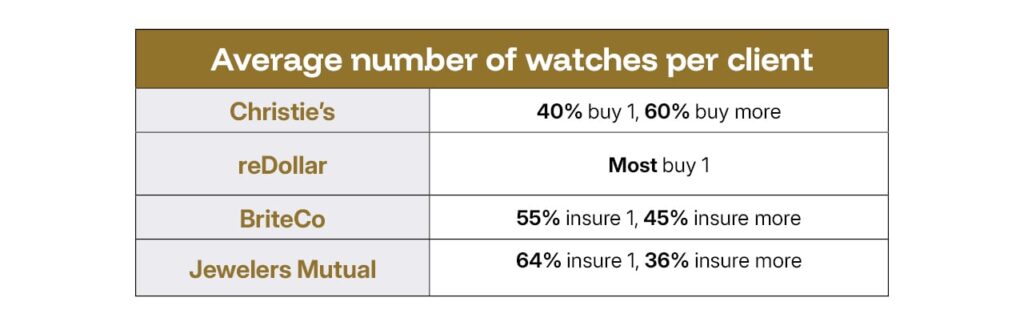
On average, most watch buyers stick to only one timepiece. BriteCo says 55% of its clients cover one watch, while 45% go for more. At Jewelers Mutual, the latter figure is slightly higher; although multi-watch collections are becoming more common, says the firm, 64% of current policies that include watches insure only one, with the remainder insuring two or more.
“We have relatively few repeat buyers in [the watch] category,” says Robinson of reDollar. “Most customers purchase one watch, typically as a one-time acquisition, rather than part of a collecting strategy.”
At Christie’s, the opposite effect is in play: 40% of its current clients are new buyers, with 60% returning to add another watch to their collection.
The mean value of the timepieces can also vary greatly. The average selling price of a watch at reDollar is $5,000, though it depends on the brand, condition and material.
“Over the past five to 10 years, average prices have trended upward, primarily due to rising gold prices and increased demand for luxury timepieces,” says Robinson. “Solid-gold watches in particular have seen significant price appreciation, as their value is closely tied to the gold price. Additionally, strong resale demand for leading brands has supported higher transaction values across the board.”
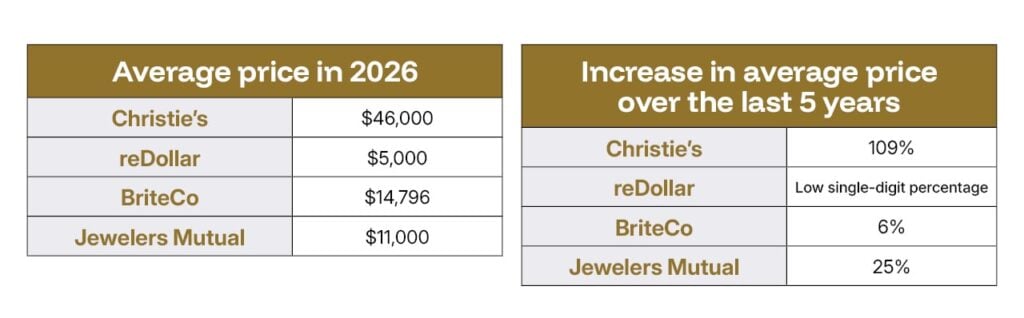
At Jewelers Mutual, the average insured value for watches is about $11,000, reflecting a mix of everyday luxury timepieces and higher-value collector watches, says McDonald. “While watch values can fluctuate based on brand, materials and market demand, the average insured value has increased by approximately 35% over the past five years.”
BriteCo has seen the average insurance value increase 6% since 2022, amounting to $14,796 this year. Over the last decade, the average price at Christie’s has more than doubled, going from $22,000 in 2016, to $46,000 so far in 2026.
And the demand for timepieces is not likely to fade, despite the occasional “microbubble,” according to Guillemin. “When it comes to interest in watches, I don’t think we’re talking about a bubble. We’re talking about items and a category that is growing in people’s hearts, and that people are highly passionate about. As long as that endures, which I believe it will, both the primary market and the secondhand market will continue to be strong.”
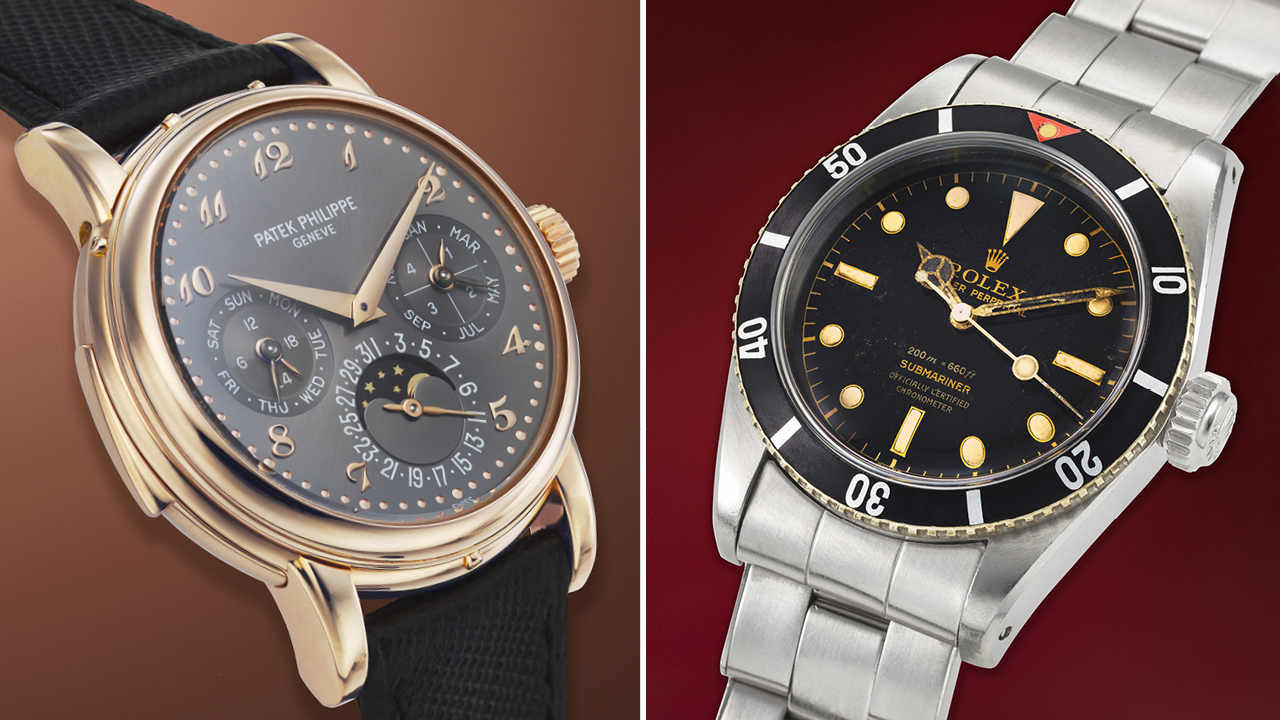
Main image: A pink-gold Patek Philippe automatic minute-repeating perpetual calendar wristwatch (left), and a stainless steel Rolex automatic wristwatch with sweep center seconds and black gilt dial. (Christie’s)