
In a rare show of unity for an industry traditionally divided among manufacturers, wholesalers, retailers and other stakeholders, natural-diamond leaders have launched The One of One Project, a first-of-its-kind initiative designed to educate Gen Z and Millennial consumers about the individuality, rarity and emotional significance of natural diamonds.
The program began taking shape during a Summit Dinner on May 30 at the JCK Las Vegas show, where industry leaders gathered to discuss a coordinated response to shifting consumer preferences and growing competition from lab-grown diamonds.
Members include representatives from SRK Diamonds, RDI Diamonds, Del Gatto Finance Group, House of Diamonds, Khepri Jewels, the International Gemological Institute (IGI), Pristine Gems and Rapaport, along with additional participants from the manufacturing, wholesale, retail and associated sectors.
At an event Khepri Jewels hosted in New York City on June 11, several members discussed the consumer trends and industry challenges that led to the project’s creation, including why many Gen Z and Millennial consumers were choosing lab-grown diamonds and how the natural-diamond industry could better communicate the unique qualities of natural stones.
Why some industry leaders believe younger consumers are choosing lab-grown diamonds:
Reema Chopra, founder of Khepri Jewels, which specializes in fancy-color diamonds, has seen a large percentage of her engagement-ring customers asking for off-color stones over the past few months, she said. Yet these were luxury customers, she observed.
“We are still not targeting more mainstream Gen Z,” Chopra said. The industry is still not reaching mainstream Gen Z, and it is losing them through its current marketing strategy for natural diamonds, she stressed.
“This is someone who is 25 to 29 but still has disposable money,” Chopra continued. “They’re coming in and they’re asking me for X, Y, Z stones, and their budgets are $50,000 and up.”
The requests for off-color diamonds indicate a shift among Gen Z consumers, she pointed out. “They want to buy natural diamonds, but they want some character attached to the stone that separates it from the colorless white we are used to with lab-grown diamonds,” she said.
Based on her interactions with customers, nine out of 10 people in their 20s she would ask about their diamonds were wearing lab-grown, she added.
“They [Gen Z] are just practical,” Chopra said. “All they care about is now, and the purpose it serves for them today. They don’t care what’s happening 10 years from now.”
These conversations she was having with younger consumers helped shape the thinking behind The One of One Project, which seeks to position natural diamonds as unique, one-of-a-kind products rather than commodities, she said.
One defining characteristic of Gen Z, she commented, is that many consumers are not seeking perfection. “They want to celebrate their unique characteristics – they are truly comfortable in their skin and they won’t compromise that,” according to Chopra. Many younger consumers are seeking products that reflect individuality and authenticity, she said.
“It’s like, treat the white diamond like an AI woman; it’s just so virtually perfect,” Chopra said. “But do you want that or do you want something that feels individual to you? You’re not perfect – [you’ve] got your own unique characteristics, body shape, hair that makes you, you. Imagine a diamond that you can connect to that feels the exact same way. That’s when I realized that I was connecting to them.”
Jeff Angel, director of diamond procurement at RDI Diamonds, a wholesale diamond distributor, emphasized the uniqueness of each natural diamond.
“I’ll guarantee you, you’re getting something uniquely different,” Angel said. “I look at 10,000 stones a month. I still don’t see two of the same all the time. Every inclusion is a little different, every stone is a little different. Yeah, they look similar, but they’re not the same.”
Gen Z and Millennials may be choosing lab-grown diamonds over natural stones for several reasons, he reflected.
“Because they don’t know any better or they don’t care, either or,” Angel said. “They don’t want to spend $20,000 or they heard horror stories.”
While Chopra and Angel focused on consumer perceptions, Kunal Shah, president of Pristine Gems, which specializes in fancy-shape natural diamonds, argued that the natural-diamond industry must also confront its own structural challenges.
Gen Z and Millennials are buying lab-grown diamonds because of “overabundance,” he said, explaining that “sheer overabundance” was something lab and natural had in common.
“If you want to keep the narrative that [natural is] scarce and rare, you have to make it scarce and rare,” Shah said. “You can’t overproduce.”
Julia Chafé, a jewelry designer and industry influencer with 920,000 Instagram followers, also attended the Khepri Jewels event on June 11. Chafé, who considers herself a “zillennial,” outlined why she thought the natural-diamond industry was so divided.
“I think natural diamonds have a more exclusive price point…. My generation, Gen Z, are just not earning as much income as previous generations, and that hurts when they’re supposed to get something as an engagement ring,” Chafé said. “You’re supposed to have this special exclusive thing, and you can’t reach that price point. I think that’s what’s really calling to them and then the greenwashing is just pushing them in the direction of machine-made diamonds.”
Industry leaders discuss how to strengthen natural-diamond demand:
When asked how the natural-diamond industry can educate Gen Z and Millennials on mined diamonds, Shah said that the industry couldn’t educate them unless it changed its structural problems.
“You can say something is scarce and rare and expect people to believe it; you can keep flooding the market,” Shah said. “[But] I think it’s kind of putting a Band-Aid on a big wound – it’s not going to work. You got to first fix the oversupply, [and] then we can say, okay, there’s genuinely a shortage of supply. Then you put it in stores where it’s reflected like it’s scarce and rare.”
To guide Gen Z and Millennials toward natural diamonds, price points need to be made more accessible, Chopra added.
“That’s the main thing, giving them such a luxurious feel, but at an innovative price point,” she said.
“So innovative and interesting pieces that are culturally relevant, and most importantly you’re giving them something that can’t be replicated through lab,” Chopra continued. “So not only are you creating value for buying natural beyond long-term value, but you are also creating interesting concepts that [are] not super expensive.”
When asked the same question, Chafé emphasized the irony of the narratives that the machine-made diamond industry is pushing.
“It’s ironic that the machine-made diamond industry is pushing a narrative that African children are being harmed by something, when in reality natural diamonds are uplifting African communities, and the same people who want to empower these people are the same people who are removing their power, and I think that’s a narrative that we really have to push better,” she said.
While members and industry influencers expressed differing views on pricing, supply, consumer behavior and messaging, they agreed that the natural-diamond industry must do a better job communicating what makes natural diamonds distinct. Through The One of One Project, members hope to create a unified message focused on individuality, rarity and emotional significance for younger consumers.
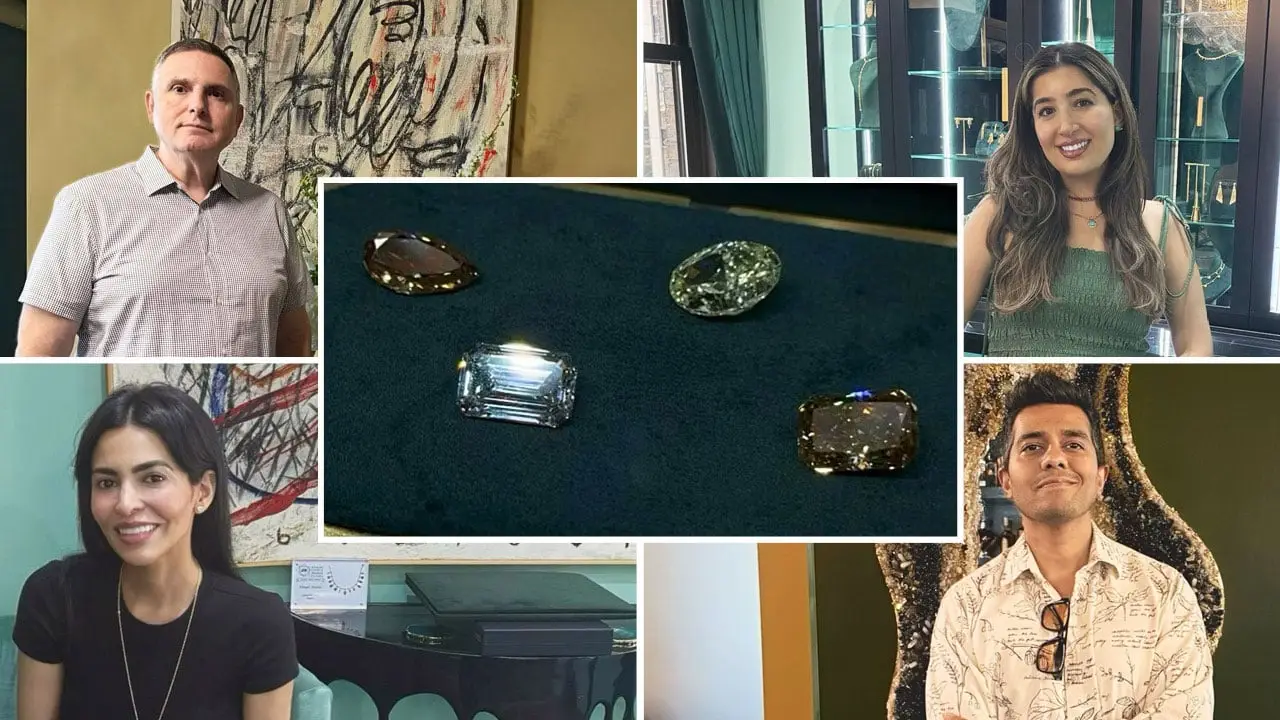
Image (clockwise from top left): Jeff Angel, Julia Chafe, Kunal Shah and Reema Chopra.