
De Beers’ deficit narrowed in the first half of 2026 as the company reduced its expenses and enjoyed more stable pricing.
The miner’s underlying loss shrank 23% to $188 million, parent company Anglo American reported Thursday. Before interest, taxes, depreciation, and amortization, the loss came to $113 million, a 40% reduction from $189 million a year earlier.
The improvement reflected a transition from trading losses in the first half of 2025 – when rough prices declined and the company sold off weaker inventory at low margins – to trading profits in the first half of this year. “Pricing was relatively stable during the current period, supporting more consistent margins and trading profits,” Anglo American said.
De Beers’ rough index fell 16% year on year for the first half. However, it remained steady through the period, at 68 in the first quarter and 69 in the second, relative to 100 as at December 2006, according to Anglo American’s recent production report.
The diamond-producing companies within De Beers – such as Debswana in Botswana – sell their rough into De Beers’ trading business, at which point De Beers’ price book sets the value of the goods. The various trading companies within the group – such as Global Sightholder Sales (GSS) – then sell the rough on to sightholders and other customers, again using the price book to set the value of the sale. If the price index declines in the period between purchase and sale, this results in losses in the trading business, De Beers spokesperson explained to Rapaport News on Thursday.
“The stability in the rough-price index across the first half of 2026 supported profitability, as it meant we were not purchasing at a higher price but then selling at a lower price due to a declining price index,” the spokesperson said.
Underlying earnings before interest, taxes, depreciation, and amortization (EBITDA) for the trading division amounted to $30 million in the first half, compared with a loss of $260 million a year earlier. The EBITDA margin for the segment improved to 2%, from a negative margin of 16% a year before. These figures also incorporate the trading business’s operating costs, the spokesperson clarified.
Unit costs for De Beers as a whole fell 26% year on year to $64 per carat following reductions to operating expenses as well as the impact of higher-grade ore output, particularly at the Gahcho Kué mine in Canada. Capital expenditure dropped 33% to $115 million, reflecting the company’s cash-preservation measures.
De Beers’ revenue fell 19% year on year to $1.58 billion for the six months, with the average selling price down 32% at $105 per carat.
Earlier this month, De Beers announced it would embark on further cost cuts as it prepared for the company sale, including pausing production at its Venetia mine in South Africa for two years. Since 2024, the company has slashed annual overheads by more than $100 million.
Anglo American is in talks to sell its 85% stake in De Beers, with a consortium led by Gareth Penny, the miner’s former CEO, reportedly the leading contender to buy it. The deal currently under discussion put the price tag at $1 billion, Bloomberg reported Wednesday – far less than the $12.75 billion it was worth when the mining conglomerate bought out the famous brand from the Oppenheimer family in 2011.
The owner is “advancing the sale process for De Beers alongside streamlining opportunities to improve its cost performance and reduce capital expenditure to minimize the impact from challenging diamond markets,” said Anglo American CEO Duncan Wanblad.
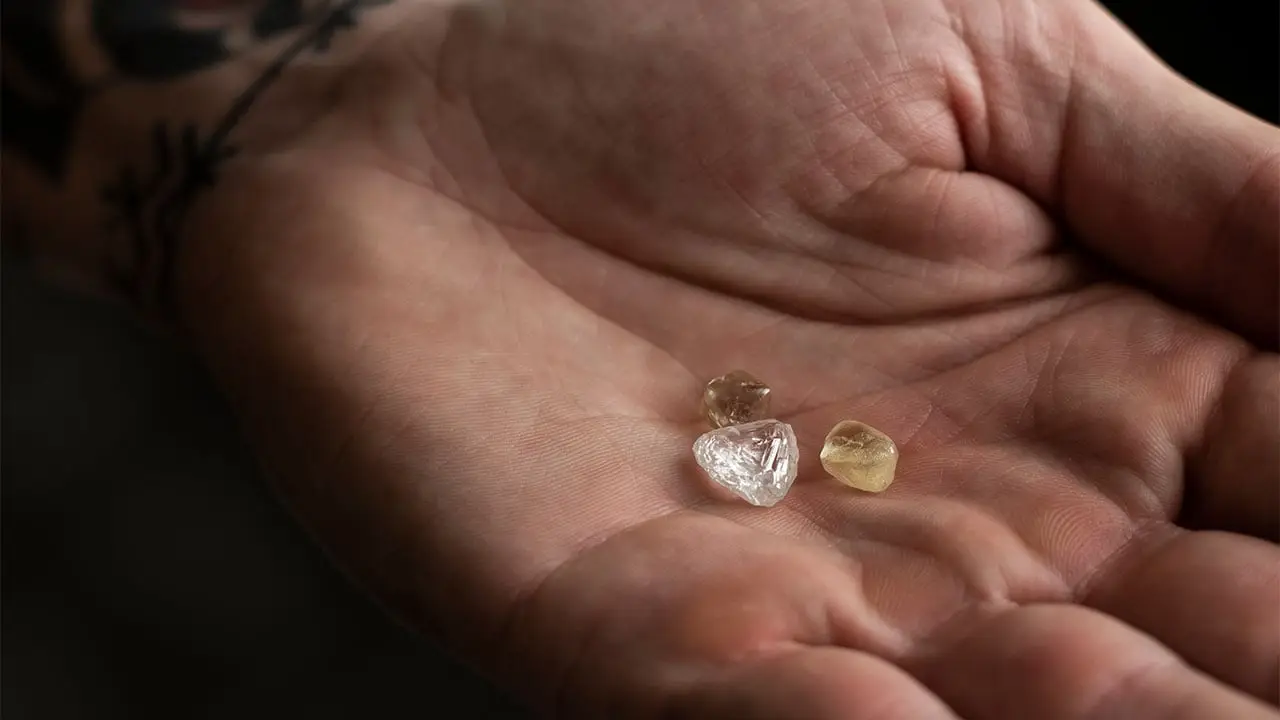
Image: Rough diamonds on display at De Beers’ offices in Calgary, Canada. (Ben Perry/Armoury Films/De Beers)