
The rise in metal prices and a buzz around lab-grown diamonds dominated discussions in Mumbai this week as India’s jewelry industry gathered for one of its biggest trade shows of the year.
The IIJS Bharat – Signature fair began Thursday amid a record gold rate and followed Titan Company’s high-profile launch of a synthetics brand, beYon.
India was one of the world’s top-performing jewelry markets in 2025, benefiting from economic and population growth alongside its traditional passion for jewelry. This supported the global diamond trade amid challenges in the US and China.
However, reports of a slowdown have surfaced in the past month, mainly because prices of the beloved yellow metal have reduced consumers’ spending power.
Weighting game
The gold price was just over $4,500 per ounce at press time, compared with around $2,000 two years ago. Silver was around $80 per ounce, up from about $24 in January 2024.
The impact is apparent in both directions, exhibitors explained on the first two days of IIJS, which stands for India International Jewellery Show.
Shoppers can’t afford as much gold jewelry as before, a reality that, in turn, reduces diamond sales. But it has also attracted investment demand from those with enough money to bet on further increases.
“Studded [jewelry] is bringing more value to the consumer, and they are ready to go for it,” said Sandrine Conseiller, CEO of De Beers Brands, at the show’s inauguration ceremony on Thursday. “On the low price, I know that [jewelers] are very creative with the karatage of gold, so the challenge can bring opportunities.”
The negative effect has been more common, show participants observed. This has been visible across the board, including in the nation’s most important jewelry segment: wedding adornments.
“The bride still has the same budget, but there’s a little compromise on the side characters — the mother’s, the sister’s jewelry,” said Akshay Shah, sales director for the solitaires division of Mumbai-based polished manufacturer Dharmanandan Diamonds.
One consequence has been a shift toward diamond jewelry with smaller volumes or purities of gold. This has offered consumers an affordable price point, with declines in diamond valuations further offsetting the high gold rate.
“It’s a tough time for the market because of rising gold and silver prices, but what is actually helping us is our focus on lightweight diamond jewelry [containing less gold],” said Neil Sonawala, managing director of retail chain Zen Diamond India, which exhibited at the show. “That’s actually helping us, because probably 50% to 60% of the value in the jewelry piece is in diamonds.”
Lab experiment
Meanwhile, a sharp expansion of India’s lab-grown sector has raised concerns that natural diamonds will lose share of the fashion-jewelry market.
Exhibitors cited not only Titan’s recent move but also a significant addition of stores dedicated to lab-grown diamonds in the past year, including by Senco Gold and Diamonds and Limelight.
The most probable scenario, according to exhibitors, is that lab-grown will take some business in the everyday segment but also bring in new consumers that have never bought diamonds of any type before.
Natural-diamond jewelry in the bridal space is likely to be safe given India’s strong focus on long-term value, exhibitors predicted — in contrast to the US, where consumers’ emphasis on price supported the cannibalization of the engagement-ring market.
“The Asian culture is very different,” said Sonawala. “People prefer rare things, things that hold value, and it’s an emotional purchase.”
Low expectations
The 18th edition of the show takes place over two venues. Booths at the Jio World Convention Centre opened on Thursday and continued until Sunday. The other half of the fair runs Friday to Monday at the Bombay Exhibition Centre, commonly known as Nesco after the company that owns it.
Traffic was broadly in line with last year, with Jio busier on Thursday and Nesco seeing brisk footfall on Friday. Trading matched low expectations given the market situation, but exhibitors were still optimistic for the rest of the wedding season.
The fair coincided with De Beers’ opening of its new flagship Forevermark Diamond Jewellery store in Mumbai. Meanwhile, the Indian Natural Diamond Retailers Alliance (INDRA) launched a new marketing program to help Indian retailers sell natural diamonds. The show also marked the start of India’s year as chair of the Kimberley Process (KP).
The US’s 50% tariffs on Indian products were low on the agenda, since the show focuses on the domestic jewelry market. In addition, polished manufacturers in Mumbai generally felt that China’s near-absence from the diamond market had taken a greater toll on the global trade than America’s import duties.
“The negotiations with [the US] are ongoing,” said Kirit Bhansali, chairman of the Gem & Jewellery Export Promotion Council (GJEPC), which organizes the show. “I am confident that the government of India will continue to strengthen both our industry and the interests of our country.”
The reporter attended the show as a guest of the Gem & Jewellery Export Promotion Council (GJEPC).
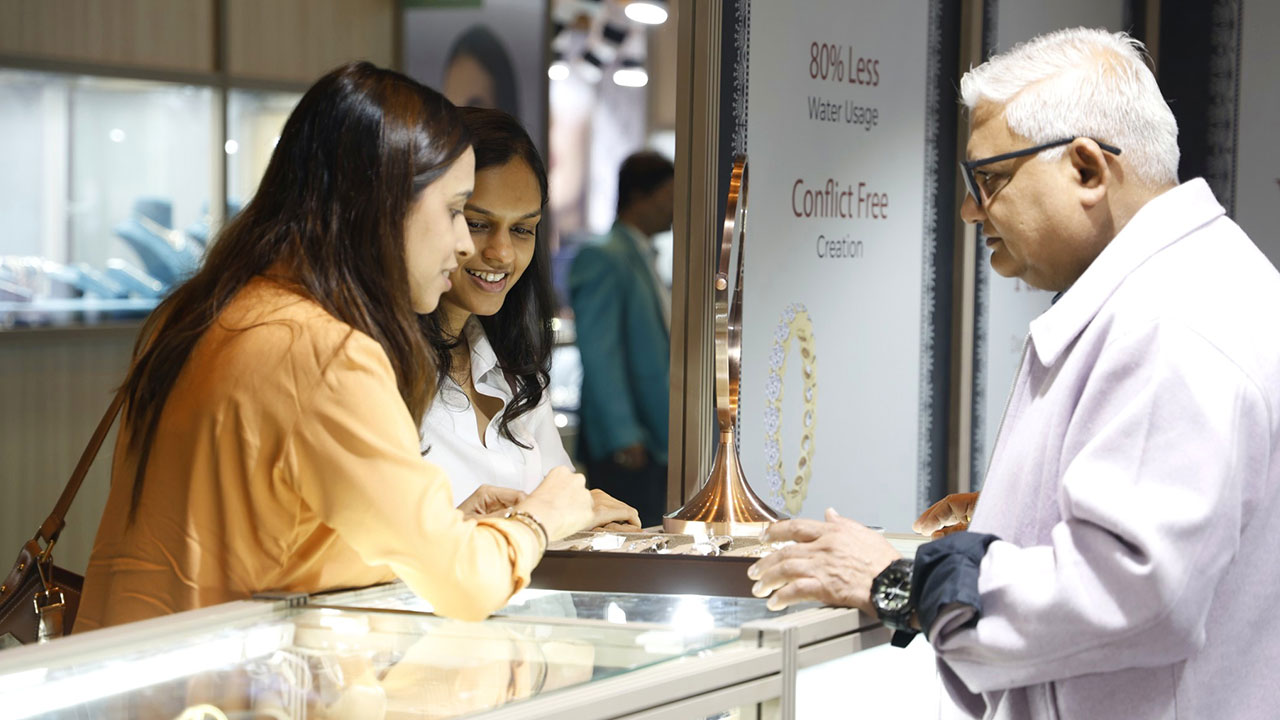
Image: Participants at the IIJS Bharat – Signature show. (Gem & Jewellery Export Promotion Council)