
On September 7, the board of the World Jewellery Confederation (CIBJO) approved a recommendation that its Blue Books make “synthetic” the sole descriptor for a created product with the same chemical composition, physical properties and structure as its natural counterpart. After CIBJO’s decision, the argument is moving on to the Federal Trade Commission (FTC): Several industry organizations now want “synthetic” adopted in any future revision of the FTC’s Jewelry Guides, which in 2018 dropped the word from their examples of recommended descriptors. I sell natural diamonds for a living, and I am not writing to argue for the word. A lab-grown diamond is a diamond. The more useful question is what happens to a gem’s value once it can be manufactured – and on that, we have an unusually good precedent.
On December 5, 1906, The New York Times ran an advertisement from the jeweler M. Tecla & Co. under the headline “Nature More Costly Than Science.” Nature’s rubies cost $125 a carat; scientific rubies, $12, the ad pointed out. Beneath the prices, three words: “Both Are Genuine.” The copy explained that the component parts of Tecla’s rubies were “identically the same as those of natural rubies.”
That is today’s lab-grown pitch, 120 years early. And the vocabulary fight was already on. The ad’s own header read “Tecla’s Reconstructed Gems.”
‘Reconstructed,’ ‘scientific,’ ‘synthetic’
“Reconstructed” suggested natural ruby was recycled by fusing fragments into a larger stone. In 1911, writing in the magazine Revue des Deux Mondes, the French author P. Banet-Rivet took care to explain that the flame-fusion ruby Auguste Verneuil grew from alumina and chromium oxide at the beginning of the 20th century had “nothing whatever to do with so-called reconstituted [reconstructed] ruby.” Calling a ruby “reconstructed” could make it sound closer to nature. Yet even if natural rubies were melted down and the melt used to grow a new crystal, the result would be synthetic ruby: Natural starting material does not make a man-made crystal natural. Substitute today’s words; the argument needs no translation.
Verneuil published his method in 1904. By 1907, producers were making an estimated 5 million carats a year. Banet-Rivet observed that the value of “scientific rubies” had already fallen very low while fine natural rubies still fetched 1,000 to 2,000 francs a carat – and he asked what cheap mass production would one day do to a synthetic diamond. He answered with the ruby: “After a passing crisis, the natural ruby…regained all the favor of the public, and the scientific ruby saw its prices fall further and further. It will probably be the same with the synthetic diamond.”
By April 1914, a French popular-science magazine described factories turning out 40 to 50 kilograms of synthetic ruby a day. Rough had fallen from 40 to 50 francs a carat to 12 to 15 centimes, against a production cost of about 4 centimes. Cut synthetic ruby sold for around 2.50 francs a carat, and the cutting, the author noted, accounted for most of that price. Natural ruby, meanwhile, was holding and even rising. The Mont-de-Piété, the Paris municipal pawnbroker, had stopped lending against any stone but diamond, because it could no longer be sure what it was holding.
The whole story in one decade: material equivalence as a sales argument, a fight over nomenclature, a price collapse to production cost plus cutting, and a natural counterpart whose value depended on being verifiably natural. These are not modern indices, and some output was lower quality. The direction is not in doubt.
Material truth, economic expectation
I still see the aftermath in my practice. Families bring me old jewelry set with a large red stone that generations have regarded as a valuable natural ruby. Sometimes, examination reveals the characteristic curved growth banding of a Verneuil synthetic ruby. The piece keeps its craftsmanship, its history and its meaning. What disappears is the assumption behind its expected value: that the stone is natural and scarce.
A lab-grown diamond is not glass or cubic zirconia. Its chemical composition, crystal structure and key physical properties are essentially those of a natural stone. The real question is whether that makes it the same economic product at a discount. I don’t believe it does – and I should declare an interest: I run a family jewelry company that sells natural diamonds. That interest is also why the century-old pitch frustrates me. A material truth is being used to imply an economic equivalence.
Not every natural diamond is exceptionally rare, and natural origin alone guarantees nothing; rarity varies enormously by size, color, clarity, cut and category, and the natural market is not immune to marketing, supply management or excess inventory. The crucial distinction is that a natural stone cannot be reproduced to order in another production run. Lab-grown capacity has real constraints – equipment, energy, capital, know-how, growth time, yield – but when the economics justify it, it can be expanded. Geological origin cannot. Materially, a lab-grown diamond is far closer to a natural diamond than to cubic zirconia. In the economics of supply, it behaves like other manufactured stones: Over time, price anchors to growing, cutting, grading, distribution and brand, not to scarcity.
Where the market is now
The grading language has already begun to separate. Since October 1, 2025, GIA no longer applies its natural-diamond color and clarity nomenclature to D to Z lab-grown diamonds. It now describes qualifying stones as “premium” or “standard,” saying most fall into a very narrow range. That is not a judgment about price. It is the institution that built the 4Cs concluding that a vocabulary developed for a natural continuum does not describe a manufactured product.
Lightbox is an imperfect proxy. De Beers launched it in 2018 at a linear $800 a carat and positioned it, explicitly, as fashion jewelry separate from natural diamonds; the opening price was strategy as much as market signal. But the subsequent fall cannot be pinned on one company. Lightbox cut its base price to $500 in 2024 as wholesale prices fell, and in announcing the brand’s closure in 2025, De Beers said wholesale lab-grown prices had dropped 90% since 2018 and were “tracking closer to a cost-plus model.” Edahn Golan’s wholesale index puts the decline at 93% since tracking began in July 2018. His methodology has evolved, but the drop is too large to dismiss as strategy or statistical artifact.
The honest counter-picture
None of this means lab-grown is failing as a product. Demand is strong. Wesley Hunt, chair of CIBJO’s lab-grown diamond committee, told the Vicenza congress that more than half of US engagement rings sold by volume now feature a lab-grown diamond. Golan’s third-quarter report, published October 7, shows US lab-grown jewelry unit sales up 25% in September and demand up nearly 23% year to date. His wholesale index was still down 15% year on year, but 1-carat rounds rose 1.3% versus the previous quarter and 1- to 3-carat rounds about 2%, and growers, after years of cuts, are holding rough prices steady. Golan himself says it is “too early to declare that the market has definitively reached its bottom.” The curve may be flattening.
But look at what those numbers describe: More units sold while average spending, by Golan’s second-quarter account, stayed within a narrow range. The consumer is buying a bigger diamond for the same budget, not spending more. That is how a market behaves when supply grows faster than willingness to pay per unit of material. This is the ruby story, not a departure from it.
Natural prices have fallen, too, and anyone selling natural diamonds as an automatic investment is misleading buyers. The 1-carat Rapaport Trade Diamond Index (RAPI™) – the average asking price of the lowest-priced 10% of Gemological Institute of America (GIA)-graded, RapSpec A3-or-better round diamonds in each of the top 25 D to H, internally flawless to VS2 quality categories offered on Rapaport Trade (formerly RapNet) – fell 9.9% in 2025; the 0.30- and 0.50-carat indices dropped 20.3% and 26%, round, 1-carat, SI goods lost 24.1%, and 3-carat goods were essentially flat. De Beers’ average rough price index was 16% lower year on year in the first half of 2026, a figure that includes the effect of its 2025 inventory rebalancing. Within the half, the company described the index as stable, and it said smaller and lower-quality goods “continued to face pricing pressure from the impact of synthetic lab-grown diamonds.” But when a natural diamond’s price falls, it does so within a geologically constrained supply, in response to weak demand, inventories, recession, fashion or lab-grown competition. A lab-grown diamond faces all of that plus reproducible production and falling technology costs. Same direction, different mechanism.
What this means at the counter
For a jeweler, the 1906 ad is less a warning than a job description.
Don’t sell a lab-grown diamond as a natural diamond at a discount. It is a different product with different economics, and a customer who understands that will not come back angry in five years.
Don’t promise value retention. Neither category is an automatic investment, and one of them sits on a manufacturing cost curve.
Do sell its real virtues – size, beauty, durability, price – without apology. Lab-grown is a rational purchase for a buyer who wants a large, beautiful, durable stone and understands what it is.
Do explain origin plainly, because origin is where the value expectation lives. The Mont-de-Piété learned that in 1914.
Whatever CIBJO, the FTC or the next Blue Book decides, that is the part the customer will remember. The word is not the point. What reproducibility does to value is.
We can manufacture a diamond. We cannot manufacture geological history.
Martin Mikuš is a gemologist, lawyer and court-registered expert witness in gemstones, precious metals and jewelry in Slovakia, a member of the Diamantclub van Antwerpen and cofounder of the Slovak Gemological Institute. He is chief executive of Mikuš Diamonds, a family jewelry company that sells natural diamonds, and therefore has a direct commercial interest in the distinction discussed. This article was not commissioned or funded by a mining company, diamond producer or trade marketing body.
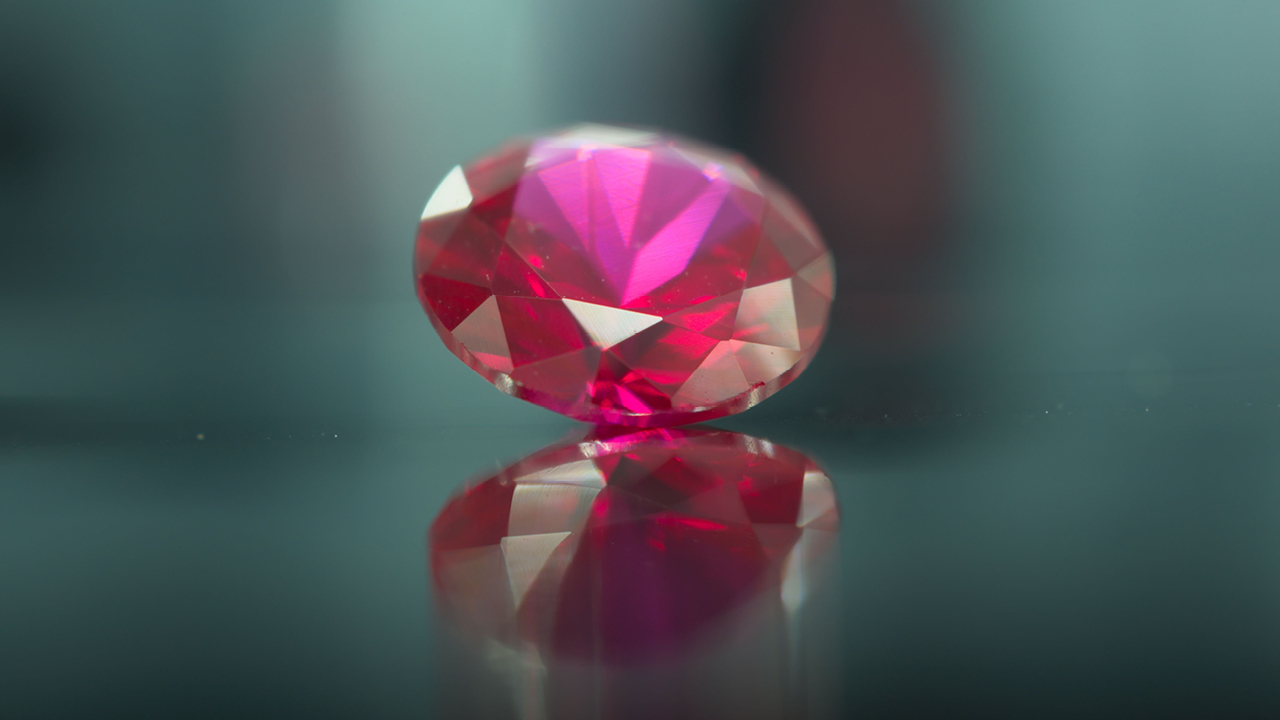
Image: A lab-grown ruby. (Shutterstock)