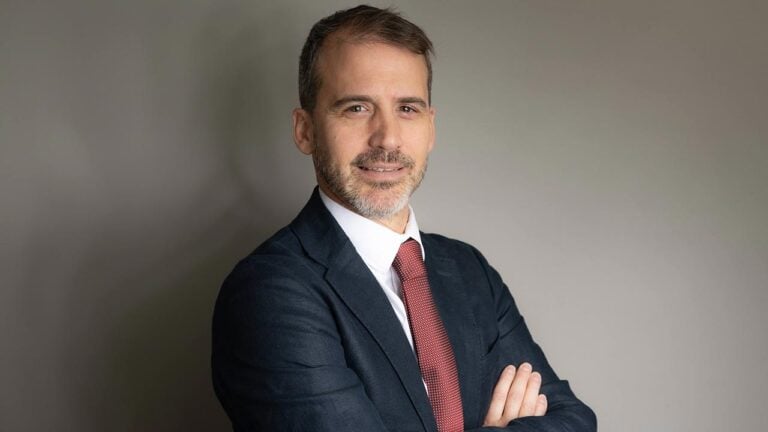



What does sustainability mean in 2025? “Nothing — literally,” says Tiffany Stevens. “The Federal Trade Commission (FTC) hasn’t been able to commit to a definition and probably won’t anytime soon with [its] Green Guides under review in an increasingly chaotic regulatory reality.”
Lately, says the former Jewelers Vigilance Committee (JVC) CEO, “sustainability has been a catchall, an umbrella term for a vast array of big esoteric concepts and technical realities — a mirror for our fears, hopes, dreams and aspirations, and [a buzzword in] political maneuvering on climate and responsibility.”
Stevens — who is launching a supply-chain consultancy business called Source Strategy Studio this fall — forms these thoughts while reflecting on her recent visit to Terras, an invitation-only gathering of sustainability leaders. The event, which took place in Tuscany this past June, was free from slide shows, panel discussions and social media; instead, it prioritized human-to-human dialogue at a remote 500-acre estate in the Italian countryside. Leaders from industries as diverse as aviation, fashion, agriculture and AI joined together in talking circles, with researchers from UK-based climate think tank Zero Ideas moderating the sessions.
This breaking of norms worked, according to Stevens: “The natural setting alchemized deep conversation and an openness among the group that felt very rare. It was a catalyst for new ideas because of the cross-sector [approach to the] topics and the thoughtful moderation of discussion.”

A safe space to collaborate
Reframing sustainability and ethics as a collaborative responsibility rather than a set of self-serving corporate checkboxes is a concept that’s gaining momentum among industry players with advanced environmental, social and governance (ESG) strategies. And alliances are quietly forming.
Margot Stuart is at the heart of such ideological matchmaking. She is the cofounder of Originalluxury, which she describes as a “knowledge-sharing hub” that brings luxury companies and ESG-focused tech innovators together to exchange ideas. “We are not here to compete or push one solution over another,” she says. “We want to be the safe space where people can ask questions and share knowledge that makes the industry move forward.”
To do this, Originalluxury hosts closed-door sessions that prioritize discretion. It does not promote its educational events in advance and invites no media outlets, nor is there social media coverage. This allows the leading luxury brands in attendance to ask questions and disclose information, knowing that nothing will leave the room.
One persistent theme in Originalluxury’s content is how to create value. “What is the value creation of implementing traceability?” Stuart asks. “It’s not an obvious [question].”
But the platform has made strides in bringing the financial sector into the conversation, hosting roundtables with investors, banks and asset managers. “They are looking to invest in companies that provide robust, accountable data — something traceability technologies can enable.”
The next chapter for Originalluxury includes a luxury innovation center at the Dubai Multi Commodities Centre (DMCC), a training program for women in Angola’s mining industry, and support for the DMCC’s Lab-Grown Diamond Symposium.
“We are agnostic when it comes to mined or lab-grown,” says Stuart. “We are trying to steer the conversation toward creativity and desirability — not comparison.”

Putting a lid on emissions
Digital solutions are also at the heart of the Aura Blockchain Consortium, founded by LVMH, Richemont, Prada and Italian fashion group OTB. Aura makes it possible to trace individual items and generate product passports that document the goods’ journey through the supply chain. It also provides emissions tracking and compliance features in alignment with EU regulations.
The project’s existence reflects a broader trend: Sustainability now relies on interoperable infrastructure as much as on intention. This is especially important as ESG strategies begin to look beyond internal yardsticks toward wider supply chains.
Emissions are a case in point. Scope 1 and 2 emissions, which are the first ones ESG efforts usually target, come directly from a company’s operations and indirectly from purchased energy. Scope 3 emissions include all other indirect emissions across the value chain, such as those from suppliers — and such emissions can often account for more than 70% of a company’s carbon footprint, according to professional-services company Deloitte.
One retail leader taking on the challenge of addressing Scope 3 emissions is Chow Tai Fook, China’s largest jewelry retailer. The company is now in its 10th year of sustainability reporting and recently released its Sustainability 2049 blueprint. The plan, which company director of sustainability Lianne Ng laid out at the Jewellery & Gem Asia show in June, includes transitioning all product lines to 100% recycled gold, achieving full traceability for diamonds and gemstones by 2029, and expanding the jeweler’s decarbonization efforts into Scope 3.
In fiscal 2025, Chow Tai Fook reduced its Scope 1 and 2 greenhouse gas emissions by 18% and completed a Scope 3 greenhouse gas inventory, which revealed that value-chain emissions accounted for 98% of the company’s total emissions impact.
“The sheer volume of our raw materials means huge emissions, and we have to help reduce those emissions [by] understanding the footprint of the value chain and understanding where we can reduce that,” said Ng. Given Chow Tai Fook’s scale, this could have a significant ripple effect on the industry — not only within China, but globally.

Carbon-cutting strategies
The Watch & Jewellery Initiative (WJI) 2030 is similarly focusing on Scope 3 emissions. Addressing them “is critical for the watch and jewelry industry today due to their dominant share of total emissions and growing regulatory and market pressures,” says Iris Van der Veken, the body’s executive director. “I see an urgent need for more education and practical toolkits to help suppliers understand that a strong climate strategy makes business sense.”
To that end, WJI 2030 has created the Decarbonisation Workstream, “which focuses on improving climate data collection from suppliers and calculating material emission factors, starting with gold,” she says.
WJI 2030 is also collaborating with Deloitte on a Circularity Workstream project that explores ways of reusing and recycling materials to reduce carbon footprints. It plans to launch a white paper on this topic in Rome during Climate Week 2025.
Such resources could also help businesses of all sizes respond to evolving compliance regulations — another area of sustainability and ethics that Van der Veken deems pressing.
“With [EU] initiatives such as the Corporate Sustainability Due Diligence Directive and the Corporate Sustainability Reporting Directive, companies are facing new accountability requirements that demand stronger due diligence and reporting practices,” she says. “These developments are not only reshaping compliance and de-risking strategies, but also accelerating the integration of ESG considerations into core business operations. This is where collaboration becomes essential.”
To support that transition, WJI 2030 launched a pilot project with several leading brands and suppliers, focusing on three topics: supplier engagement; the link between human rights and environmental due diligence; and double materiality assessment, which examines the impact organizations have on society and the environment, and vice versa. The outcome was an open-source guidance note titled “Preparing for the Corporate Sustainability Due Diligence Directive in the Watch & Jewellery Industry,” which is available to download from the WJI 2030 website. The group plans to launch more toolkits on these subjects in the future.
Strong standards
Another organization reshaping ESG at scale is the Responsible Jewellery Council (RJC), which celebrates its 20th anniversary this year. The group started with 14 founding members in 2005 and now has more than 2,000 “championing ethical and sustainable practices in 74 countries,” according to RJC interim executive director John Hall.
“Among our most impactful contributions is the establishment of a robust assurance system with independent audit, which ensures that member companies adhere to rigorous standards related to human rights, environmental protection, and responsible sourcing,” he says.
Key milestones from the past 20 years include the launch of the RJC Code of Practices (COP), which sets ESG standards for its members, and the RJC Chain of Custody (COC), which acts as a framework for companies to improve their responsible-sourcing measures.
In this anniversary year, the RJC has released updated versions of both the COP and COC, and it put out a COP Self-Assessment Workbook at the end of 2024. The workbook will “empower members to strategically evaluate their organizational practices against established benchmarks, facilitating deeper insights into operational strengths and areas for growth,” says Hall.
The RJC is also introducing a new framework this year that mandates responsible business practices for lab-grown diamonds. The Laboratory Grown Material Standard, which the group presented to members at a New York RJC event in July, aims to introduce clarity and accountability into the synthetic-gemstone market, setting clear protocols for disclosure, sourcing and chain of custody.
Regions of conflict
As these efforts converge, the industry is also confronting legacy challenges. The Kimberley Process (KP) Intersessional in Dubai earlier this year focused on redefining conflict diamonds and improving oversight of artisanal mining.
World Diamond Council (WDC) president Feriel Zerouki left the week-long session feeling “energized,” she said at the time, posting on LinkedIn that “at the halfway mark of this final year [of the KP review and reform cycle, the KP] has delivered nearly all the critical reforms we set out to achieve.”
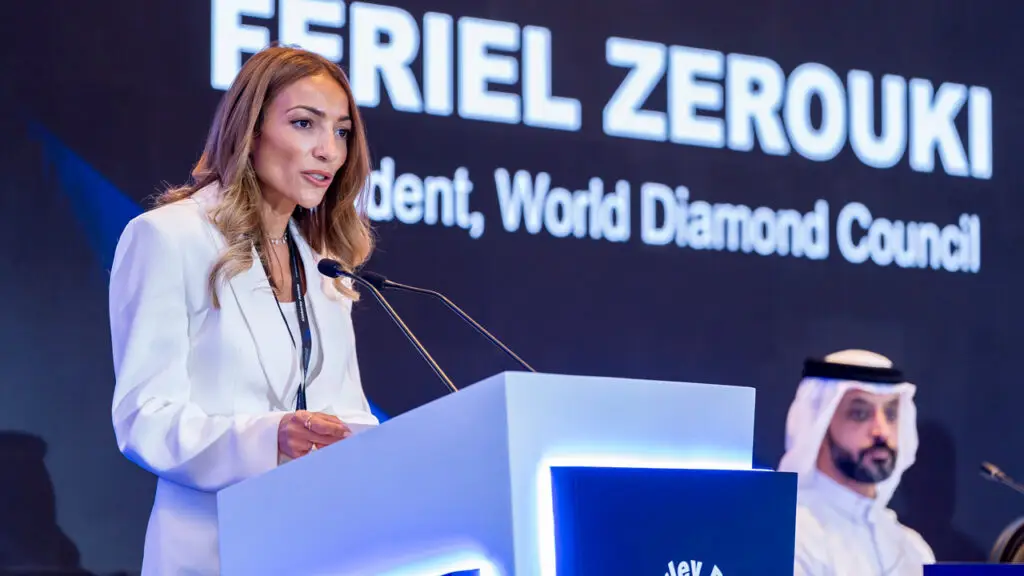
Among those reforms, said Zerouki — who is also chief trade and industry officer for De Beers Group — were transparency efforts “such as disclosing the country of mining origin on KP certificates, digitizing the certification and statistics-sharing systems, [having] inclusive and equitable leadership to enable all countries to share the chairmanship, and [creating] a framework that gives diamond-impacted communities access to technical assistance and support from the KP should they request it.”
While the industry has a long list of geopolitical and fiscal challenges that go far beyond conflict diamonds, Hall believes that in these difficult times, it is even more pressing to shore up ESG policies, particularly as supply chains shift accordingly.
Many businesses are reevaluating their sourcing strategies and working to curb their reliance on geographic areas that could pose ethical, political or other risks, he says. “Additionally, geopolitical tensions can exacerbate volatility in commodity prices and limit collaboration opportunities among international partners. As organizations navigate this complex terrain…companies must develop agile strategies that not only respond to immediate challenges, but also anticipate future shifts in the global economic landscape while striving for sustainable growth amid instability.”
No body is an island
What must ultimately bind all these varied ESG efforts — be they reactive or vision-driven — is a shared understanding that no actor, no matter how large or influential, can do it alone.
“The watch and jewelry industry stands to gain significantly from a more cohesive and collaborative approach, particularly when addressing deep-rooted, systemic challenges that no single company can solve in isolation,” stresses Van der Veken. She calls for “aligned action, shared standards and coordinated investment” regarding issues such as decarbonization, responsible sourcing, biodiversity loss, and social inclusion.
Collaboration is more than a feel-good endeavor; it’s crucial to success, she says: “By working alongside governments, regulators, NGOs, academic institutions, and international organizations, we can strengthen oversight, close regulatory and policy gaps, and bring both legitimacy and scale to industry-wide efforts. Collaboration ensures we’re not duplicating efforts or working at cross purposes. It enables us to accelerate progress, pool resources, and build solutions that are both practical and aligned with global expectations on sustainability and human rights.”
The frameworks are in place. The goals are clear. What remains is for the jewelry industry to act as one to get there.
Main image: Iris Van der Veken of the Watch & Jewellery Initiative 2030 (right) in conversation at the Terras event. (Terras)