

“There have been fewer super-high-end sales in the past few years than what you saw 10 years ago, and that is just a statement of fact,” says Quig Bruning, Sotheby’s head of jewelry for the Americas and for Europe, the Middle East and Africa (EMEA). The reasons for the drop vary, from fewer elite buyers and a dearth of “wow” stones, to collection hoarding, oversaturation, and a growing knowledge of prices.
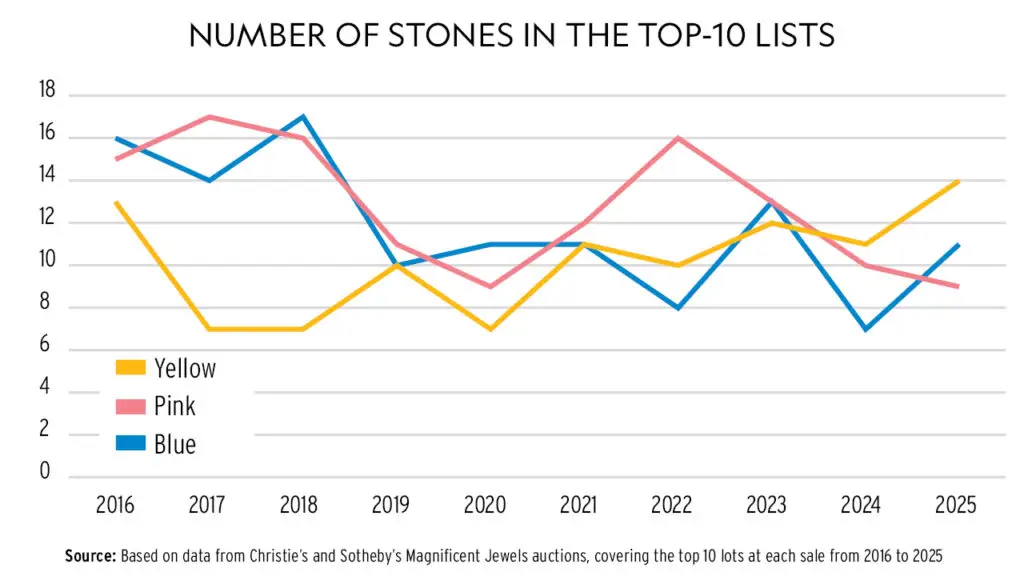
However, the number of exceptional blue, pink and yellow diamonds on offer is just one of the aspects that has changed at high-jewelry auctions over the last decade. Data on colored diamonds that have placed in the top 10 at Christie’s and Sotheby’s Magnificent Jewels sales since 2016 have shown some surprising trends over the years.
Top stones tapering off
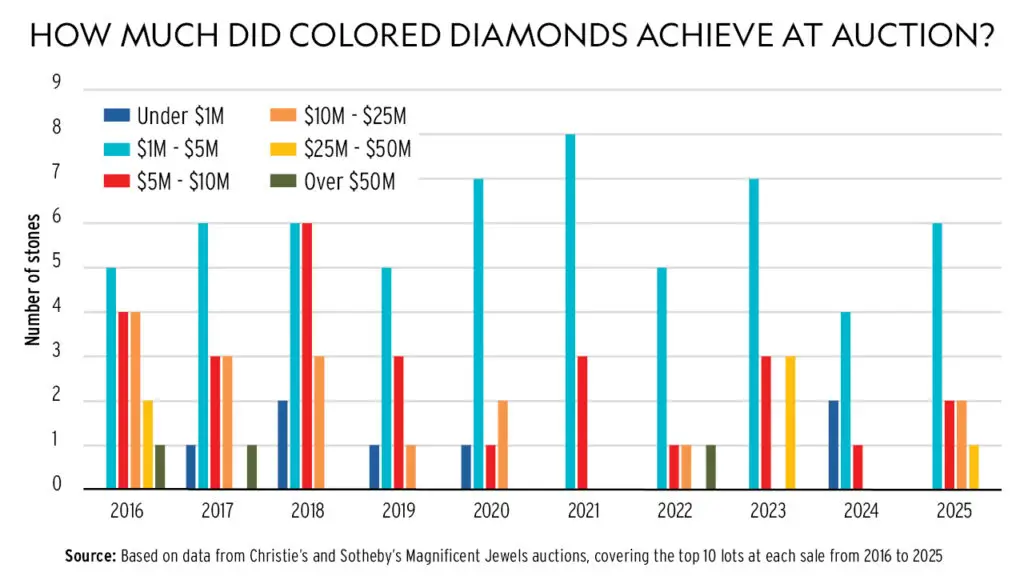
A whopping nine colored diamonds that made the top 10 in 2016 nabbed prices higher than $20 million, while a further three raked in more than $10 million. Those included the Oppenheimer Blue, which sold for over $70 million, and the Steinmetz diamond, which brought in more than $30 million. A year later, 10 stones topped the $10 million mark, with the CTF Pink Star beating $70 million, and a 14.54-carat fancy-vivid blue breaking $50 million.
However, by 2023, only four colored diamonds realized prices above $20 million, and in 2024, the closest contender was a pink that fetched just over $13 million. And it’s not just price that marked the decline, but volume as well: 44 pinks, blues and yellows made the top 10 a decade ago, while only 28 did so just nine years later.
What’s causing the decline?
One of the major problems is simply that these large, impressive stones are in limited supply, according to Bruning.
“Ten years ago, we were routinely having $100 million sales, and now we’re routinely having $50 million sales, and that’s driven in large part by a dearth of those top stones,” he says. “You have a lack of supply due to rarity, and those that own them are not selling.”
Max Fawcett agrees, observing that miners have been recovering less top material these days, and that the diamonds already in collections are unlikely to see the light of day any time soon. “Those goods will likely take years to resurface [at auction], which is good,” says the global head of jewelry for Christie’s. “If things come back up too quickly, it’s very bad for the market and puts real downward pressure on prices, which is not good for anyone.”
Another reason for the decline is a lack of buyers. As the market changes, collectors’ hunger for colored diamonds has faded.
“You had this interesting bubble around 2016, at the peak of the colored-diamond craze, and that market has matured over the past 10 years,” elaborates Bruning. Today, “the finite number of buyers you have for $30 million-plus diamonds have often already bought their amazing blue or pink or yellow, and tend not to want another one.”
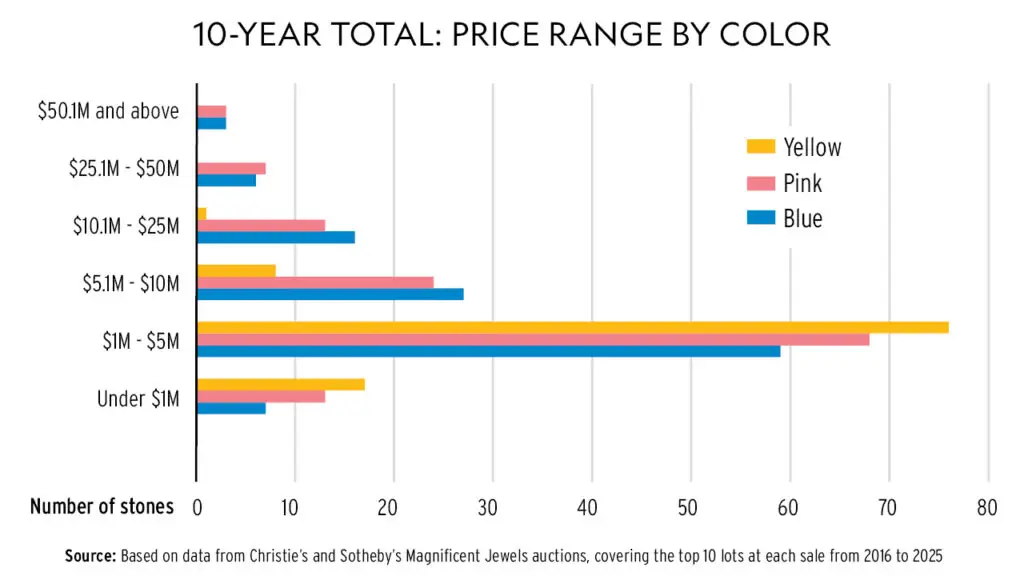
He also points to waning interest on the part of Far East buyers, who once comprised a majority of the market for big, expensive stones. A movement toward the $5 million-and-below price point, where colored diamonds are more liquid, is another factor he cites, as is the rise of the Middle East as a target collector for high-end items.
“When you think about auctions — jewelry, paintings, whatever — it’s unbelievably remarkable that we can dictate to the wealthiest people, the most discerning collectors in the world, ‘Hey, you have to come to our place at X time, and you have to compete to try and buy something, and you don’t know what you’re going to pay for that thing.’ That’s not how most [regular] sales happen,” he explains. “That requires a massive shift in mentality, and we are laying the groundwork for that in the Middle East right now, but it’s yet to fully come to fruition, so I’m not surprised that you don’t have those buyers at auction who are jumping in at that price point.”
No-sell zone
Given the scarcity of new material, it would seem natural for auction houses to procure high-end colored diamonds from known collections and bring them back to the block. But the opportunities to do so are limited.
“Consider what happened with the Golconda Blue last year,” says Harsh Maheshwari, director of colored-diamond trader Kunming Diamonds. The stone in question was set to go up for auction at Christie’s last year with an estimate of $50 million, only to get withdrawn ahead of the May sale. It later sold within the consignor’s family. “They saw the hype and realized, ‘Why are we selling something spectacular like that? We don’t need the money.’”
According to Fawcett, the people who buy stones at that level have no intention of ever selling them; they buy for passion. And certainly, he notes, 10 years is not enough time for such goods to make their way back to market in the event that the owner does choose to sell.
“I believe in 20 to 30 years, maybe we will see some of those diamonds come back up for sale,” he says. “Perhaps when they pass on to the next generation, and maybe that generation is not so interested in diamonds, we could see some coming back. But right now, I can say the collector who purchased the Oppenheimer Blue would never sell, and I can’t imagine a situation where the Blue Moon [of Josephine — a 12.03-carat blue diamond that achieved a then-record $48.5 million in 2015 — ] would be sold.”
Marketing misses
Creating a buzz for a top auction item is a necessity when you’re asking people to shell out millions for one piece. But auction houses just aren’t marketing today the way they were 10 years ago, and in a weakened economy, this can mean that even if a diamond is of the caliber to reach such high levels, it may fail to do so. Maheshwari points to the Mellon Blue, which sold for just over $25 million last year — an amazing price, but not as good as the $32.6 million it garnered in 2014, just 11 years earlier.
“If the trade had more liquidity, you could have seen it go up a bit more,” he maintains, positing that the key issue is “an absence of hype. I think the industry is just not effectively selling the dream. They aren’t making collectors hungry.”
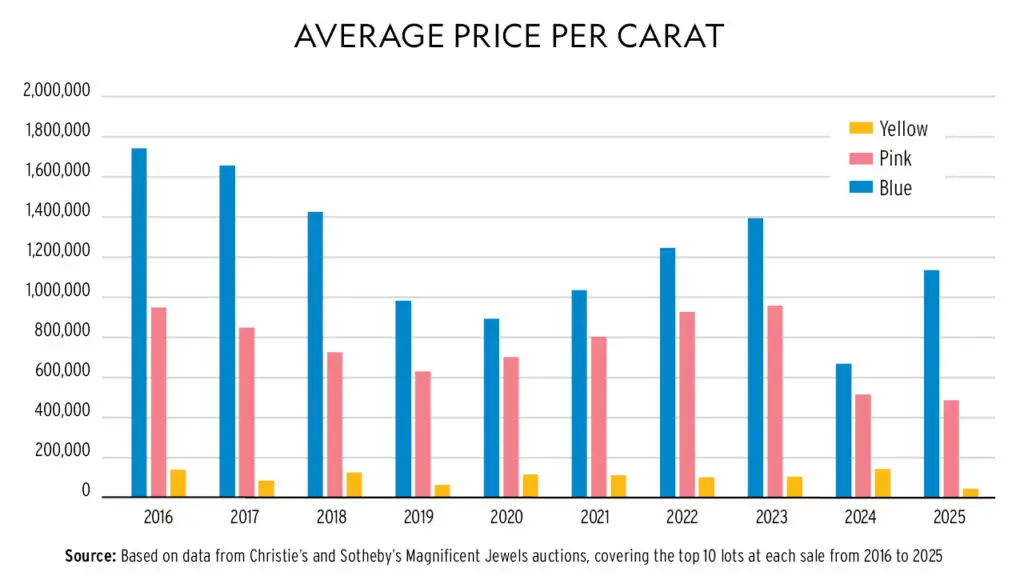
Oversaturation is also a factor. A few years ago, a number of huge blue diamonds hit the market in quick succession, beginning with the Mellon Blue, which “really lit the match paper with regard to blue-diamond prices,” Fawcett explains. Within a short time, the Oppenheimer Blue and the Blue Moon hit the block, all fetching over $3 million a carat. But it was “too quick, and too much product, all at one time, and then we saw a bit of normalcy return, and we saw more realistic prices.”
Making a switch
“At the moment, the real hot-ticket item is colored stones, and I don’t mean diamonds,” Fawcett says. “I mean rubies, emeralds and sapphires. A lot of colored-diamond dealers, very established and important ones, have told me recently that colored gemstones are now a huge part of their business, and they’re moving away from colored diamonds.”
Part of the reason for the switch is colored gems’ more approachable price point, he continues, estimating that even the most expensive sapphire would get around $250,000 per carat at auction. For that price, he says, you would get nothing in a top blue or pink, and even at the lower color level, you would get only a tiny stone.
Beyond that, he adds, fashion is changing, and the younger generation has no use for large colored diamonds. “I think the occasions that one would have to wear something of the $10 million to $30 million caliber in the world we live in today are very [few]. It’s very different than it was even 10 years ago.”
Not going public
One secret the experts share is that while super-expensive colored diamonds are not coming up regularly for auction, that doesn’t mean they aren’t on the market at all.
“There are collectors who want it to be very private, very hush-hush,” says Maheshwari. “For them, true luxury is when you can own it just because you have the money, and no one else is able to put their hands on it.”
Roy Safit, CEO of the Fancy Color Research Foundation (FCRF), backs up this theory, especially when it comes to stones with provenance. “When you have something that has pedigree or is a really impressive collector’s item, the chances are that the deal is going to be sealed before it even comes under the hammer.”
While Bruning is loath to speak about private sales — they’re private for a reason, he points out — he does concede that Sotheby’s had some in 2025 that exceeded any achieved auction prices.
Fawcett is more open, revealing that Christie’s has had “a lot of success” with very big colored diamonds through private sales. “We have clients who would prefer the discretion and anonymity, and we have clients who love to buy privately and will be in contact with us throughout the year with a wish list of things they they’re looking for at a very high level, that are rare, that we might have access to.”
Geneva magic
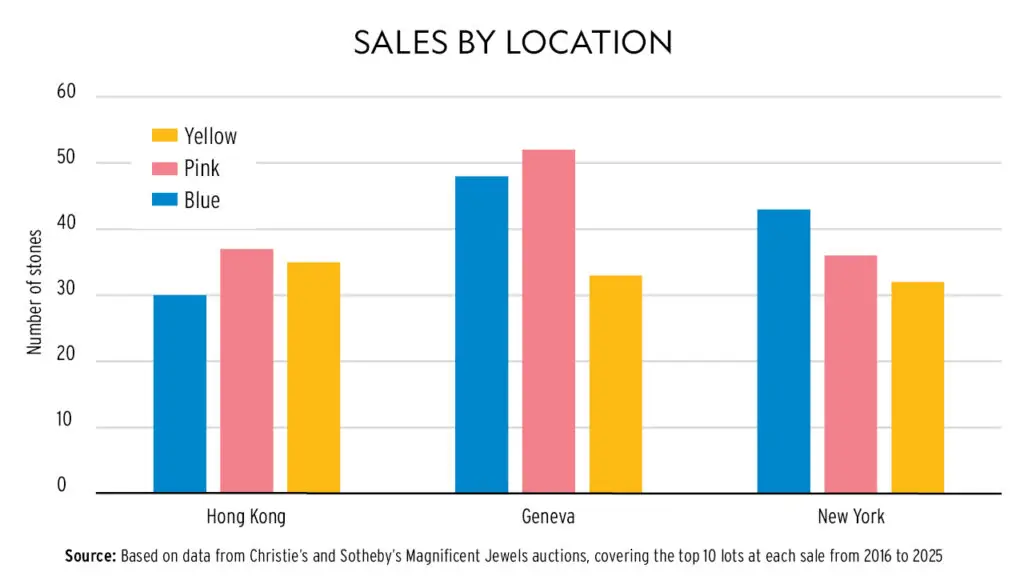
Another noticeable trend is the emergence of Geneva as the sales center for high-value colored diamonds, particularly as buyers become more international. Over the last few years, it was the purchase point for 130 top-10 blues, pinks and yellows, while New York had 111 and Hong Kong 102.
Not only is Geneva geographically central to the Far East, the Middle East and the US, it has the function of the Freeport, which provides clients with a tax-free zone. That makes it easier to sell big-ticket items to international buyers without worrying about shipping duties, says Fawcett.
It’s also convenient for attendees of the GemGenève jewelry show, which takes place at the same time, Maheshwari adds.
Bruning brings up another of the city’s assets: “The Geneva sales tend to have really intriguing stones that are fresh to market, particularly ones that come from old European collections, which always capture people’s imagination and attention. I also think the Geneva sale is the one where the market coalesces. And there’s just something ineffable about the Geneva salesroom that can create auction magic in ways that other salesrooms can’t, even though we try.”
The estimate question
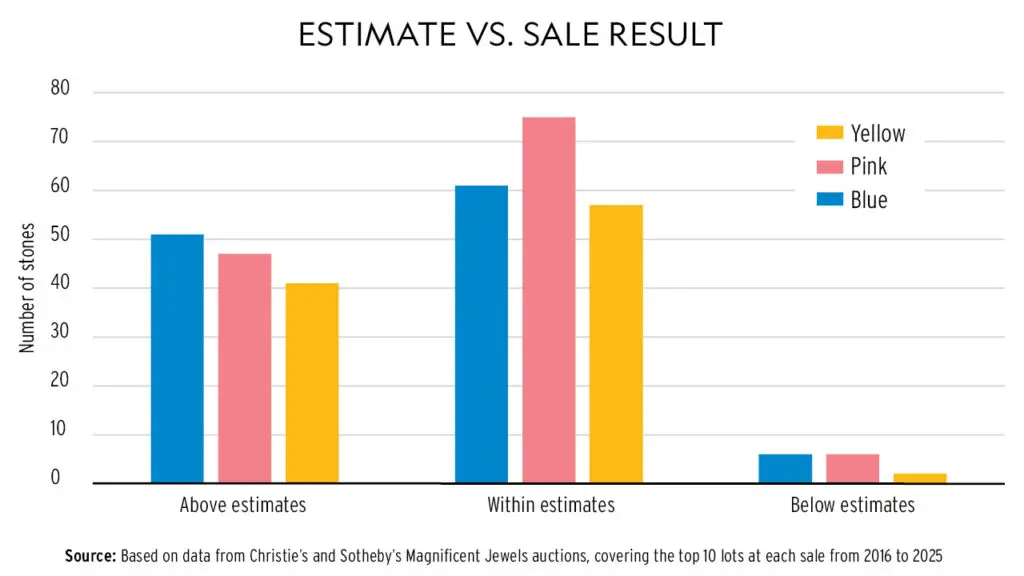
Eight to 10 years ago, blues and pinks consistently beat their presale estimates. There were 16 that did so in 2017, and 17 in 2018. However, there were only eight in 2024 and a mere six last year. The reason? Estimate pricing has gotten more efficient over time, says Bruning.
“Ten years ago, it was more an art than a science, and you didn’t have data points to justify the prices, because they were so unknown to the market,” he explains.
However, Fawcett believes competition plays a bigger role. “It’s become a lot more competitive between the auction houses in terms of fighting for the same business, and when that happens, you no longer have full control of how the item is priced, because if you say you want to price it for $1 million to $2 million, and the other house says they’ll price it for $2 million to $3 million, you’ve got a very high chance of losing the business. So as a result, you have to price things much closer to market value, and that’s why you see [fewer] things making five to six times their estimate. The idea that people just walk in and say, ‘Here’s my blue diamond, price it however you want and good luck to me, I’ll see you in a few months’ is not realistic; 10 years ago, it was less competitive.”
Yellows have gone in the opposite direction, with just two or three yielding above-estimate results nine to 10 years ago versus seven last year. This is because the market is so flooded with yellows that auction houses are “almost required to create interest by having lower estimates on them,” Bruning says.
“If you took every 10-carat vivid blue that’s ever been put on the market, you could probably fit them in a pants pocket, they’re so rare,” he remarks. “But there’s a plethora of yellows. I know they all fall under the fancy-color diamond umbrella, but you’re talking about a golf umbrella for the yellows, and one of those teeny-tiny little mini umbrellas you pick up from a bodega for blues and pinks.”
If you have a 10-carat, fancy-intense-yellow diamond that’s worth $15,000 a carat, and you price it at that level, you’re not going to have enough interest, he continues. But if you price it at $10,000 a carat, people will get excited to bid on it, and that will drive up the price.
A cut above
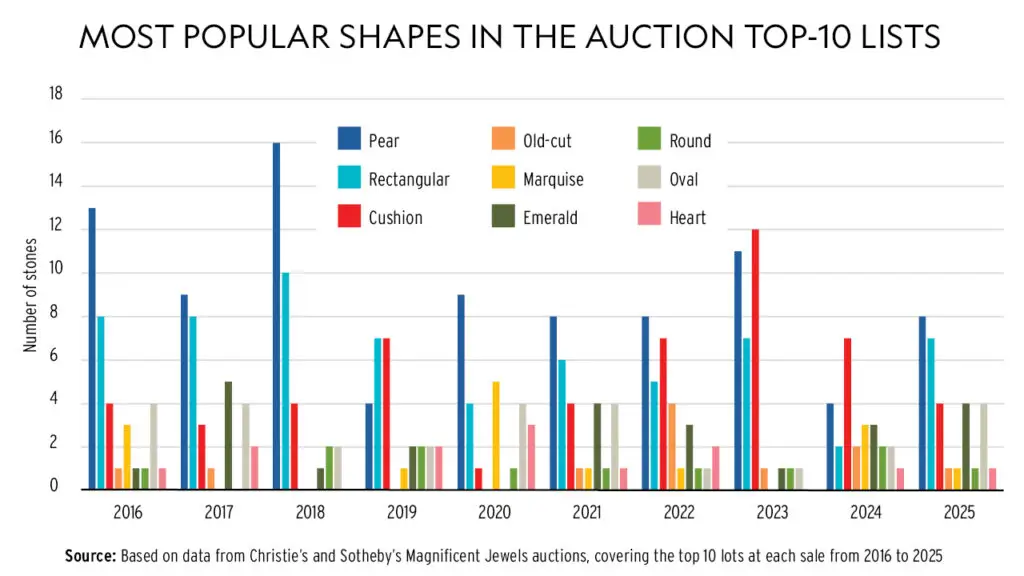
Pears have consistently been the top shape for colored diamonds in the top 10 due to the shape’s strong ability to hold color, as well as its versatility for different styles of jewelry, Safit says. Still, the number of pear-shaped diamonds making that list has waned, going from 13 in 2016 and 16 in 2018, to four and eight in 2024 and 2025 respectively.
Meanwhile, other shapes have come out stronger in the last couple of years than they were a decade ago. While old cuts rarely hit the block between 2016 and 2020, nine of them have graced the top 10 since then. And marquises, which were popular several years back, have seen a revival of sorts in the past half-decade.
“I don’t know what’s driving that at all, and that’s something we actually have been discussing internally — this sort of renaissance of marquises,” says Bruning. “They are absolutely more popular.”
So we know where the high-value colored-diamond auction market has been and where it is now, but where is it headed?
“Auctions have a life of their own, and a dynamic of their own,” says Safit. “It’s influenced by so many aspects. That makes it interesting and intriguing on one hand, but on the other hand, it’s impossible to say what will be. It’s not something that can be calculated in a laboratory.”
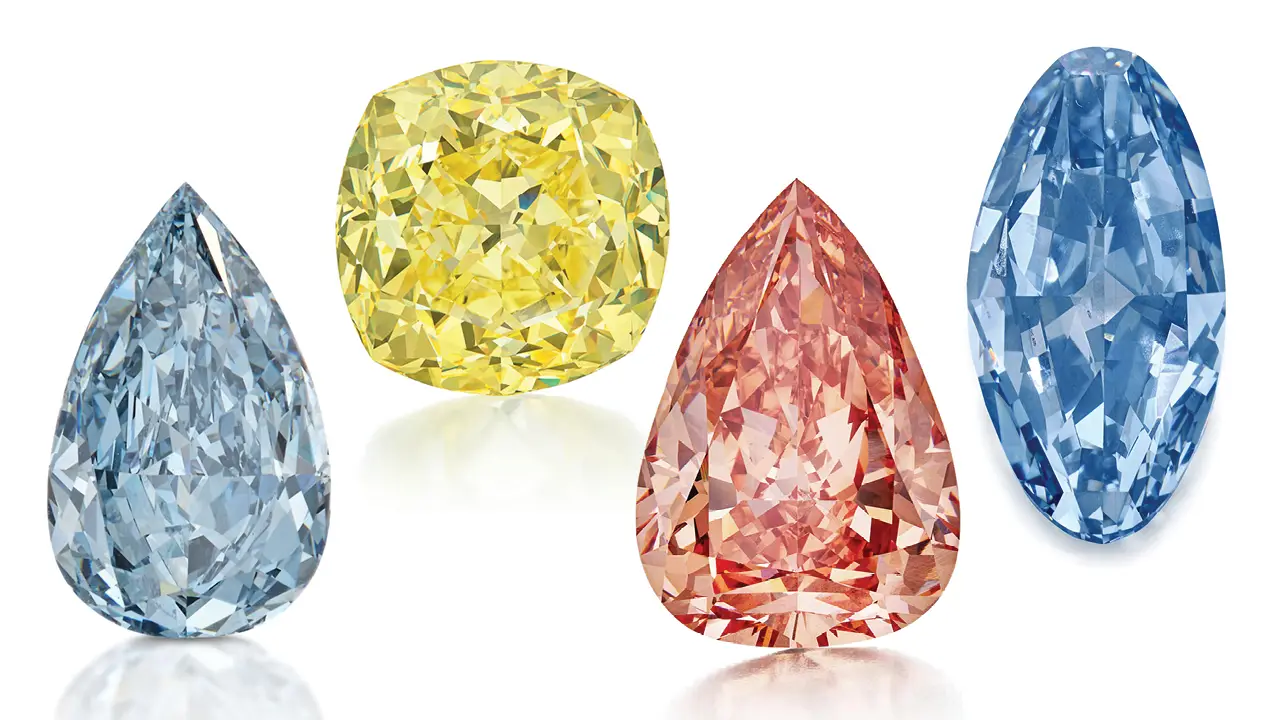
Main image: Some of the large colored diamonds that have brought in multimillion-dollar prices at auction in recent years. (Sotheby’s)