


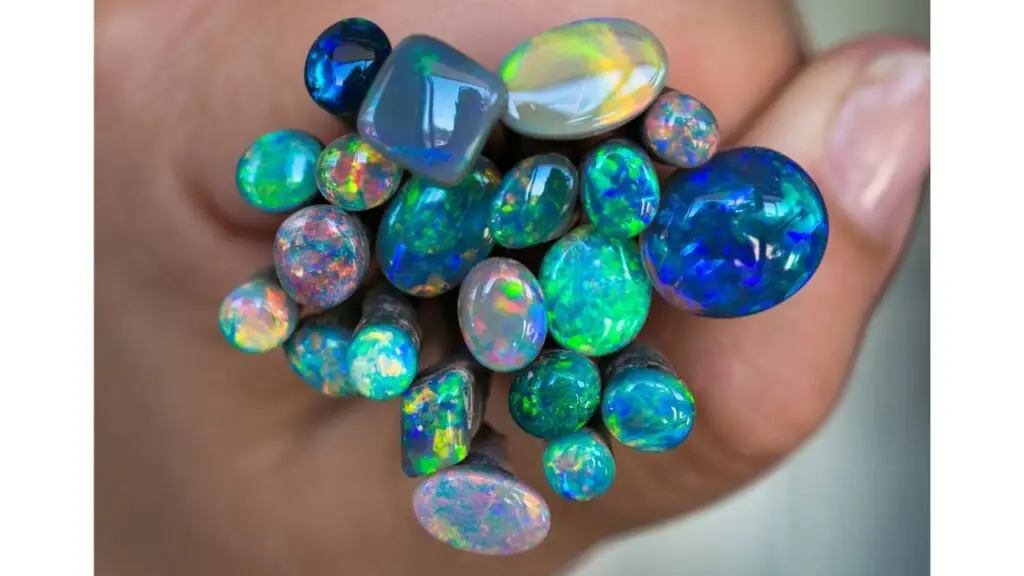
Opals have captivated humanity for millennia. For the Romans, they symbolized love and hope. Bedouin tribes believed they fell to the ground in thunderstorms, with lightning trapped inside. In Australia, which produces over 90% of the global supply, opals are deeply intertwined with its First Nations people’s spiritual traditions.
Australia’s distinctive geology created its rich opal deposits, which form when silicon dioxide and water seep into crevices in the earth and crystallize over millennia. Different kinds of opals are found in different regions: rare black opals at Lightning Ridge in New South Wales (NSW), white opals in South Australia’s Coober Pedy, and boulder opals in Queensland. Global demand for the stones has jumped in recent years, with the opal-jewelry market set to grow from last year’s $3.5 billion to $5.3 billion by 2032, according to market research company Wise Guy Reports.
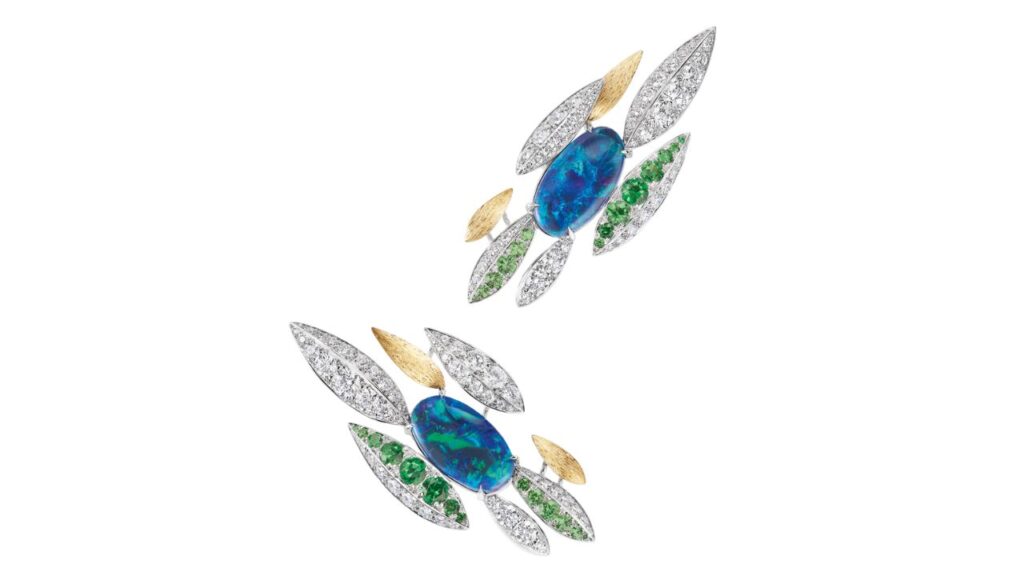
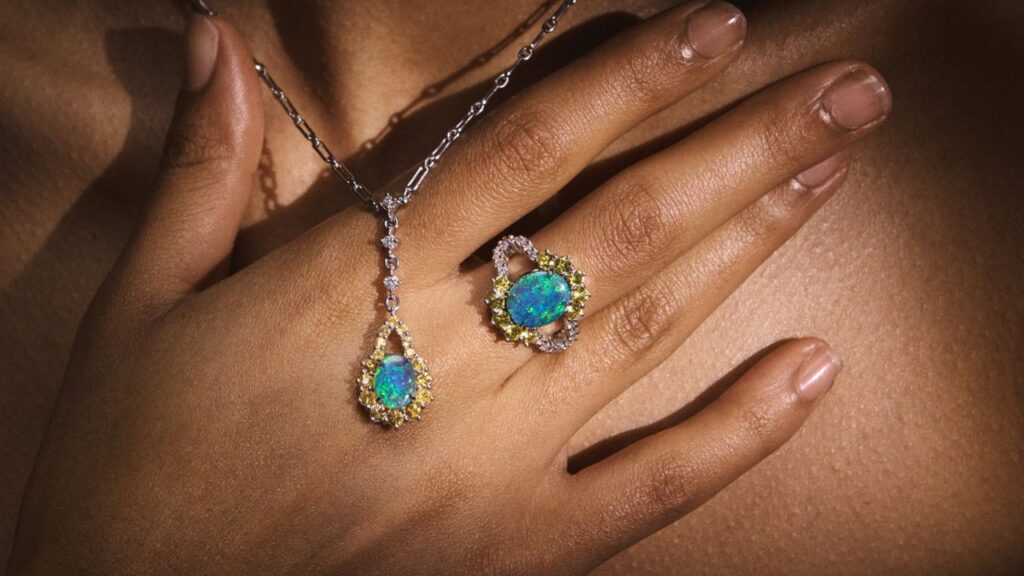
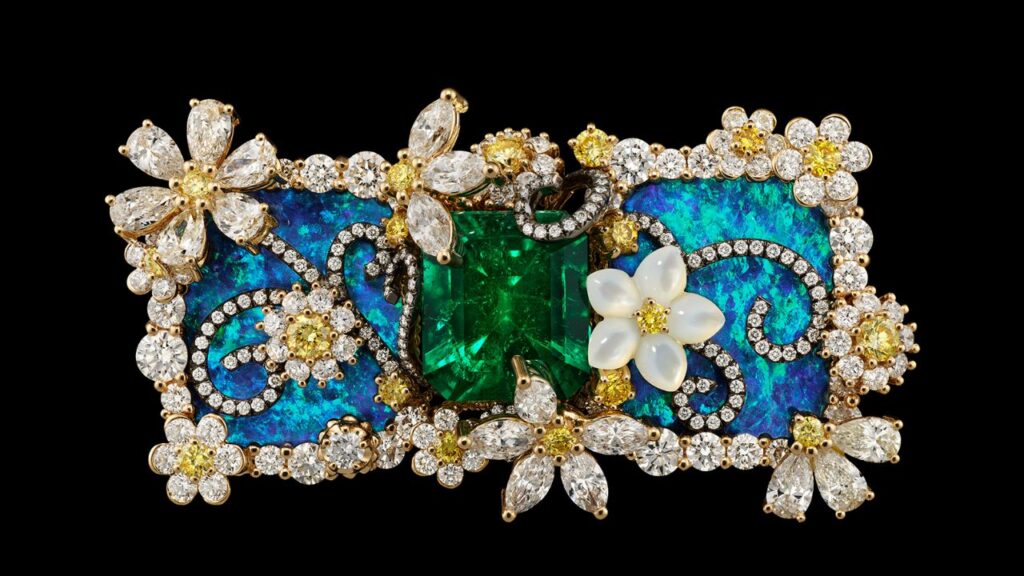
Leading jewelry houses and designers have featured the gemstones in their collections. Dior Joaillerie creative director Victoire de Castellane chose opals for the maison’s Diorexquis haute couture line this year, pairing them with diamonds to create “enchanting landscapes.” Chaumet also used the stones to great effect in its 2025 Bamboo collection, combining diamonds, tsavorite garnets and Australian black opals in a paean to “enduring nature.” Meanwhile, Tiffany & Co. dressed actress Anya Taylor Joy in a magnificent diamond necklace with 64 carats of opals at this year’s Golden Globes.
“Opal is an interesting material in jewelry because it embodies a living stone,” remarks a Chaumet spokesperson. “Depending on how you look at it, you will never see it in the same way, and its flashes suggest a thousand and one ideas and call for reverie.”

Artisanal nature
Opals’ global popularity is a relatively recent phenomenon. The industry has transformed dramatically in the last 20 years, according to Ruth Benjamin-Thomas, president of the Australian Opal Association and CEO of dealer Black Opal Direct.
“For consumers, opal was always very difficult to access [due to Australia’s location]; they saw a very limited range,” she explains. “But with the advent of the internet, and the professionalism of companies like ours and many of the Opal Association members, we’ve been able to bring that opal to consumers. People are now comfortable buying from overseas.”
She also points to the influence of social media. “It has made opals enormously popular. Consumers are much more educated now.” Black Opal Direct’s YouTube channel has almost 300,000 subscribers, and popular TV shows like Outback Opal Hunters have also helped spread the word.
It’s been a positive step forward for the Australian opal industry, which consists almost entirely of self-employed miners and small, often family businesses that lease 50-square-meter patches of land for digging in the country’s most remote Outback locations. The work is hands-on, dirty and dangerous, and finding a seam of opal is far from certain; some miners can go years without finding anything.
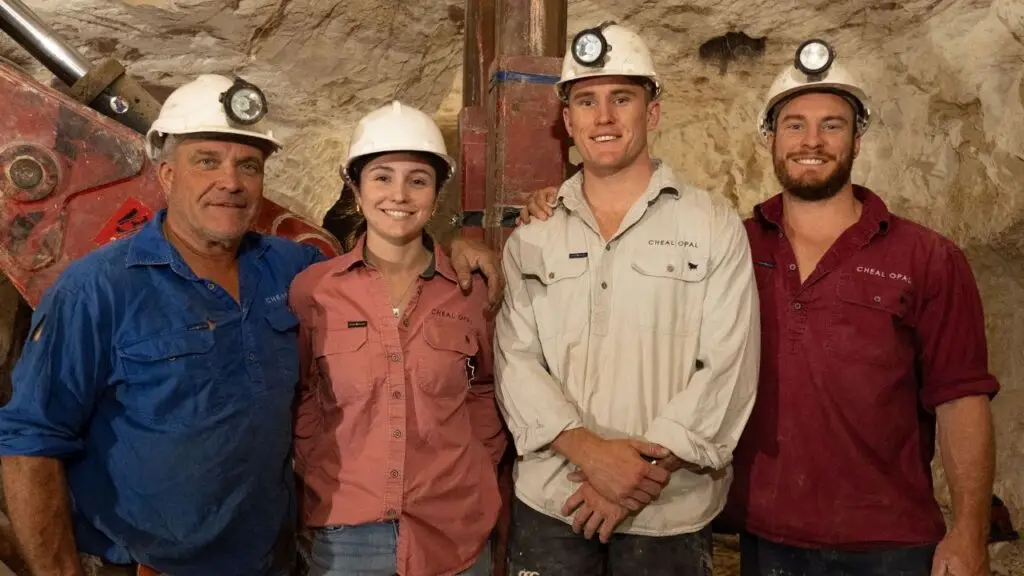
“It’s a pretty harsh landscape out there,” says Oscar Cheal, managing director of Cheal Opal. His father, Chris, who started the family business, mines rare black opals in Lightning Ridge.
“There’s extreme heat over summer, which is something we struggle with,” relates the younger Cheal. “It’s a hard way of life. It’s an emotional roller coaster, and there’s no guarantee [of locating opals or making money].”
But the rush of finally unearthing the gems is what keeps many miners like the Cheals going. “The feeling when you actually find a pocket — it’s like nothing you’ll ever get anywhere else,” he says.
The artisanal nature of Australian opal mining defines the industry and is one of its major selling points, as jewelry customers around the world increasingly demand transparency, traceability and ethical practices from gemstone mining.
“Because there are very few places in the world where you can find Australian opal, often you can know exactly where it came from,” explains Cheal. “And you can know for sure it’s ethically mined.”
The sustainability question
However, despite the stone’s burgeoning popularity, the future of the Australian industry hangs in the balance. There are ongoing tensions among miners, landowners and the government, as well as debates around the sustainability and environmental impact of opal mining.
In 2024, a government-commissioned independent review by retired judge Terry Sheahan examined the laws and regulations governing small-scale opal-mining titles in NSW. It also covered issues such as land access and landholder compensation.
“The cumulative and unremediated environmental damage caused by the mining of opals over the last 130 years — what one submission described as the ‘debris of a bygone era,’ comprising mounds of salty dirt, and much rusting equipment — simply has to be addressed, as does the poisonous and aggressive climate that now surrounds dealings between landholders and miners,” Sheahan wrote in the introduction.
Benjamin-Thomas acknowledges that “in the past, things were perhaps not done in an ideal way.” However, miners now do rehabilitation work to return the land to how it was before they started digging, she says, adding that the industry’s small-scale nature means the impact is limited.
“We’re not digging massive pits. We’re not contaminating water,” she argues.
“Our goal, when we leave, is for you not even to be able to know we were there,” affirms Cheal. “The environment has given us this beautiful gemstone. It’s a privilege to be able to dig it [up], and we want to pay that respect back by leaving the land in the best condition we can.”
Benjamin-Thomas also addresses the “poisonous” relationship Sheahan described between landowners and miners, who have competing uses for the land. “Yes, there is tension, there is a rub,” she agrees. But the report, she maintains, doesn’t paint a full picture of the area’s complexities; in the Outback, landowners, miners and conservationists can often be one and the same.
Land scarcity
The lack of available new land for prospecting is another concern for the opal-mining community.
“The main challenge for people dealing with governments and different stakeholders is opening up more [of the] country for exploration,” says Maxine O’Brien, coordinator of the Australian Opal Exhibition trade show and former secretary/manager of the Lightning Ridge Miners’ Association. “That becomes more crucial as opals become more popular.”
Much of the existing opal-mining country is “almost exhausted,” says Cheal. “We’re essentially running out of opal in those spots.”
The industry is already seeing shortages, according to Benjamin-Thomas: “There’s a small jewelry brand that’s desperate for 100 to 200 pieces in a certain size and quality, and they can’t find anybody to fill the order.”
Over in Queensland, an 870,000-acre cattle station that’s home to many opal claims has been sold to the government, which plans to turn it into a national park for endangered species. Local miners have expressed concern about what this may mean for the future of their businesses.
“We will work to ensure an ecologically sustainable coexistence between the existing opal-mining operations and conservation of the important natural and cultural values on the property,” said Queensland Environment Minister Leanne Linard following the announcement last year. “We will allow small-scale opal-mining interests to continue their operations on suitable areas.”
In NSW, the 81 recommendations that Sheahan gave in the 2024 report are currently under review by a working group that includes opal miners, landholders, First Nations representatives and other stakeholders.
“The government’s priority is to ensure that miners, landholders and community members on the ground are given a full opportunity to inform the government’s response,” Courtney Houssos, the state’s minister for natural resources, said at the end of last year.
Miners are concerned, however, that further rules and restrictions will hamper the industry’s ability to keep up the supply of opals that the international trade demands.
“We’re not blind to the fact that there are competing priorities in government,” says Benjamin-Thomas. “But regulation is couched in such legalistic terms that people have forgotten the actual people on the ground. The industry is full of doers; we’re not lawyers or policymakers. We’re people with a connection to the land and to this beautiful gemstone.”
Cheal also highlights the powerlessness some miners feel. “We want to cooperate as best as we can with the government and with the regulatory bodies. [But] a lot of miners feel frustrated with the lack of power they have when it comes to those regulations. A little bit of leniency or cooperation from the government and the regulatory bodies would go a long way with the miners who are just out there trying to have a go.”
The sector’s small-scale, self-employed nature also makes it difficult for the mining community to lobby effectively for its interests.
“We’re not a very organized industry,” says Benjamin-Thomas, “and that makes it challenging when we have to organize to get our point across.”
Carving out a legacy
Meanwhile, the global opal market is growing, and Cheal hopes this will encourage more young people to join an industry where the average age is reportedly 63.
“If [opal] does continue to have that appreciation around the world and that growing demand, I think it’ll attract more miners to pursue it,” he says.
Benjamin-Thomas highlights the work she’s been doing with the World Jewellery Confederation (CIBJO) on a “comprehensive opal guide of all regions in the world,” which will classify these gems and help formalize a fragmented global industry. She hopes it will be ready to launch in 2026.
There are already many positives to Australian opal mining. Few gemstones are as ethical or traceable — two growing concerns for jewelry customers worldwide. Ultimately it’s a case of balancing competing interests in the land that produces them — and finding a way for the government, landowners, conservationists and miners to work together so everyone wins.
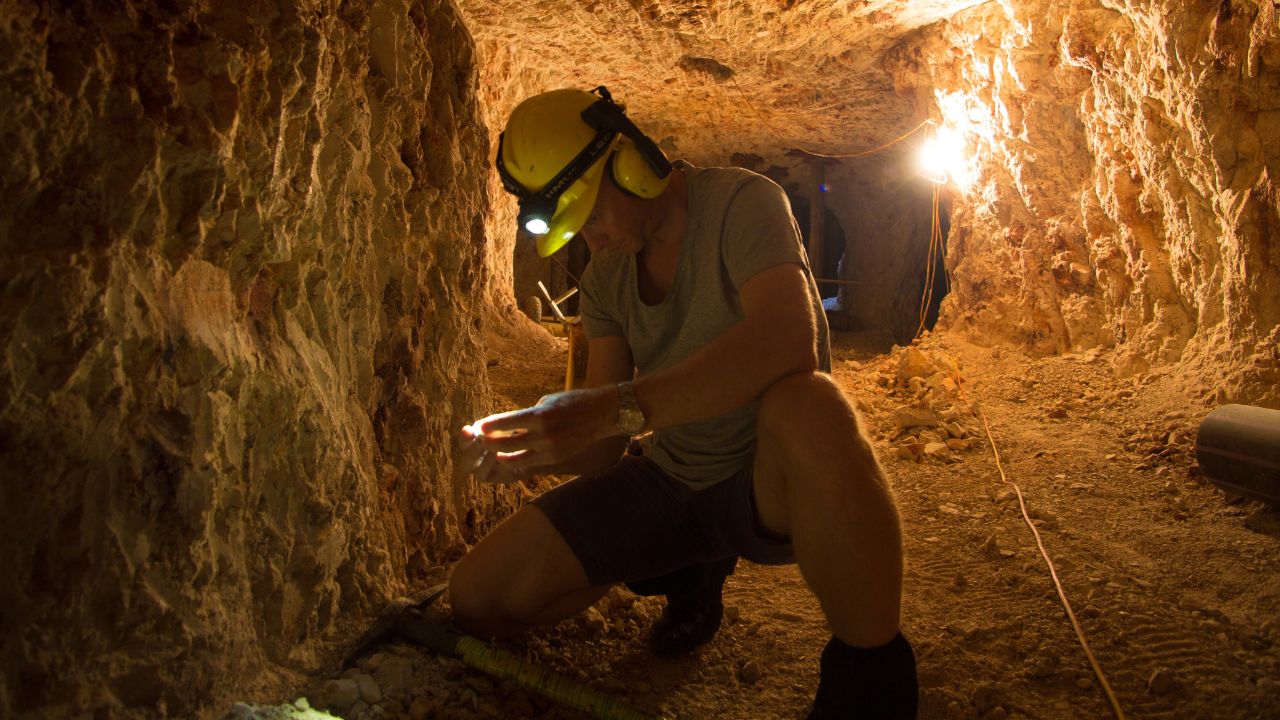
Main image: Black Opal Direct miners find opal in an Australian mine. (Black Opal Direct)