


When Bonnie Harris Frey installed a 12- by 12-foot digital highway billboard at the site of her new Harris Jeweler store, city and county officials showed up to watch. As the only sign of its kind in Troy, Ohio (population 27,000), it was that big of a deal.
That sign, combined with the exterior design of her building — a former Ruby Tuesday restaurant — is designed to boost her store’s profile in the most organic way possible.
“Exiting the freeway, the first thing drivers see is a beautiful building with diamonds all over it,” Harris Frey says. “People really can’t miss us. If they don’t know there’s a jewelry store here, they must be blind.”
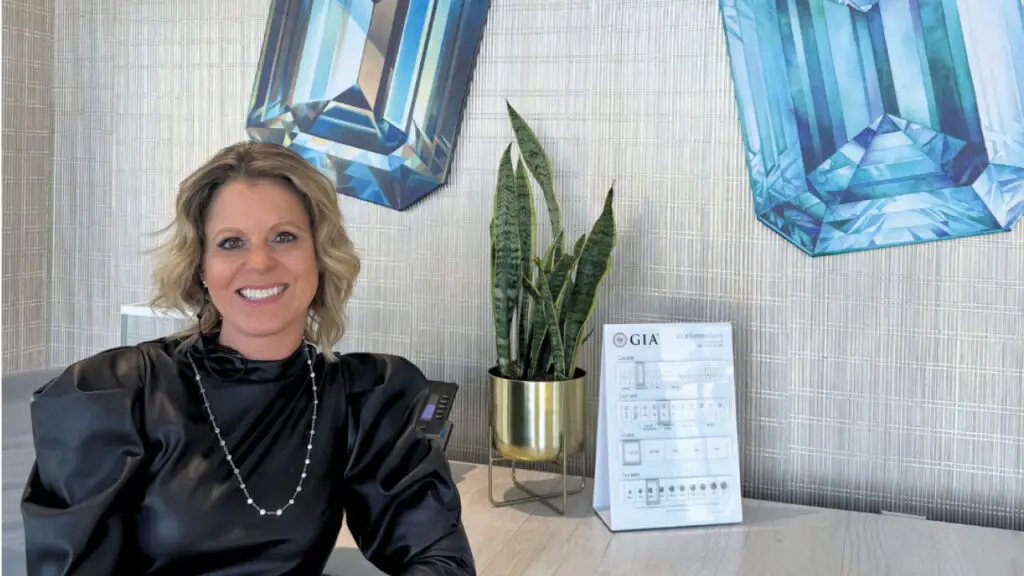
Reversing the customer flow
Like the sign, the 6,600-square-foot store she built is unique for Troy.
Her grandfather, Harold M. Harris, founded Harris Jeweler in 1946 in Sidney, Ohio, and soon became a member of the American Gem Society (AGS). His son, Mark, took over the business in 1976 and later relocated to nearby Troy, which is 19 miles north of Dayton.
In smaller communities like this one, a single main retailer often evolves to meet all the community’s jewelry needs, says Jesse Balaity, owner of Balaity Property Enhancement, who spearheaded the new store’s design. But while customers love these stores for familiarity, service and value, they may save larger splurges for big-city boutiques or vacation destinations.
By adding a dose of luxury and glamour to its design, Harris Jeweler clarified that it was a destination in itself. “Now, instead of losing customers to nearby Dayton, she’s drawing them from Dayton and beyond,” Balaity says.
Harris Frey concurs. “In Troy, Ohio, you can’t walk into another retail space like this. We definitely don’t fit in.”
Her previous store was just down the street, but far less visible. “It was an attractive, beloved space, but certainly not an expression of her vibrant personality and style,” Balaity says. “No one could levy that criticism of the new store. Bonnie was very open to bold design ideas.”
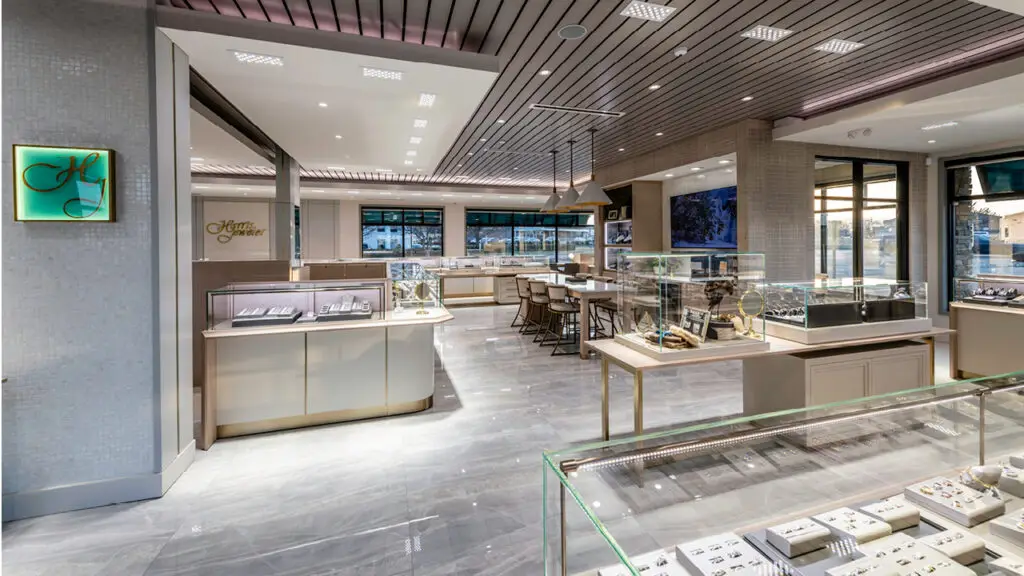
Harris Frey describes the aesthetic as a balance of luxury and approachability. The design team installed custom showcases, brilliant lighting, and pops of the brand’s signature teal throughout the store. The light tone-on-tone palette and walls of windows make the space feel bright even on gloomy winter days.
“Most important, we created a new store that is still all things for all jewelry customers,” Balaity says. “There are so many functional aspects to this space — custom studio, private and open consult areas, bridal gallery, dedicated silver jewelry, bar and community table, open views to the workshop, and a massive service area — but they all unfold seamlessly as customers explore the store.”
The bridal transformation
When Harris Frey saw the opportunity to build her business into the largest bridal store in her market, she brought in designer bridal brands Tacori and Verragio and watched sales for the category jump by 35%. Other top brands in the store include A. Jaffe, Hearts On Fire, John Hardy, and Le Vian.
“It’s the difference between selling more generic-type bridal and focusing on branded bridal presentations,” she says, explaining that “we went from having all of our bridal displays by type — halo, straight line, three-stone, etc. — to being displayed by brand.”
The store also introduced stand-up rather than seated shopping for bridal customers because it made the area less congested and allowed sales associates to assist more shoppers simultaneously.
“We have an amazing custom design department,” Harris Frey says. “Full-blown custom is about 15%, but making minor modifications, customized bridal, is common. We have a ring builder on our site now. It’s like a funnel for leads. People design their rings on our website and set an appointment to come in. They may just want to change one little thing. Usually they design a ring I probably have in stock.”
Meanwhile, Harris Jeweler is gaining a high profile online as well. A TikTok effort known as the “Boyfriend Test” drew 3.4 million views, and the business — which has also positioned itself as the premier estate-jewelry store in the area — has earned 1,600 five-star Google reviews.
Room at the table
Beyond product offerings and merchandising strategies, Harris Frey has reimagined how customers experience the store itself. At the heart of this transformation is an element she initially worried might be a mistake: the community table.
“The most important thing we can do is to make every guest feel welcome,” she says. “We all hear stories of people who have felt ‘turned away’ at a jewelry store because of how they look, who they love, etc. Every person who comes through our door should feel welcome, should be treated like royalty.”
For Harris Frey, many guests “are longtime friends or have become friends. The community table gives us a place to reconnect, catch up and visit a bit before moving on to the sale. The space also functions as the perfect place for refreshments during events and for husbands to sneak a peek at a game playing on the TV while their wives shop.”
The table itself is counter-height, making it easy for sales staff to present jewelry to seated guests. Multiple clients often sit with jewelry in front of them, chatting with strangers and encouraging each other to purchase. Along with a “create your own” ring display, the table has dedicated storage and power for permanent jewelry — pieces that customers can get welded on. This lets the store host jewelry parties rather than treating permanent jewelry as an afterthought.
What Harris Frey once feared would become wasted square footage has instead become a gathering place that embodies everything she wanted the new store to be: luxurious yet approachable, efficient yet intimate, and above all, welcoming.
Main image: Harris Jeweler exterior. (Harris Jeweler)

What Does Love Look Like? Not Out-of-Touch Lab-Grown Messaging
The natural-diamond industry won’t attract couples by telling them synthetics devalue their relationship.

Bridal Shopping in the Age of AI
Couples are researching online, but they still want to make the ring purchase personal – and that creates opportunities.
Six Brands Serving Fresh Engagement-Ring Designs
Whether it’s hand-sculpted organic gold or reimagined divorce jewels, these designers are setting trends that resonate with bridal shoppers.