
On the surface, this week’s De Beers sight has been uneventful. The miner kept prices and flexibility rules the same as at the last sale. Demand remained split, with large rough selling and small goods out of favor — a dynamic in line with recent months’ trading sessions. Many of the Indian customers turned out only later in the week because of the Jain festival of Paryushana.
But beneath the façade is a brewing crisis for the rough market and the wider diamond industry, even with retail sales remaining steady. Some might say the crisis has already arrived.
The US tariffs have sapped sentiment in the diamond trade and caused deep uncertainty throughout the supply chain. This was evident at the August sight, which began on Monday in Gaborone, Botswana. On Wednesday, the middle day of the sight, duties on Indian goods rose from 25% to 50%.
Added to this is nervousness about the amount of rough on the market following De Beers’ “stock rebalancing,” sales of large volumes from Russia and Angola, and the imminent release of more Botswana goods as the African country tackles an economic crisis. Meanwhile, the longest-running obstacle — lab-grown diamonds — has far from gone away.
“The mood on the sight floor is dead,” a sightholder told Rapaport News Tuesday on condition of anonymity. “There’s no real hunger or appetite for rough.”
De Beers declined to comment.
Large vs. small
Sightholders refused a lot of goods at the sight, mostly in sizes under 4-grainers (1 carat), and to some extent also in 4- to 6-grainers (1 to 1.50 carats), insiders said.
De Beers allows clients to defer their allocations only once per half-year. Since many did this at the July sight, which was the first trading session of 2025’s second half, their options were to buy the goods or refuse them. When sightholders do the latter, it has been known to count against them for future allocations.
In contrast, larger goods were in demand and in short supply. This has been the case for several months because of steady retail demand and lower production.
There are several reasons for this bifurcation. The main one is that De Beers prices for smalls are heavily misaligned with market rates. Prices on the rough market have fallen sharply this year, whereas De Beers has not significantly adjusted its list prices since December 2024. This has left the miner’s small goods some 20% more expensive than those at other auctions and tenders.
Tender prices for melee-sized rough in the “+11” (about 0.10-carat) category and smaller have fallen by around 10% since mid-July, according to rough-pricing tool eValuer. In the 3- and 4-grainer range (0.75 to 1 carat), spotted and clivage goods — relatively low-quality diamonds that tend to produce polished with an average clarity of SI to I1 — fell 5% in the same period. Meanwhile, prices for larger rough have held up better across the board.
Lab-grown and tariffs
Synthetics are another factor that’s had a greater impact on small, lower-quality polished diamonds than on big ones, since consumers can get a larger lab-grown stone with higher color and clarity than natural for the same price or less. In addition, fashion jewelry — an important destination for small stones — has increasingly shifted to lab-grown, especially at the major US retailers. The RapNet Diamond Index (RAPI™) for 0.50-carat natural diamonds fell 5.2% between January 1 and August 1 this year.
The tariffs have also had an outsized effect on the outlook for small goods, sightholders said at the sale. Activity has declined at Mumbai’s Santacruz Electronic Export Processing Zone (SEEPZ) — a special economic zone with many jewelry manufacturers — because America is its most important export market. That decline has further damaged demand for small natural diamonds destined for export as jewelry. The hub was already shifting increasingly toward lab-grown, reflecting demand from the US majors.
Beyond that, the solutions that India manufacturers have found for shipping goods to the US tend to work better with larger, higher-value stones. One option is to send loose diamonds to Mexico, set them locally into jewelry, and then ship the goods on to the US, according to industry members. If the jewelry casting happens in Mexico, the products are duty-free on entry to America under the United States-Mexico-Canada Agreement (USMCA), as the August issue of the Rapaport Research Report explained. (There are various ways that manufacturers are rumored to be getting around the tariffs, and it’s unclear which ones fall within the bounds of legality.) The scale of operations necessary for setting so many small stones in jewelry makes the Mexico shipping tactic impractical for that size category, a sightholder pointed out.
Meanwhile, small-diamond manufacturers have been reducing production or shifting to larger goods to improve their cash flow. This is different from past crises, when factories focused on smalls to keep workers busy with cheap rough.
Flood of goods
To compound the situation, dealers have observed miners taking a less cautious approach to rough sales than in past downturns.
While the large miners maintained price levels in 2023 and 2024 to avoid flooding the market, De Beers has reportedly made bulk deals this year with sightholders for smaller goods at reduced prices despite the hit to its margins. This has prompted other miners — notably Angolan sellers and Russia’s Alrosa — to prioritize sales volume over price, market sources explained. It has also enabled manufacturers to reduce their own prices for polished without seriously damaging their margins.
At the root of this shift is an economic crisis in Botswana resulting partly from the multi-year crash in diamond demand.
On Monday, Botswana President Duma Boko declared a national health emergency and a shortage of medical supplies. Once a positive example of diamond mining’s benefits, the nation is now in serious need of cash. For this reason, it is seeking to offload the diamond inventories that the country has accumulated during the last two or three years of low sales.
The size of Botswana’s diamond stash is not public, but in December 2024 the Financial Times reported that De Beers — which mines mostly in the African country — held around $2 billion in inventory. In June of this year, De Beers CEO Al Cook told diamond analyst Avi Krawitz that the miner had reduced its stockpile by $100 million.
Boko has publicly criticized the way De Beers sells Botswana’s diamonds. There is a sentiment in the market that De Beers’ special-price deals resulted from government pressure to offload rough rather than maintain its usual price-over-volume strategy.
In a similar vein, Okavango Diamond Company (ODC), Botswana’s state-owned rough trader, wrote to selected members of the diamond industry earlier this month to gauge interest in buying large quantities of goods.
ODC is “in the process of acquiring additional run-of-mine rough diamonds,” according to that letter, which Rapaport News has seen. “The final quantities to be acquired will be influenced by our ability to secure commitments from selected customers who have demonstrated capacity and interest in bulk purchases.”
It’s offering those clients rough under 5 carats — the less-desirable sizes — in five separate lots of different value ranges, the letter said: $15 million to $30 million; $30 million to $50 million; $50 million to $75 million; $75 million to $100 million; and above $100 million.
It may take ODC two to three weeks to supply the goods, as it wants to “ensure a balanced market release,” the note said. However, the company will require payment “promptly upon allocation of the lots.” ODC was not immediately available for comment.
2026 decisions
A lot of change is happening in the diamond market and at De Beers. Parent company Anglo American is in the process of selling the miner, with Botswana itself emerging as a possible buyer of the 85% it doesn’t already own. De Beers is heavily downsizing, with several senior members of its sales team about to leave.
This upheaval comes as De Beers prepares to announce its 2026 sightholder list, which is likely to be considerably shorter than the current one. The company is expected to inform clients in September or October whether they are on the list. It’s a highly uncertain time to make such a call.
The impending decision has prompted some sightholders to make purchases at this week’s sight that they would not have made otherwise, sources said. Strategic buying is a common phenomenon in such situations. “Whatever has sold [in the smalls category] is because of the pending announcement,” stated a sightholder.
But at the same time, being a sightholder with access to De Beers rough is not the same privilege it once was. De Beers can no longer rely on its customers making purchases just to secure the following year’s allocations.
“This is quite a first for our industry, where [with] the level of rough available on the secondary market, no one cares about primary supply,” the dealer commented.
The diamond market’s predicament is multifaceted, especially in smalls — and a lot will need to change if it is to recover soon.
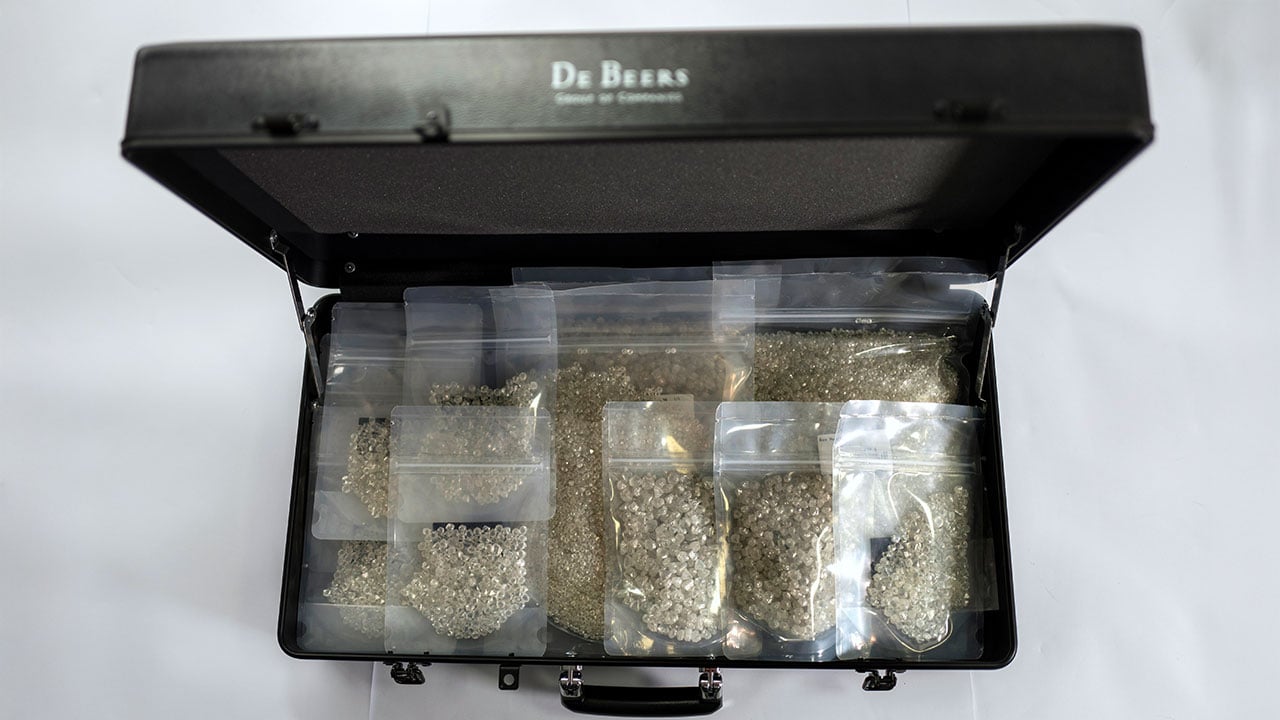
Image: Rough diamonds in a sight box. (De Beers)