

RAPAPORT… The Gemological Institute of America (GIA) has confirmed a
new mineral species discovered in Myanmar, which it has called johnkoivulaite.
The organization named the substance in honor of renowned
microscopist and GIA researcher John Koivula. The 40-year industry veteran has
co-authored several books on geology, diamonds and minerals, and has received a
number of industry awards, including the American Gem Society’s (AGS) Robert M.
Shipley Award, GIA’s Richard T. Liddicoat Award for Distinguished Achievement
and the Antonio C. Bonanno Award for Excellence in Gemology.
“We are privileged to be able to name this mineral after John
Koivula, who has contributed so much to science and the gem and jewelry
industry as a prominent gemologist and innovator in photomicrography,” Tom
Moses, GIA executive vice president and chief laboratory and research officer,
said Tuesday. “Discoveries such as this remind us of the importance of our
mission-based research and of the numerous important contributions John has
made in his more than four decades of scientific work.”
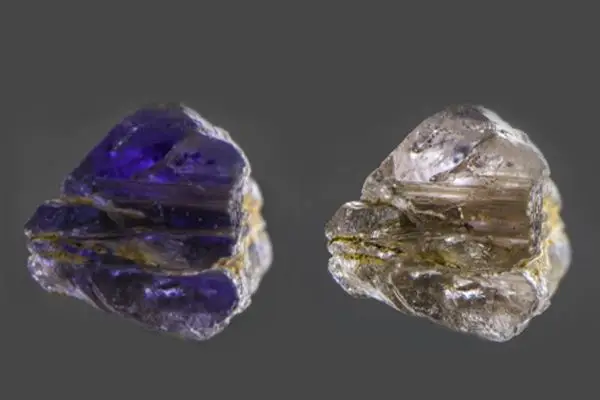
Johnkoivulaite, discovered by local Burmese gemologist Nay
Myo in the Mogok Valley, has a hexagonal crystal structure that is similar to
beryl and other members of the beryl group, such as pezzottaite. The mineral
exhibits strong pleochroism — an optical phenomenon in which a substance
has different colors when observed at different angles, especially with
polarized light. The sample found in Myanmar changes from violet to nearly colorless,
explained the GIA, whose researchers worked with scientists from the
California Institute of Technology to confirm the substance was a new mineral.
The specimen of the new mineral, which measures 1.16 carats,
will be on display in the GIA museum collection in Carlsbad, California.
Image: The johnkoivulaite in violet and colorless (top); John Koivula (right). (Gemological Institute of America/Kevin Schumacher)
Richemont and Signet Consider Participating in Bid for De Beers
Retailers are in discussions with GDC to join the group.
TAGS Tender Generates $27.1M in Revenue
94% of lots find buyers, including many special-sized and fancy-colored stones.
Sapphire and Diamond Necklace to Star in Sotheby’s Italy Auction
Piece has high estimate of $333,500 at Fine Jewelry and Watches sale in Milan.