

RAPAPORT… The Gemological Institute of America (GIA) has uncovered three synthetic moissanites with forged inscriptions that fraudsters had used to misrepresent them as natural diamonds.
The cases at the Johannesburg laboratory marked the first times the GIA had discovered fake girdle inscriptions on diamond simulants, it said in a recent article in its academic journal, Gems & Gemology.
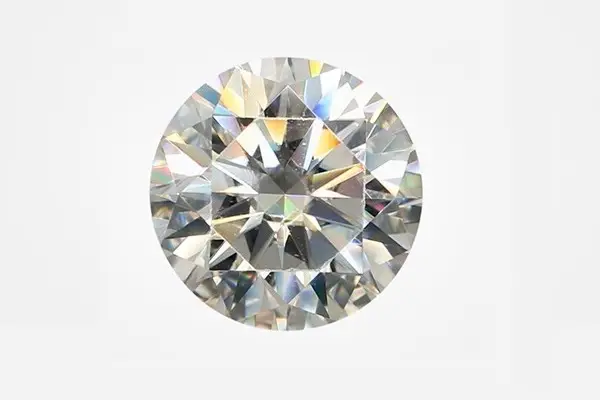
The lab initially received a round brilliant, 1.02-carat stone for a diamond-grading report. The report number on the girdle was for an E-color natural diamond with the same weight that was graded in 2019, but the dimensions were different because moissanite has lower specific gravity, meaning that it weighs less relative to its volume.
Standard testing showed the stone was not a diamond, while subsequent spectroscopic and gemological analysis proved it was synthetic moissanite, GIA researchers wrote in the fall 2020 edition of Gems & Gemology, which it released last week.
“The possibility exists that a consumer could purchase this simulant thinking it was a natural diamond, especially with a deliberately misleading inscription,” wrote Sicebiso Hlatshwayo, a supervisor of diamond grading at the GIA in Johannesburg, and Sally Eaton-Magaña, senior manager of diamond identification at the GIA in Carlsbad, California.
Since writing the article about the first stone, the same lab in South Africa received and identified two more synthetic moissanites with fraudulent inscriptions, the GIA added in a note.
In addition to the size discrepancy, the first stone’s clarity was equivalent to VVS2 (the GIA doesn’t usually give moissanite a grade of this type), whereas the diamond it was impersonating was VVS1. The inscription’s font was also distinctly different from the GIA’s standard one. The GIA obscured the fraudulent inscription, in line with its usual practice.
People sometimes mistake synthetic moissanite for diamond because some of their properties are similar, such as their hardness and thermal conductivity, the gemologists explained. The latter feature is often a method of distinguishing diamonds from simulants, but it can fail if the stone is moissanite.
However, the stone showed “double refraction” — a feature of moissanite, absent in diamonds, that gives it more brilliance.
Another key difference between the materials is dispersion, the GIA pointed out. Moissanite has higher dispersion, meaning light that enters the stone is refracted more. The eye, therefore, sees a more distinct range of colors, giving it more “fire” than diamonds.
Image: The 1.02-carat synthetic moissanite. (Innocentia Nzuza/GIA)

Richemont and Signet Consider Participating in Bid for De Beers
Retailers are in discussions with GDC to join the group.
TAGS Tender Generates $27.1M in Revenue
94% of lots find buyers, including many special-sized and fancy-colored stones.
Sapphire and Diamond Necklace to Star in Sotheby’s Italy Auction
Piece has high estimate of $333,500 at Fine Jewelry and Watches sale in Milan.