
The diamond industry has a nervous wait after Monday’s news of a US-India trade pact.
First things first: There’s no formal announcement yet. At press time, there had been no official White House statement, executive order, or notice in the Federal Register or from US Customs and Border Protection.
US President Donald Trump merely declared on the Truth Social platform that he and Indian Prime Minister Narendra Modi had “agreed to a trade deal” that would lower America’s reciprocal tariff on India from 25% to 18%. In return, the Asian country would stop buying Russian oil and remove its own duties and “barriers” against the US.
Trump didn’t explicitly address the additional 25% penalty tariff he had placed on India for purchasing Russian oil. A White House official confirmed that it would drop that levy under the deal, the BBC reported. This would mean the total US tariff on Indian goods will fall from 50% to 18% once the agreement is in effect. Modi also confirmed the news in a post on X.
Annex III
For loose diamonds, gemstones and natural pearls, the outcome could be 0% tariffs. All three products are on the White House’s Annex III, a list of categories for which the US has declared itself open to allowing duty-free imports for “aligned partners.” Being an “aligned partner” broadly correlates with having a trade agreement with the US, but it is not automatic. Finished jewelry is not on that list, so it would incur 18% tariffs once the deal is in place.
Therefore, achieving that tariff exemption for diamonds, gemstones and pearls — as the European Union did in September — still involves further hurdles, even once the trade agreement is final. “They will need to negotiate for it and will at least be eligible once the deal is negotiated and signed,” said Sara Yood, CEO and general counsel of the Jewelers Vigilance Committee (JVC), which guides the industry on legal matters.
Becoming an “aligned partner” involves US officials determining that India’s commitments under the deal satisfy the requirements for tariff relief, explained Liz Fraccaro, assistant counsel at the JVC. And there’s an additional step even then.
“Even if the US decides that India is an aligned partner, the trade deal must explicitly cover tariff adjustments for specific products, or the US must choose to apply the Annex III carve-outs to India for those products,” Fraccaro continued. “Just being on an ‘aligned partner’ list doesn’t, in and of itself, cut tariffs — it only enables the possibility of doing so under the administrative framework.”
India’s Gem & Jewellery Export Promotion Council is “optimistic that, based on India signing the trade deal, loose diamonds and colored gemstones from India will get the benefit of zero-duty imports in [the] US…providing much-needed support for diamond exports,” said Kirit Bhansali, chairman of the GJEPC, in a statement on Monday.
On Wednesday, an official in the Indian gem and jewelry industry told Rapaport News he understood that Annex III was “part of the agreement.”
However, “in the absence of a consistent, documented basis of agreement, there remains uncertainty as to whether any binding or implementable arrangement has actually been concluded,” added Supreme Kothari, a partner in the tax practice of Indian business law firm ELP.
Sentiment boost
The immediate reaction to Trump’s social media post was positive. Indian diamond manufacturers were pleased with the news and hopeful that the potential 18% rate would eventually become 0%.
“We are hoping that this 18% will drop even further, but the mood is fantastic,” said Richa Singh, managing director for India and the Middle East at the Natural Diamond Council (NDC), in an interview on Tuesday for a forthcoming episode of the Rapaport Diamond Podcast. “[We’re] waiting for the final signing. I think…the volatility we saw in pricing [should] also stabilize now with the tariff situation settling.”
However, it also means an awkward interim period has begun. Dealers and manufacturers in India expect imminent confirmation of lower duties and are holding off exporting anything to the US.
“We’ve stopped all our shipments, too,” said a New York-based dealer who imports loose from India.
There’s also a lot of issues in the industry that won’t change. While tariffs have been the biggest geopolitical theme of the past year, reducing direct imports to the US, the more established companies that want to get goods into America have found ways. Major Indian manufacturers tend to identify other more fundamental problems for their business, such as the difficulty of balancing supply and demand, and the lack of a recovery in Chinese retail demand.
The most-discussed tariff-era routes to the US market — shipping through Mexico or, for finished jewelry, carrying out the casting in America — will likely continue to be an option industry members use in the short term and possibly for longer if 18% tariffs become fixed.
So far, the India deal “doesn’t help the jewelry industry, as [duty] is still very high,” said a US-based jewelry manufacturer who has used some of the workarounds. “But the real boost will come [if] loose diamonds and gemstones duty goes down to zero.”
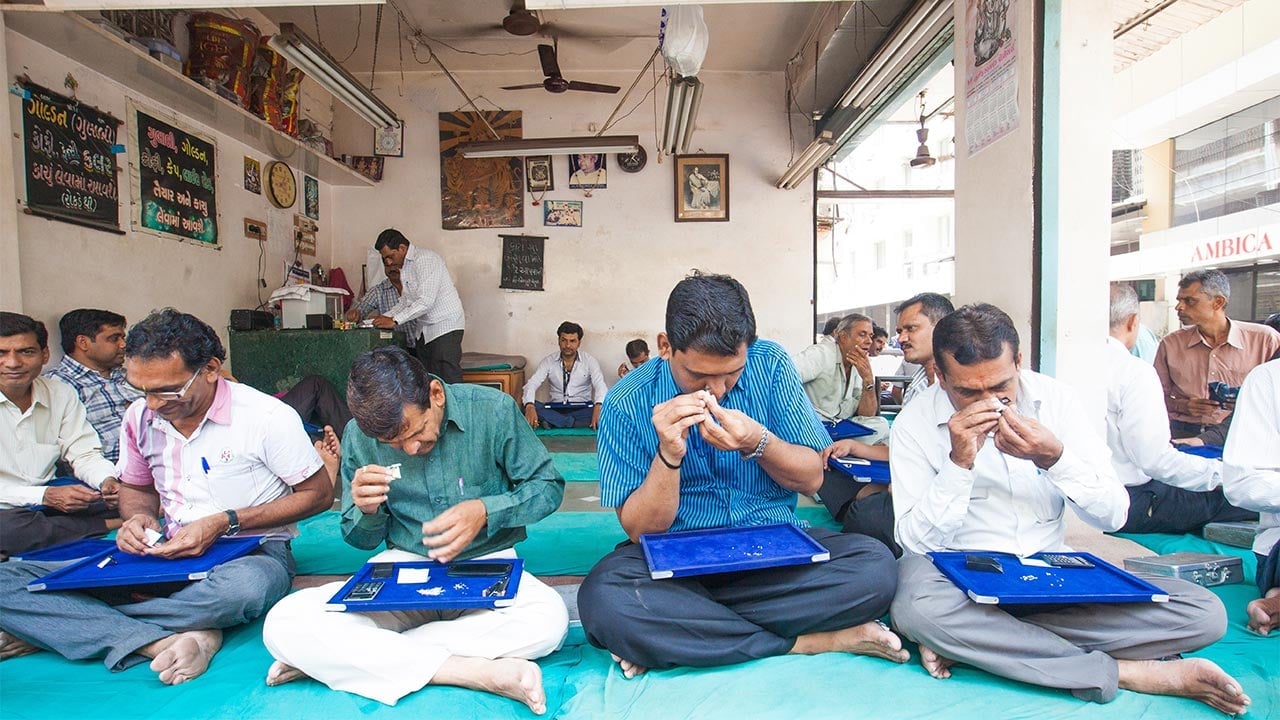
Image: Diamond merchants examine diamonds on the streets of Mahidharpura, Surat. (Shutterstock)