

De Beers has reduced prices of weaker rough goods at this week’s sight, sources estimated — but a key change to the miner’s policy has made it harder to calculate adjustments.
The company is no longer providing sightholders with price breakdowns by category, market participants told Rapaport News on Monday, the first day of the January sight.
The goal, dealers explained, is to make rough boxes less commoditized and reduce the impact on the diamond market resulting from discussion and speculation about its rough prices. However, it also makes pricing more opaque.
Previously, the miner would tell sightholders the value of each box in their rough allocations, allowing them to know whether the price had increased or decreased. Now, it’s giving “one-line” invoices — meaning customers find out the overall average price for their entire sight purchase but not for individual categories, the sources said. Russian miner Alrosa moved to this method several years ago.
“We have received a number of sightholder requests to implement this change,” a De Beers spokesperson said. “Given that the approach also supports the efficiency and simplicity of our internal processes, we have agreed to pilot the change in approach during sight 1.”
Sightholders told Rapaport News the new system gave them more flexibility to sell at the value they saw in the goods rather than at cost plus a fixed margin.
However, it’s now “harder to determine exact pricing, and much harder to trade boxes,” a manufacturing executive argued on condition of anonymity.
De Beers appeared to slash prices of 4- to 8-grainer (1- to 2-carat) rough considerably, but the new invoices made this difficult to assess, said sightholders, who relied on commentary that the company gave. Some sources also estimated price reductions in 2- to 4-carat goods. These categories had been slow in the past year because of weakness in the resultant polished under 1.20 carats. Demand at sights had been especially low because De Beers’ rough prices were some 20% to 30% above market levels, according to dealers.
Prices of 5-carat and larger rough appear to have increased, reflecting a stronger market in this range, sightholders said. It was unclear at press time whether prices of 3-grainer (0.75-carat) and down had changed. De Beers does not comment on prices on a sight-by-sight basis.
Meanwhile, De Beers reverted to its standard policy of allowing sightholders to sell up to 10% of their purchases by carat weight back to the miner for 11 boxes, according to a note that Rapaport News has seen. In recent months, it had increased that concession — known as buybacks — to 20% in less popular categories. For the January sight, it listed seven boxes for which it was still letting sightholders refuse purchases without it impacting their future allocations.
The miner also allowed sightholders to view example assortments — known as “to-see” boxes — for 28 categories to give them an idea of the goods available at upcoming sights.
De Beers shook up its sight boxes starting with this month’s trading session, with 8-grainer (2-carat) stones moving out of the 2- to 4-carat boxes and into a new size called 4- to 8-grainers, as Rapaport News reported last month.
The first sight of the year runs from Monday through Friday in Gaborone, Botswana. The company holds 10 sights a year.
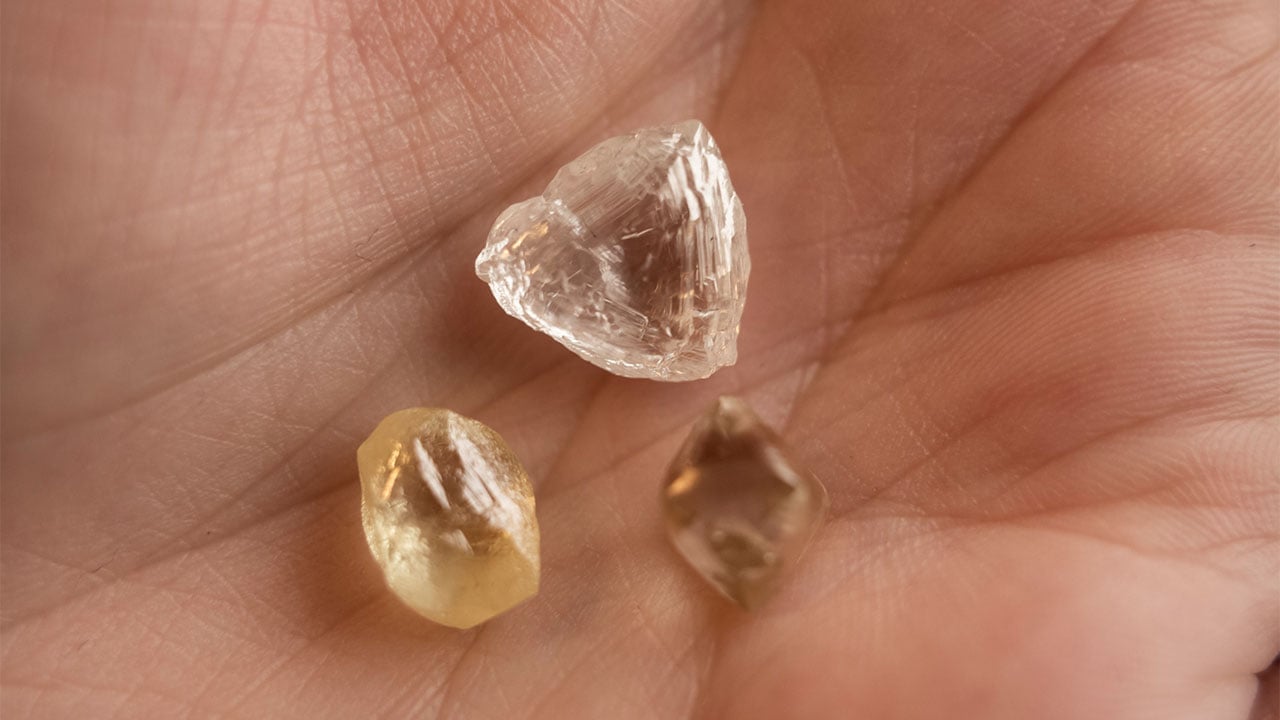
Image: Rough diamonds at De Beers’ offices in Calgary, Canada. (Ben Perry/Armoury Films/De Beers)