 WhatsApp
 Email
Email
 Facebook
 Twitter
 LinkedIn
Today, the average master bench jeweler is over 60 years old, with retirement on the horizon and almost no younger generation stepping in to carry on the tradition. Without a sustainable pipeline of skilled artisans, jewelry businesses’ ability to deliver quality craftsmanship and maintain operations is at risk.
Jewelers and precious-stone and -metal workers held about 35,100 jobs in 2024, according to the US Bureau of Labor Statistics, which predicts a 5% drop in that number by 2034. Yet the projected decline does not remove the need for new talent. The bureau still expects an average of 4,000 job openings each year in that decade, all of them tied to replacing the workers who transfer to other occupations or leave the labor force, including through retirement.
For retailers, manufacturers, designers and service providers, that creates a difficult equation: Demand for skilled workers persists, but fewer of them are entering or staying in the profession.
A critical position
Recent research by insurer Jewelers Mutual Group underscores that pressure, finding last year that more than 70% of jewelers were planning to hire bench workers and were struggling to find qualified candidates.
“We’re seeing a fundamental imbalance in the jewelry industry today,” says Jennifer Markas, Jewelers Mutual’s head of industry relations and impact fund. “Demand for skilled bench jewelers continues to grow, while the pipeline of new talent has not kept pace.”
The problem reaches beyond the bench itself. Bench jewelers sit at one of the most sensitive points in the jewelry value chain: fabrication, setting, finishing, repair and restoration. A shortage of experienced workers can affect production capacity, repair turnaround times, customer satisfaction, and businesses’ ability to support custom work.
Markas describes the issue as structural as well as operational: “Many highly skilled bench jewelers are approaching retirement, and the industry hasn’t had a sufficient system in place to replace that expertise at the scale required.”
Pathways and access barriers
For many years, jewelry training relied heavily on proximity: a family-owned and -operated business, a local mentor, an employer willing to train, or a trade-school pathway. But those routes are not always visible or accessible to younger people. Nor are employers always able to devote time to training when day-to-day business pressures are mounting.
Ryan Allen sees that gap at the entry point. “A lot of [younger people] are uncertain about what path they would like to take, and have a creative side to them that they haven’t really been able to explore,” says the founder of trade website Jewelers Connect and nonprofit online educational platform JC Academy, both serving jewelry professionals. “That’s why we think giving them access to an opportunity to learn and harness their true potential [can help them] potentially make a career in the jewelry industry or grow a business in it.”
The traditional transfer of skills has been harder to sustain since the pandemic, according to Allen. “I’ve noticed that it has become very challenging for established people to teach their skill set to the next generation. I’ve seen how internships have dropped tremendously over the last couple of years, especially post-Covid. People say they are getting too busy and don’t have time to teach what they know, and it has left voids for the future.”
JC Academy is working to lower some of those access barriers by bringing together bench jewelers, designers, watchmakers, casters, marketers, sales experts and business owners through video-based lessons and one-on-one sessions. The model is broad by design; the goal is not to push students toward one narrow role, says Allen, but to show them the range of careers available across the trade.
“There’s a place for retailers, for casting experts, [for computer-aided design (CAD) professionals], you name it,” he says. And because it’s online, someone “from a remote area like northern Idaho can get started with their educational journey right from the comfort of their home.”

Technology and the jeweler’s role
The next generation of jewelers must be prepared for an expanding role that blends artistry with technology.
“Technology does not replace craftsmanship; it expands what craftsmanship can achieve,” says Jay Song, chair of jewelry at the Savannah College of Art and Design (SCAD). “The future belongs to professionals who can bridge the bench and the screen while connecting meaningfully with the people who wear and cherish the jewelry they create.”
Markas sees the same need from the employer side. “It’s both technical and practical, and increasingly, it’s the combination of the two that matters most,” she says. “Where we see the biggest gap is in commercial readiness.” Beyond foundational skills such as fabrication, stone-setting, finishing and repair, she explains, employers need candidates who can step into a modern production environment “and contribute with confidence from day one.”
Building up the talent pipeline
That is one reason Jewelers Mutual made a $10 million, 10-year alliance with SCAD to support bench jeweler education. The initiative includes a bench education endowment, scholarships, academic programming, upgrades to technology and equipment, and stronger connections between students and employers through internships, apprenticeships, mentorship, and hiring pathways.
“At Jewelers Mutual, we believe that protecting and strengthening the industry goes beyond insurance,” Markas says. “It means investing in the people who sustain it.”
For SCAD, too, the goal of the investment is to strengthen the existing pipeline. The college reports a 99% employment rate for graduates overall, while 100% of its jewelry students – both graduate and undergrad – find employment within 10 months of completing their degree, according to Song.
While the SCAD jewelry program does not publicly share enrollment figures for media purposes, Song describes it as the largest STEM-designated degree-granting jewelry program in the US. “Our alumni work throughout the jewelry, luxury and fashion industries at companies such as Van Cleef & Arpels, LVMH, Tiffany & Co., David Yurman, Kendra Scott, Tapestry, Tory Burch, John Hardy, James Avery and Centric Brands, among many others.” Recent internships, she adds, have included Stuller, Amedeo, Mark Davis, Josefina Baillères High Jewelry, and other organizations in the jewelry, luxury, design, manufacturing and retail spaces.

Collective responsibility
For industry leaders, the lesson is that the trade cannot treat training as someone else’s responsibility. The success of the Jewelers Mutual endowment will be measured not only through scholarships, says Markas, but through enrollment and graduation outcomes, the number of students entering bench-focused careers, employer satisfaction, hiring success, and stronger student-to-business connections.
“This is not a challenge any one organization can solve alone,” she states. “The strongest talent pipelines are built through collective effort.”
That collective effort may require jewelry businesses to become more active participants in the educational component. Retailers and manufacturers can provide internships, apprenticeships, mentoring, access to sophisticated equipment, guest teaching, curriculum feedback, and entry-level opportunities that help students gain real-world experience before graduation.
Schools can continue integrating bench skills with CAD, client communication, entrepreneurship, and production knowledge. Online platforms can help expose young people to the trade earlier and make career exploration less dependent on geography or personal connections.
For an industry built on savoir-faire and continuity, the bench challenge is also an opportunity. Preserving craftsmanship will depend less on nostalgia and more on bold investment, accessible education, and intentional training models that make the profession visible, viable, and exciting for new talent.
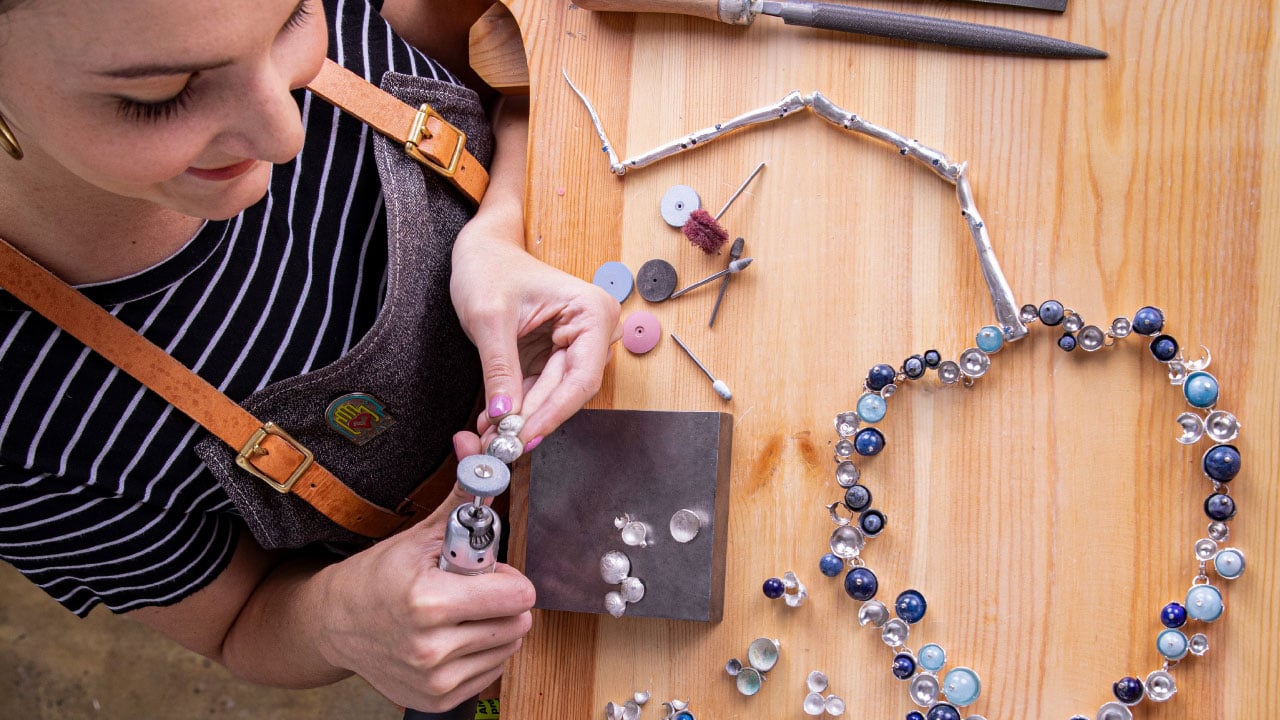
Main image: A SCAD student works on jewelry. (Savannah College of Art and Design)