 WhatsApp
 Email
Email
 Facebook
 Twitter
 LinkedIn

For most in the diamond trade, fluorescence is nothing but an unwanted nuisance that lowers the price of colorless to near-colorless diamonds. The stronger the fluorescence, the greater the discount on the stone — but fluorescence is actually an asset in many diamonds. Here are several little-known facts about this diamond trait.
1. If the fluorescence of a colorless to light-yellow (D- to Z-color) diamond is blue, then the diamond will appear less yellow than it actually is.
That’s because the blue fluorescence compensates for the light absorption that yields the yellowish color; their wavelengths cancel each other out. Medium-blue or stronger fluorescence noticeably influences the diamond’s observed color, an effect that can be significant in very strong blue-fluorescing diamonds. This makes the common practice of discounting fluorescent diamonds even more unfortunate, as strong to very strong blue-fluorescing diamonds are rare.
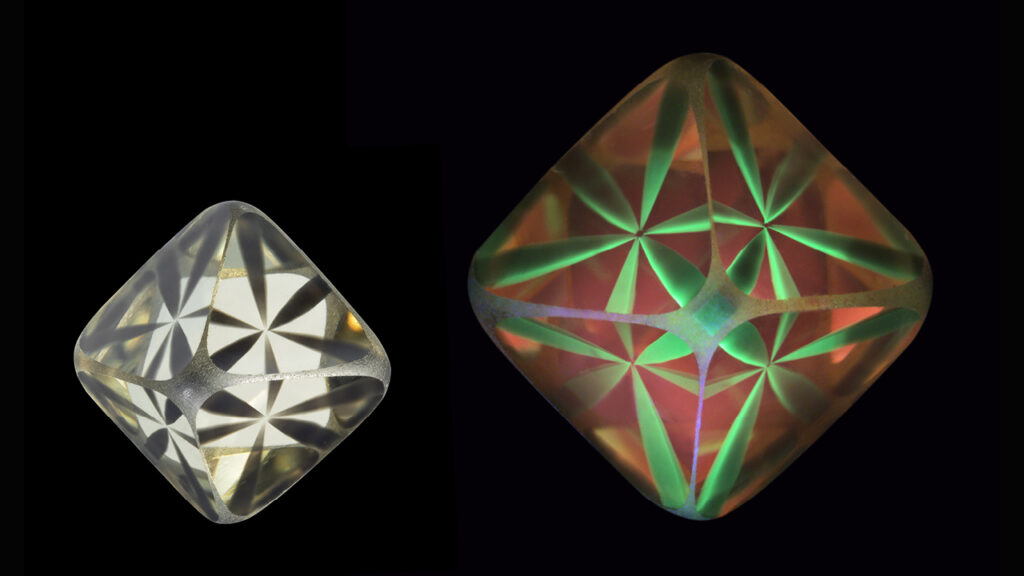
2. Fluorescence can be a positive factor when it comes to colored diamonds.
Unlike with colorless diamonds, fluorescence can significantly increase a colored diamond’s value, as it has an important influence on the color you see. This is most dramatic in so-called “green emitters” — diamonds that fluoresce strongly green, to the point that they exhibit a green observed color. Some diamonds with purely yellow body color appear to glow “kryptonite-green” under regular viewing conditions thanks to their fluorescence.
3. Ultraviolet light is not the only way to trigger fluorescence.
Fluorescence occurs when a material absorbs light and naturally needs to get rid of the excess energy; fluorescence is one way of losing this absorbed energy. Because absorption effects can occur at points all along the electromagnetic scale, fluorescence can result from wavelengths beyond UV. A good example is the purest orange diamonds: Under UV light, they exhibit yellow fluorescence, but if you excite these stones with blue to green (visible) light, they fluoresce bright red, resulting in an unusual reddish glow that enhances their orange appearance.
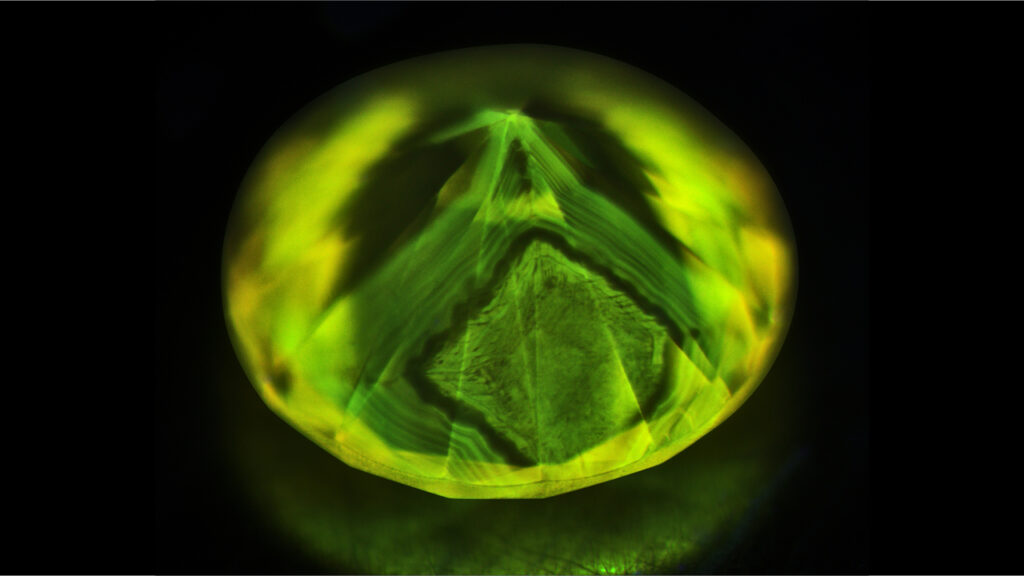
4. Fluorescence can occur in any color and rarely manifests in a homogenous pattern.
Diamond is the material with the broadest range of fluorescence effects, because there are so many defects that can be present in the diamond lattice to cause them. Fluorescence can occur in virtually any color, from violet to deep red; multiple colors can even occur in a single stone. The fluorescence of a given diamond is only rarely homogenous, as the defects are distributed across the stone’s different growth sectors. That means it’s possible to record amazing fluorescence images that mimic a diamond’s growth patterns.
5. Nonfluorescent natural diamonds are practically nonexistent.
While a diamond tested under a standard 4-watt long-wave UV source will often receive a fluorescence grade of “none,” a more powerful UV source and a greater variety of wavelengths covering the entire UV domain — from deep UV at around 225 nanometers, up to wavelengths of about 400 nanometers — will make absolutely any natural diamond fluoresce. The only diamonds we have ever seen without any observable fluorescence are certain synthetic diamonds.
About the writer
Dr. Thomas Hainschwang is the cofounder of GGTL Laboratories and the author of The Beauty of Diamond Fluorescence. The hardcover book includes the 100 best fluorescence images he has recorded in the past 15 years on the DFI fluorescence microscopy system that he started to build in 2008; the multi-excitation version of the system has been available since about 2010. The book covers the fluorescence of treated and untreated natural diamonds, as well as synthetic diamonds. It also has an introduction to the theory of fluorescence and its relation to growth and post-growth diamond phenomena such as plastic deformation and irradiation/annealing. For more information, email Thomas.Hainschwang@ggtl-lab.org.
Main image: A yellow, type Ib/IaA High Pressure-High Temperature (HPHT) synthetic diamond. (Thomas Hainschwang)