 WhatsApp
 Email
Email
 Facebook
 Twitter
 LinkedIn

“A single eye is enough to evoke an entire world of emotions and states of mind,” says Italy-based jeweler Giulia Fracasso. In recent years, eye jewelry has surged into the spotlight, from protective evil eyes to the bold symbolism of the Illuminati. But the motif known as the “lover’s eye” has its own particular history. Part portrait, part jewel, and difficult to categorize, this elusive style emerged in the late 18th and early 19th centuries, when brooches and pendants featuring only the painted eye of a loved one became tokens of romance, secrecy and devotion.
These pieces — which artists would render on parchment or ivory in delicate watercolor or gouache, framing them with gemstones — were never meant for public display, but for intimate keeping. Britain’s Prince George (later King George IV) famously popularized the trend when he gifted a lover’s eye to his secret mistress, Maria Fitzherbert, in the 1780s. In some cases, the painted eyes were also in memory of the deceased, with people tucking them into pockets or pinning them close to the heart.
Back then, the goal was realism — a faithful, solitary depiction of a beloved’s gaze. Only the giver and the recipient would recognize the eye, lending the pieces an enigmatic, almost haunting allure. Today, jewelers are reimagining the lover’s eye with a contemporary lens, sometimes favoring more abstract interpretations of what has long been called the “mirror of the soul.”
Post-romantic symbolism
“The motif is no longer tied to forbidden secrets or clandestine love, but to a broader sense of connection: memory, belonging, protection,” says Fracasso. “For us, it has become a symbol of care — an eye that watches, that keeps.”
Commissions range from romantic cameos to portraits of family members and memorials for the deceased. While some clients are drawn to the motif’s history of forbidden love, others appreciate the contemporary interpretations that conflate it with the protective evil eye.
US jeweler Ana-Katarina Vinkler-Petrovic moves beyond romantic symbolism in her Ana Katarina brand, framing the eye instead as an emblem of self-awareness and the talismanic “third eye.”
“I wear our [customizable] Eye See necklace featuring my own eye as a daily reminder to connect with my intuition,” she says.
Painting the soul
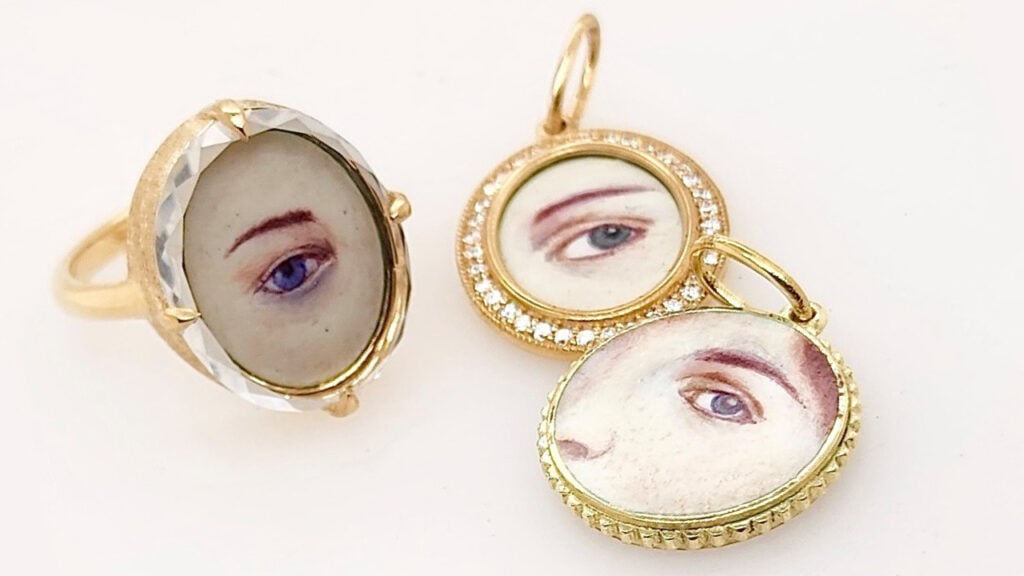
Some designers remain faithful to the motif’s painterly origins, creating each piece entirely in-house. Erica Molinari, for instance, works with vitreous enamel, focusing on capturing the personality and story behind an eye — “an aspect that is both challenging and essential,” she says. Using enamel glass, she conveys depth and nuance in a way that closely mirrors fine-art portraiture. The jeweler grinds the enamel to a fine, flour-like consistency before mixing pigments with an oil-based medium. “The process is highly time-consuming; preparation alone can take one to two hours, and each painting involves [multiple meticulous] stages, from model-making through to the finished piece,” she explains.
Fracasso and her husband Asanka Jayasinghe create the lover’s eye pieces for their Asalia brand in their studio, pairing antique frames with bespoke settings. “The miniatures are painted by our own hands; we don’t collaborate with external painters, because we want every step, from design to painting, to be ours,” says Fracasso. “It’s a slow process. It always begins with a photograph and a shared story, translated into just a few millimeters of enamel or paint.”
Their recent series focuses on the eyes of albino individuals and people of diverse ethnicities to celebrate the beauty of every gaze. “We wanted to counter bias and affirm that every pair of eyes deserves to be portrayed,” Fracasso states.
Niche carving
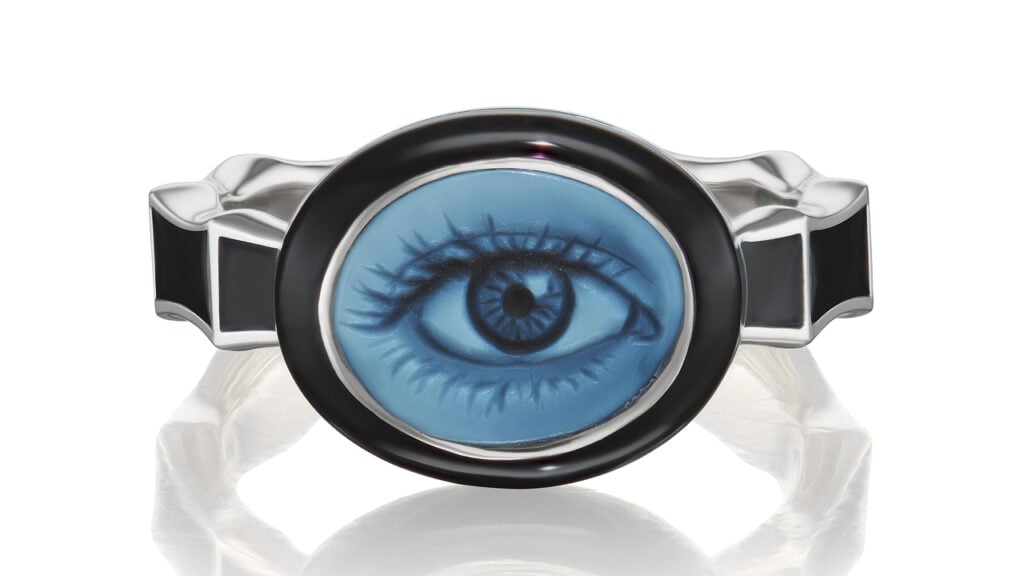
Other designers push the genre further. Ana Katarina’s Eye Love collection centers on hand-carved miniature eye cameos of Brazilian agate.
“The depth of the carving brings out darker tones in the stone, adding dimension and life to each piece,” explains Vinkler-Petrovic, emphasizing that the pieces are entirely unpainted. To realize these designs, she works closely with a master glyptographer who “translates my drawings into sculptural forms, capturing the subtle expressions that make each eye uniquely emotive.”
In custom commissions, the process becomes even more intimate. Vinkler-Petrovic’s clients submit close-up photographs of a loved one’s eye, which she reviews together with them, “refining [the image] until it perfectly conveys the individual’s eye and emotion,” she says. The glyptographer then carves the result in the agate by hand — a moment she describes as transformative: “Watching it evolve from a rendering into the final carving is breathtaking. The eye seems almost alive.”
A playful look
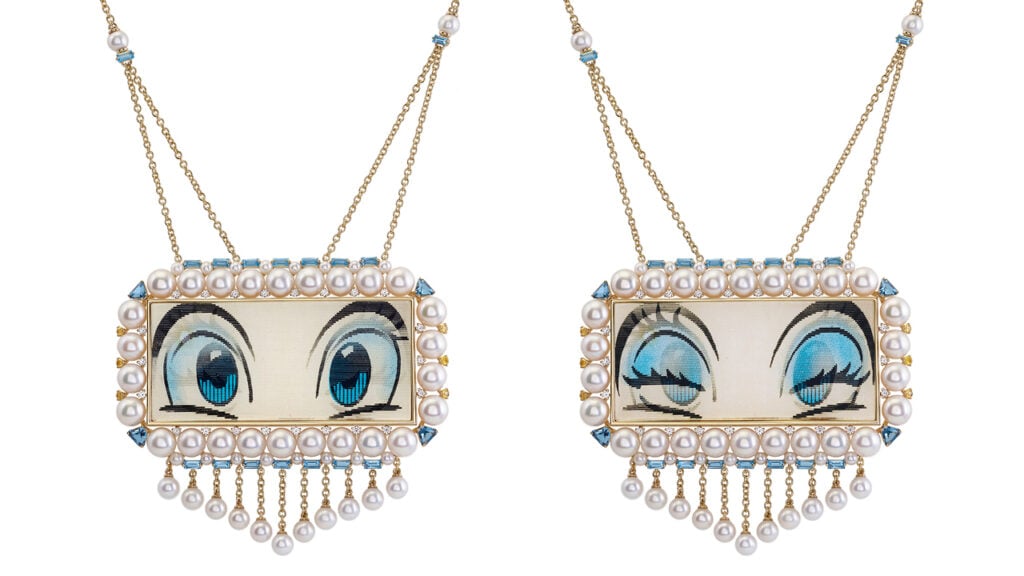
Italy-based jeweler Francesca Villa, meanwhile, radically updates the form with contemporary lenticular moving images, which change when tilted in different directions. These animated holographic interpretations of the lover’s eye offer a more whimsical take on the motif, creating a deliberately cartoonish effect.
“I’m driven to pay homage to some of [the historical lover’s eye] masterpieces, while at the same time infusing [my work] with a playful, modern spirit through the use of vintage lenticular elements,” she explains. Humor runs as a defining thread through her practice, stripping the motif of its austere seriousness as the eyes shift and wink with movement.
For Villa, painting a real person’s eyes was never an option, particularly for pieces she was planning to sell to the public. “It’s difficult to imagine selecting the eye of a loved one, or even a stranger, and turning it into a collection. That would have desecrated the intrinsic value of lover’s eyes, which are meant to remain singular, unique creations.”
Main image: Lover’s eye pendant by Asalia. (Asalia)