 WhatsApp
 Email
Email
 Facebook
 Twitter
 LinkedIn
At the top of the auction world are the big three: Christie’s, Sotheby’s and Phillips. These houses operate bases across the auction capitals — Geneva, New York, Hong Kong, London and Paris — where elaborate white-gloved presentations, viral social media videos of important pieces, and multimillion-dollar bids are commonplace. While these global behemoths serve a specific clientele and do it well, independent auction houses are proving there’s room for everyone.
Distinguishing oneself from the competition begins with a simple question: What does an auction house actually do?
“Many people simply don’t know,” says Jill Burgum, head of jewelry at Heritage Auctions in Dallas, Texas. The fear of this unknown can be intimidating for auction newcomers, she’s found, and Heritage looks to solve that problem.
That’s not just an altruistic stance; it’s a smart business move. New clients accounted for 49% of buyers at Phillips in 2024, with Millennials and Gen Z making up 34% of total purchasers.

Leveling the playing field
One way Heritage is making auctions accessible to a new generation is by taking them digital. Virtual tools have already revolutionized the auction world. No longer is it necessary to sit in a room full of velvet chairs and wait patiently for your lot number; you can review a catalogue online and set a notification for your lot.
“We’re more transparent than many of our competitors, openly revealing our reserves before each auction,” Burgum adds. In doing so, Heritage creates an even playing field for bidders.
Burgum saw online auctions take off during the pandemic, bringing with them a whole new, digitally savvy clientele. “As a result, we now dedicate significantly more time, resources, and creativity to digital marketing and promotion,” she says. The auction house provides online bidders with extra information, such as how many unique page views the lot has received, so they can gauge interest. “All of this helps create a fully open and informed experience for participants.”
A welcoming approach
Heritage isn’t the only independent player seeing results from an online interface.
“Many first-time buyers and bidders find us through our website or social media,” relates April Matteini, head of jewelry at Chicago-based auction house Freeman’s. “It’s inspiring to see a new generation embrace the accessibility of collecting at auction. I love being tagged by a new client who attended a preview and was amazed that they could not only try on the piece, but also take photos and share them.”
Freeman’s does encourage its clients to come preview pieces in person, says Matteini. “We always welcome the public in to preview and for talks. Most jewelry specialists enjoy sharing the stories of the pieces and often of the people who owned them.”

Price freedom
Despite its lower profile, Heritage grossed $1.87 billion in total sales last year. With this and other houses making significant sales, why do only a few global players stay in headlines?
“[Local firms] often don’t have the same reach, resources, or global client base needed to achieve the highest possible prices,” says Burgum.
Additionally, glossy magazine headlines are often reserved for rare, culturally important or historical pieces, which tend to be more readily available to large houses. However, the flipside is that famed auction houses are often married to the virality of signed pieces, mammoth gems and Art Deco designs — all high-end favorites. Independents can have greater flexibility in the value of goods they offer.
Freemans, which was founded in 1805 and has 16 locations in the US, specializes in pieces from $1,000 to $1 million. Its strategy is to arrange its auction categories by price point, which lets it cater to a wide range of clients, says Matteini. It presents lower-priced items in its monthly Essential Jewelry sale, and high-value jewelry in its quarterly Important Jewelry auctions. Its Edit sales, which occur three times a year, offer fashion-forward pieces spanning a variety of prices.
Contrary to appearances, the big three do not have a monopoly on auctions. Houses like Heritage and Freeman’s are honing their own communities, embracing clients old and young, experienced or not.
Auction alternatives: Windsor Jewelers
Windsor Jewelers touts itself as “New York’s auction alternative.” The Manhattan-based estate dealer has been buying and selling luxury pre-owned jewels for nearly 40 years, including a number of historic pieces.
“We have the strength, when we see a fantastic piece, to pay the highest price for it, because [unlike an auction house,] we don’t care if we have to wait a period of time to sell it,” says founder and CEO Paul Lubetsky.
Estate jewelers with sufficient buying power can indeed serve as an alternative to auction houses both large and small. Windsor holds 15,000 to 20,000 pieces in inventory at any one time, running the gamut from $500 to multiple millions of dollars, according to managing partner Avi Fattal.
In particular, Windsor prides itself on maintaining clients’ privacy. It does not list its pieces on the internet or post them on social media. Auctions, “by nature, are a public forum for sale,” explains Fattal, and “there are some people who don’t want that.” Keeping pieces totally private can positively impact their prices, Windsor has found, especially among more discreet clients.
Like auction houses, Windsor can obtain certification for its jewels, Fattal adds, but it can also go further and offer restoration and repair services. “[Auction houses] might not go through the whole process of restoring, given that they don’t actually own the items that they’re selling.”
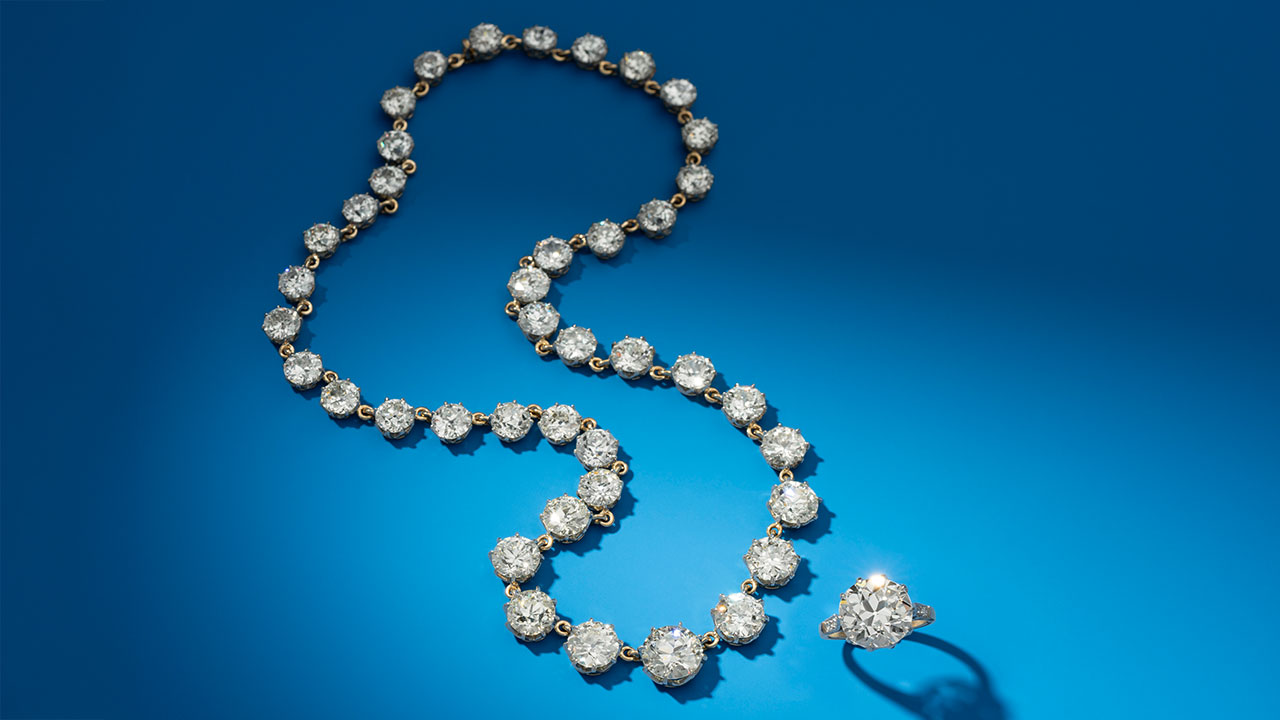
Main image: A ring and necklace with antique diamonds at Windsor Jewelers. (Windsor Jewelers)