 WhatsApp
 Email
Email
 Facebook
 Twitter
 LinkedIn

There’s something undeniably mystical and celestial about moonstone. With its creamy glow and ethereal luster, it radiates a quiet aura of mystery. A variety of orthoclase feldspar, moonstone ranges from semi-transparent to opaque, with hues from grey to golden peach to milky white and even colorless. Its luminous radiance comes from a phenomenon known as adularescence — a delicate hovering sheen of blue, silver, gold or white light. The effect mimics the moon’s pearly glow, so it’s no wonder Hindu lore imagined that the stone was made of solidified moonbeams.
Gemologically, moonstone is a potassium feldspar made of orthoclase with fine albite layers, and its adularescence comes from light scattering between these intergrowths. A common source of confusion is that the gem known as rainbow moonstone is technically labradorite — a different feldspar variety from true moonstone, with its own distinct phenomenon, labradorescence.
“In the market, moonstone and rainbow moonstone are often seen as the same,” explains Althas Cader of Sri Lanka-based dealer JewelMine Gems. “Most consumers and even retailers don’t realize they are different species.”
Mining the shine
India, Sri Lanka, Myanmar, Brazil and Tanzania have long produced orthoclase feldspar moonstones, with India and Tanzania continuing to meet demand for commercial-quality material.
“The most popular — the transparent blue-sheen moonstones — come from Sri Lanka, while the bulk of the commercial-quality comes from India,” says Safraz Jabir of Sri Lankan gemstone dealer Safaiyers.
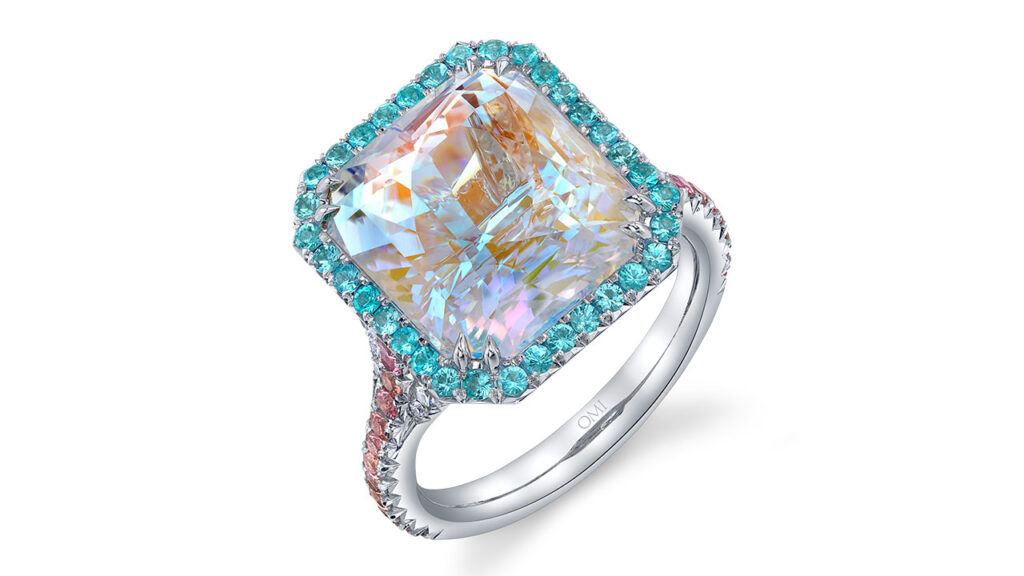
Meanwhile, the 2023 discovery of high-quality, transparent rainbow moonstone in Madagascar’s Alaotra-Mangoro region has reignited market interest in this colorful labradorite variety. The new material, which comes from the area’s Andilamena mine, displays exceptional clarity and distinctive multicolored labradorescence.
“[This type of] color play has never been seen in traditional moonstones,” asserts Jabir. “Only a few were fortunate enough to acquire these newly found deposits from a particular mining area in Madagascar.”
Dealers say moonstone supply remains steady but is gradually decreasing due to lower yields of high-quality stones, as well as rising mining and labor costs. “Already many mines are not in operation, and the finer material is almost finished,” Jabir reports.
Cader affirms that “the supply of rainbow moonstone has declined over the past five months” — a trend he expects to continue, since as far as he’s concerned, the Andilamena mine is the only source currently producing facet-quality material.
The price spectrum
Rainbow moonstones, particularly those with a vivid blue or orange sheen, are now among the most sought-after and valuable gems on the market.
“The finest rainbow moonstones display an orange sheen across the face, blended with other colors,” says Jabir. “Transparent stones with top clarity and well-proportioned cuts are highly prized by design houses, especially in sizes between 10 and 30 carats, which are rare and exceptional.”
Rising costs for the Big Three — rubies, sapphires and emeralds — and various semiprecious gemstones have left jewelers seeking fresher, more accessible options. Rainbow moonstone is answering that call, offering both beauty and versatility. Price points highlight the distinction between this type and golden moonstone — an orthoclase feldspar with a warm peach-gold body color. As Cader explains, a 5-carat golden moonstone typically sells for around $100 in total, while a rainbow moonstone of the same size would command a lot more.
Orthoclase moonstones with a blue sheen typically range from $10 to $30 per carat, according to Jabir. For rainbow moonstones smaller than 5 carats, prices tend to be between $30 and $100 per carat, depending on the play of color, while those between 5 and 10 carats run from $100 to $200 per carat, and specimens over 10 carats can fetch $150 to $350 per carat. Exceptional rainbow pieces can command as much as $300 to $1,000 per carat — and prices are likely to rise.
Cabochons or facets?
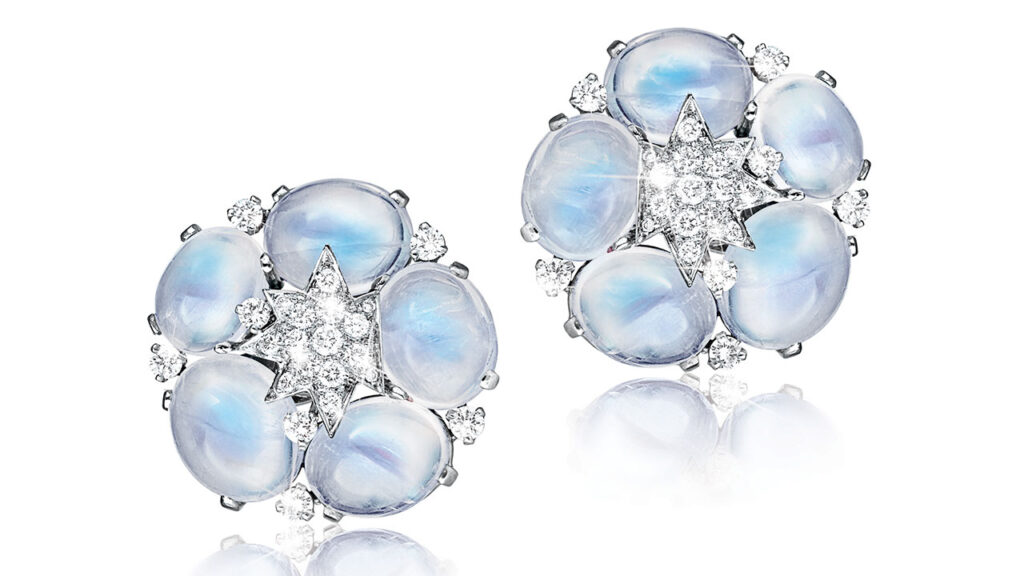
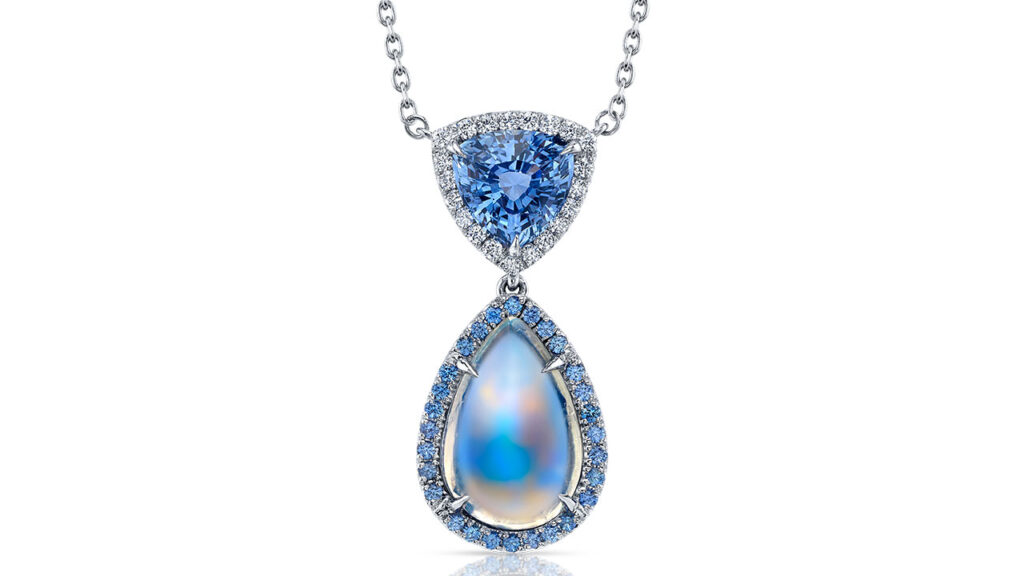
Moonstones are available in a variety of shapes, but cabochons remain the most popular. This smooth and rounded cut best reveals the gem’s signature adularescence, allowing light to shimmer and glide across the surface.
“Cabochons best enhance the glow and can mask inclusions,” elaborates Niveet Nagpal, president of supplier Omi Gems and jeweler Omi Privé. “While faceting adds brilliance and angular lines, [it] can sometimes diminish the adularescence.”
Oval is the most popular shape by far for faceted goods, “as its form naturally [draws] the moonstone’s sheen toward the center and apex of the dome,” he adds. He typically works with moonstones of 5 to 12 carats.
Jabir, meanwhile, has seen rounds and drop shapes remain popular — though for rainbow moonstones in particular, his most requested cuts have been Asschers and princesses between 5 and 15 carats. “The most preferred type of moonstones are the ones that have a blue sheen effect and are cut as cabochons for commercial, cost-effective jewelry-making,” he says. Layouts and matching pairs are also in demand for their beauty, with designers using them to create bold and innovative pieces.
Moonstone can be challenging to work with due to its tendency to cleave during setting, so it is essential to be highly selective when sourcing, cautions a spokesperson for New York-based jewelry house Verdura. “Finding stones that are both visually matched — in terms of adularescence and transparency — and structurally sound is a meticulous process that can take months, especially when sourcing over 300 carats for a single necklace. We often prefer material with subtle inclusions, but cutting those stones to specific dimensions requires great care.”
With rainbow moonstones, deciding whether to go for a cabochon or a faceted cut depends on the gem’s clarity, its optical properties, and the desired effect. Out of all the rainbow moonstone deposits in Madagascar, India, Tanzania and Sri Lanka, only about 20% of the material is suitable for cutting into fine-quality gems, explains Jabir, so it’s crucial to choose rough with good crystal quality, ideally displaying an orange sheen. In general, he says, “the key lies in finding stones with the right balance of color sheens.”
What draws the designer
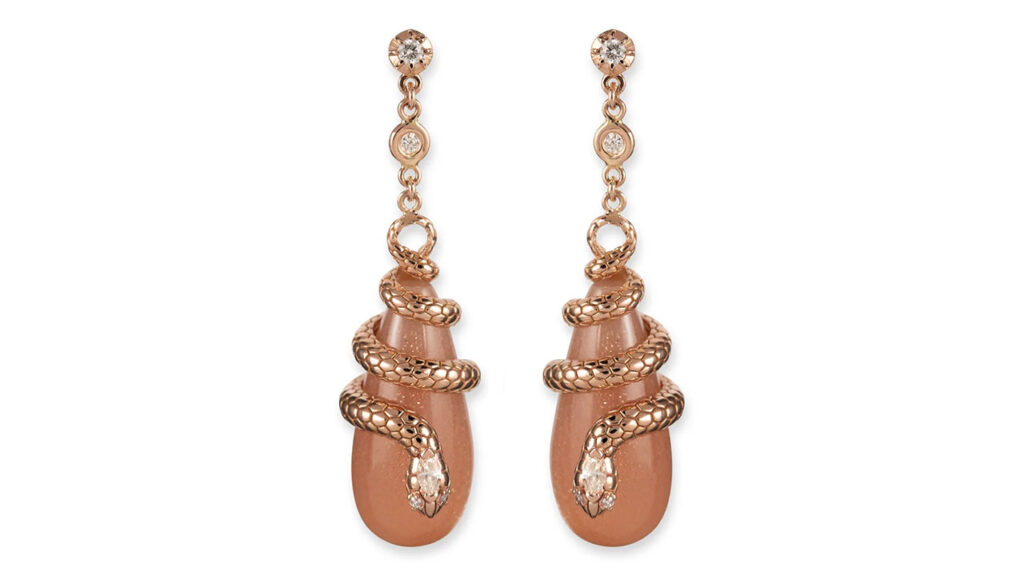
Moonstone was a favorite during the romantic Art Nouveau period, captivating master jewelers such as René Lalique, and continued to charm the artisans of the Arts and Crafts movement in the latter half of the 19th century. Today, it’s a source of renewed inspiration for jewelry brands like Verdura, Omi Privé, Jacquie Aiche, Temple St. Clair, Irene Neuwirth, Nak Armstrong, and Vram.
“Moonstone has long been admired by connoisseurs for its beauty, but it’s only recently begun to gain broader recognition in the world of fine jewelry,” says the Verdura spokesperson, adding that when sourcing moonstone, the house looks for strong blue adularescence, excellent transparency, and minimal visible inclusions. “We avoid stones with yellow body color or structural weaknesses, as these can compromise both beauty and durability. Sri Lanka consistently produces some of the highest-quality moonstone, and we often turn to their material for classic designs such as the Verdura Paisley motif.”
Omi Privé’s Nagpal had not initially considered using moonstones, but “about seven or eight years ago, I came across a few blue-sheen moonstones that caught my eye,” he recalls. “Before that, I hadn’t encountered many that truly inspired me to design.”
The turning point for him came a few years later with a remarkable parcel of rainbow moonstones from Madagascar. Unlike earlier stones, these revealed their sheen beautifully when faceted, even under minimal light and without a dark background, he says. “The way the adularescence and colors reflect through the facets creates an effect unlike anything I’ve seen before.”
Celestial splendor
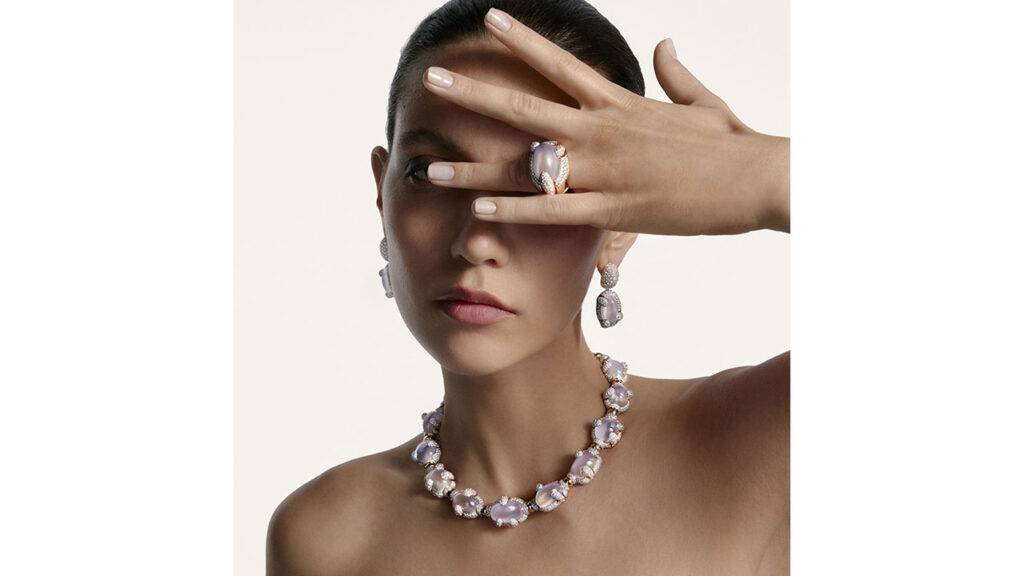
That signature glow makes moonstone a natural choice for capturing celestial magic in jewelry. Verdura’s Stardust necklace, featuring rainbow moonstone from India, is a striking example, with a dreamy, cosmic quality like drops of luminous stardust.
“We’re drawn to its mysterious glow and soft inner light, which perfectly reflect the celestial inspiration behind the design,” says the company spokesperson.
Brands like Nak Armstrong, Omi Privé, and Lebanese jeweler Noor Fares like to pair rainbow moonstones with black enamel, rhodium, or darker accent stones like sapphire and alexandrite to enhance the gem’s adularescence. Black rhodium acts as an optical amplifier, intensifying the stone’s natural luminescence.
“Moonstone reveals its finest sheen against a dark background under a single light source,” explains Nagpal, who has studied the stone’s interaction with light for years.
For Los Angeles-based designer Jacquie Aiche, moonstone has been a favorite from the start. “There’s a softness and feminine power to it that’s unlike anything else,” she says.
She gravitates toward freeform, carved and organic cuts that showcase the stone’s natural beauty, often pairing them with simple gold bezel settings and pavé diamonds. “I’m always drawn to pieces with that magical, luminous quality. The more transparent the body and the more visible the ethereal shine, the better. Every detail is designed to enhance its natural beauty and vibration. It feels like capturing moonlight.”
Main image: Two moonstone, diamond and 18-karat-gold rings from Pomellato’s The Dualism of Milan collection. (Pomellato)