 WhatsApp
 Email
Email
 Facebook
 Twitter
 LinkedIn
Some US department stores have spent decades building both an exceptional fine-jewelry offering and a high-spending clientele. And while the department store landscape has become unpredictable, change has led to new opportunities for different players. Independents and chains that perhaps weren’t quite as active in the jewelry sector in the past have seized on this shake-up and sought new ways to make their mark, while cultivating relationships with Very Important Customers (VICs) of high net worth.
In May, Nordstrom completed a transaction that saw its delisting from the New York Stock Exchange: the all-cash acquisition of the business by Mexican holding company El Puerto de Liverpool and the Nordstrom family, turning it private. Erik and Pete Nordstrom now lead the department store chain as co-CEOs.

But before this, Saks Global — parent company of landmark luxury store Saks Fifth Avenue — acquired Neiman Marcus Group for $2.65 billion in December 2024. The move has led to company-wide consolidation and change, including a recent leadership shuffle and, in September, a reported interest in selling a minority stake in Bergdorf Goodman — previously a Neiman Marcus subsidiary, now a separate company under Saks — to help reduce debt.
However, there were disruptions before the acquisition, according to some jewelry insiders and brands, who say Saks Fifth Avenue was having trouble paying vendors as early as 2023.
“In 2023, we had made some significant sales in the beginning of the year, just based on trunk shows, and by November, we still hadn’t been paid,” states a New York-based fine-jewelry agency that prefers to remain unnamed. It hired an attorney and received payment in 2024, but since the merger, additional invoices have become outstanding with Neiman Marcus, the agency says. “The brands that we represent are niche, small and privately-owned, [and they] expect a corporation to pay.”
Phillips House, a family-owned jewelry brand in Miami, Florida, launched at Saks Fifth Avenue in fall 2012. “We worked with them for a little bit over a decade. At one point, early on, it was our largest retail partner,” relates Phillips House director Derek Frankel. But in March 2023, he says, payments stalled. Later that year, while attending the Couture show in Las Vegas, he made inquiries with other exhibition vendors and discovered that many were in the same boat.
Phillips House stopped working with Saks Fifth Avenue and attempted to recover the money it was due. In the fall of 2023, Frankel hired Vivek Jayaram, founder of New York-based law firm Jayaram Law, who filed a lawsuit and secured the payment. “I have fielded calls from over a dozen brands struggling to receive payment since June of 2023 and referred them to Vivek,” Frankel says.
Strained relationships
Jayaram describes Saks Global as “a company that to me seems like it is in great distress, but they’re engaging, they’re trying to work things out.”
He should know; so far, he’s represented around 10 separate jewelry clients who have accused Saks Fifth Avenue — and more recently Saks Global — of breaching their credit terms.
Some of them first went directly to the department store, relying on the existing relationships they had there. “Clients talk to the people they’ve been talking to for years,” explains Jayaram. “And in most of these instances, because people don’t like throwing good money after bad, they’ve gone to some lengths on their own, trying to resolve these things. It’s only when those efforts fail that they really reach out to a lawyer. A lot of people in the jewelry industry are no longer talking to the people or merchants that they used to talk to,” especially with all the changes resulting from the merger.
As for Saks Global itself, he adds, “I think they have a desire to continue selling jewelry, and they want to maintain these relationships with all the jewelers, because they can’t have empty shelves. Those we have represented are getting paid, or there’s an agreement to enter into payment plans.”
In response, Saks Global tells Rapaport Magazine that “since the close of the Neiman Marcus Group transaction in December 2024, we have been working to harmonize processes and systems. As a result, we’ve experienced some integration challenges that have impacted certain payments. We are working closely with our brand partners to resolve any outstanding issues. We remain committed to fulfilling our obligations to all brand partners and are focused on executing our multi-year transformation strategy, including working with our brand partners to drive growth, continuing to capture synergies, and delivering for our customers across all of our retail brands.”
Moving to greener pastures
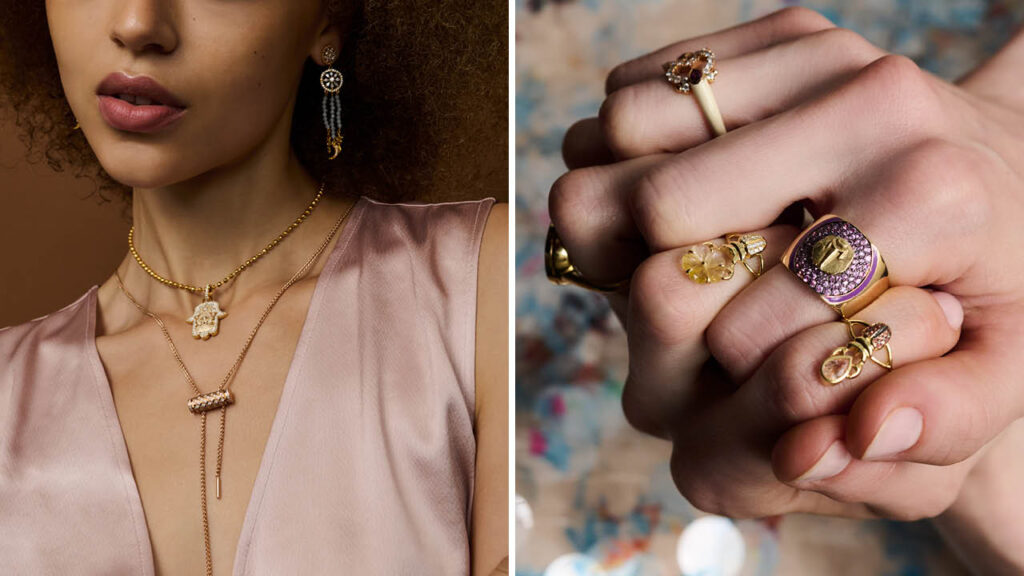
Since leaving Saks Fifth Avenue, Phillips House has ramped up its retail accounts and now conducts 90% of its distribution through independents like Florida-based jeweler Marissa Collections. Phillips House has also been selling to Bloomingdale’s since the beginning of 2024. The jewelry brand has entered locations where it already had an existing client base, such as Long Island luxury mall Walt Whitman Shops, which houses branches of both Saks and Bloomingdale’s.
“When there started to be rumblings that Saks and Neiman Marcus might merge, we elected to go with Bloomingdale’s, and thus far, our experience has been very nice,” reports Frankel. “They pay in a timely fashion.”
Historically Neiman Marcus was a major player in fine-jewelry retail and a brand builder par excellence, according to Jill Burgum, executive director for fine jewelry at Heritage Auctions in Dallas, Texas. In the 1980s and ’90s, the upscale department store chain built a reputation for seeking out “independent jewelers whose work could be beautifully showcased and marketed,” she says. “The store allowed these artists to remain independent, never attempting to buy or control their brands. That respect fostered genuine loyalty — and in turn, helped elevate both Neiman Marcus and the jewelry brands they promoted.”
However, recent changes at Neiman Marcus have led to the departure of highly experienced personnel, some of them specialists in the jewelry field. Eric Ford, for example, joined the Couture show as brand director after 30 years at the department store, where he most recently served as precious-jewelry buyer. Earlier this year, Nordstrom issued a press release announcing the arrival of Neiman Marcus’s long-serving personal shopping expert, Catherine Bloom, as its new director of luxury styling. The move was significant enough that Nordstrom renamed an entire branch for her.
“Bloom has an elite group of style-wise international clients, including Hollywood stars and boardroom executives alike, who rely on her impeccable eye and notable styling talents,” the announcement said. As such, “Nordstrom is transforming its Nordstrom Local location on Melrose Place in Los Angeles into Catherine Bloom for Nordstrom, a dedicated store for Bloom to host clients.”
Independents’ chance to shine
All of these shifts have created opportunity for smaller or alternative players when it comes to distributing fine jewelry through retail — and even more importantly, to capturing high-net-worth customers.
Mitchell Stores — the largest multi-brand specialty-store group in the US — is well-placed to appeal to VICs in search of fine jewelry. As a family-owned business, it bridges the gap between department stores and independents, and its VIC jewelry events have become a growth area. The company will take top clients to a jeweler’s shop or atelier after hours, or organize a lunch or dinner.
“It’s a great opportunity for someone who’s a collector to see the newest pieces from the designer, and also maybe have a hand in designing the piece themselves,” says group co-CEO Bob Mitchell. “Given everything that’s going on with our competition, we have an opportunity to take market share. Our greatest strength is long-term relationships with clients. Those are the people that are the easiest converts to jewelry.”
Over the next three years, he believes, jewelry will continue to grow faster than other parts of the group’s business. Mitchell has 10 stores across the country, including a 25,000-square-foot Wilkes Bashford flagship in Palo Alto, California, which opened in November 2024 with a spacious VIP suite and an expansive jewelry assortment.
“In some cases, it requires investment like this, building a bigger store with bigger offerings,” the CEO comments. Then there are cases like Dallas luxury store Stanley Korshak, which Mitchell Stores acquired in March 2025 and which already included a highly developed jewelry business.
“As some big-box stores face challenges, we’re watching independents and smaller upscale department stores and boutiques step in with their unique points of view,” remarks Beth Anne Bonanno, co-owner of luxury brand-development agency The Gems Project. She names Mitchell Stores, Cayen Collection, Elizabeth Anthony and Forty Five Ten as players worth watching. “Capturing the big-box clients may not happen overnight, but there is an undeniable appeal in more intimate spaces where luxury feels cozy and curated.”
As for the high-end department stores, she says, Bloomingdale’s at California’s upscale South Coast Plaza is now hosting private VIC events, while Nordstrom is working with VICs in New York and Beverly Hills. “These department store retailers are identifying markets where they can up the ante.”
Nordstrom’s Muse
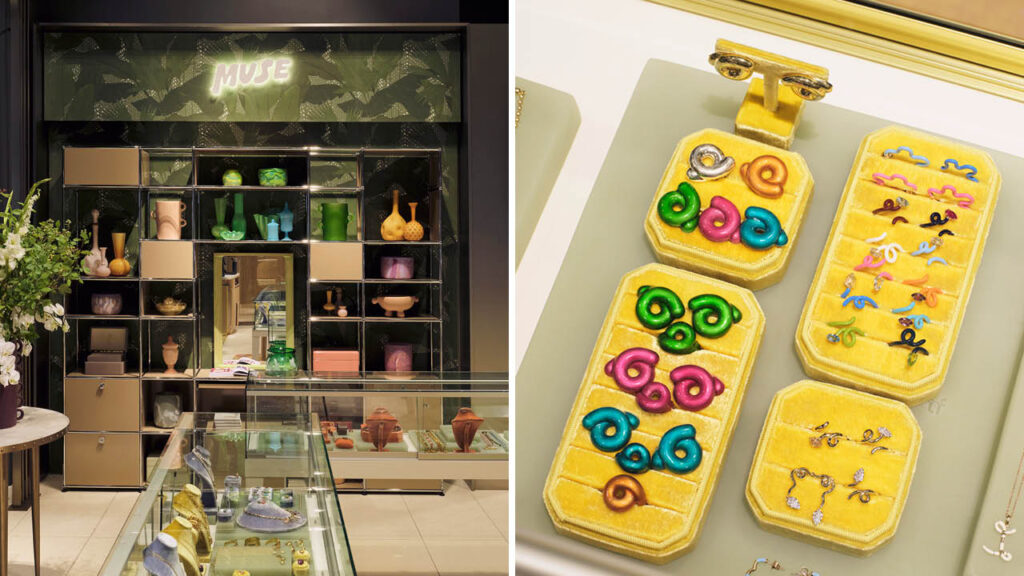
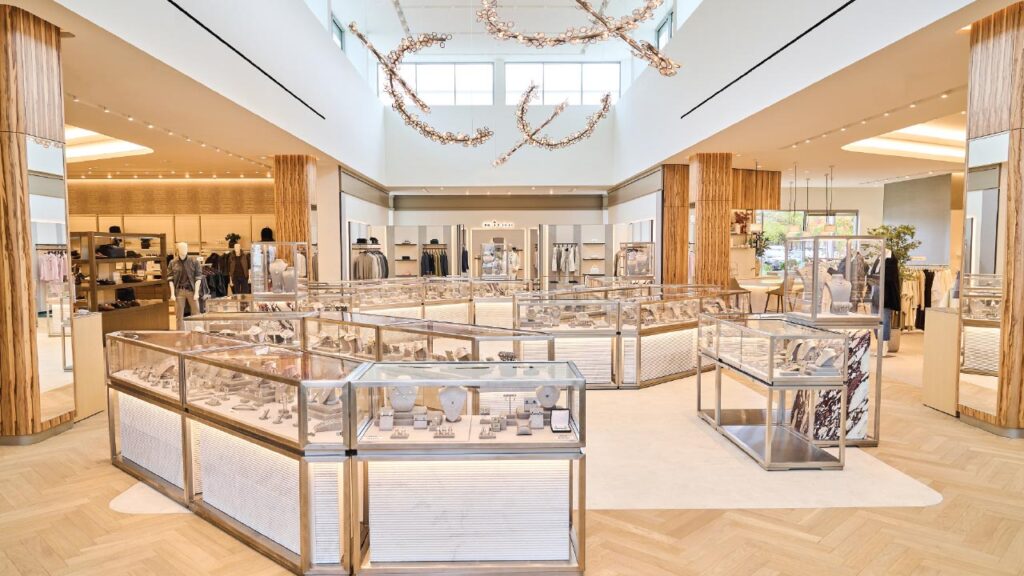
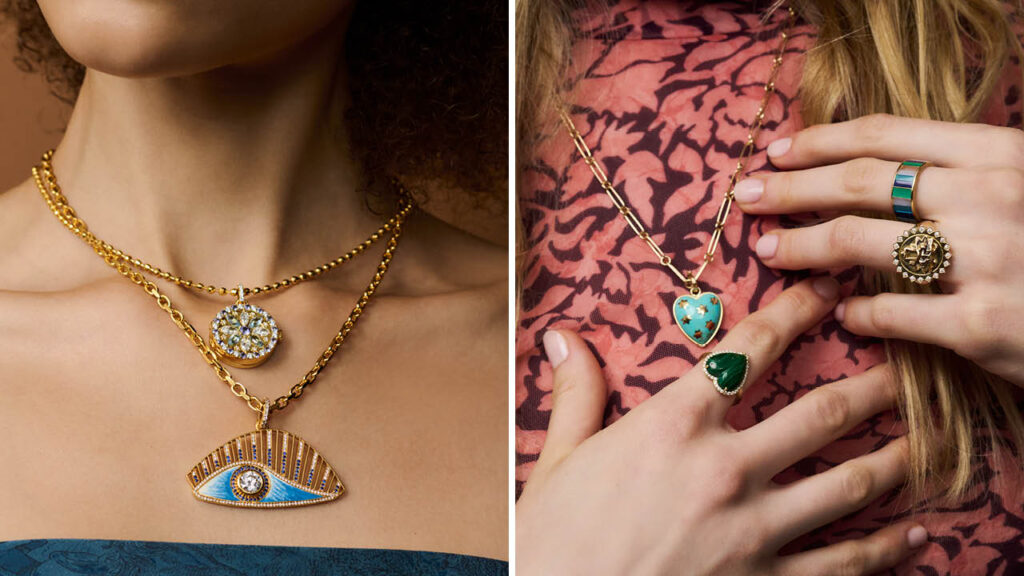
The newly reimagined jewelry hall in Nordstrom’s New York flagship is a case in point. It offers customers shop-in-shops like Muse, Tabayer, Spinelli Kilcollin and Mejuri, along with selections from coveted brands such as Fred Leighton, Dries Criel, David Webb, Mindi Mond and Roberto Coin.
“Nordstrom used to have jewelry throughout the flagship store, scattered in different areas on different floors,” says Jennifer Shanker, founder and creative director of Muse, whose 300-square-foot shop-in-shop anchors the space. “Now there’s a direct entrance off the street into the jewelry hall, which is amazing for all of us.” The entrance in question is on the corner of 58th and Broadway, boasting high commuter and tourist traffic.
Muse gained respect in the industry for its wholesale business, which distributes independent fine-jewelry brands throughout the country. During Covid-19, it experimented with direct-to-consumer selling, which led to the multi-designer Muse boutique in Manhattan’s West Village. When Nordstrom fashion director Rickie de Sole asked Shanker to bring that Muse vibe — with its combination of curation, branding and merchandising — to the department store, she responded with a resounding “yes.”
Muse also has a long-standing relationship with Bergdorf Goodman. Current Muse wholesale clients that sell at the iconic New York department store include Nikos Koulis, Mellerio, and Silvia Furmanovich. However, the Nordstrom partnership is Muse’s first retail shop-in-shop at a department store, and there’s no overlap between the 20 jewelry brands it offers there and the ones it supplies to Bergdorf Goodman.
To celebrate the new jewelry hall and Muse’s role as anchor shop, Nordstrom threw a party during New York Fashion Week in September. “It was amazing, fun, everybody had such great energy,” Shanker says. “It was like no jewelry party any of us had ever been to.”
Many jewelry-industry personalities showed up, she adds, including several from the Nordstrom-Muse line-up who flew in for the event, like Greek jeweler Christina Alexiou and Italy-based designers Bea Bongiasca and Anna Maccieri Rossi.
The party certainly revealed a newfound optimism for department-store retail against a backdrop of uncertainty. But it remains to be seen whether leading department stores such as Bergdorf Goodman and Neiman Marcus can retain their positions at the pinnacle of luxury fine jewelry, or whether competitors like Nordstrom — or independents like Mitchell Stores — can corral significant market share.
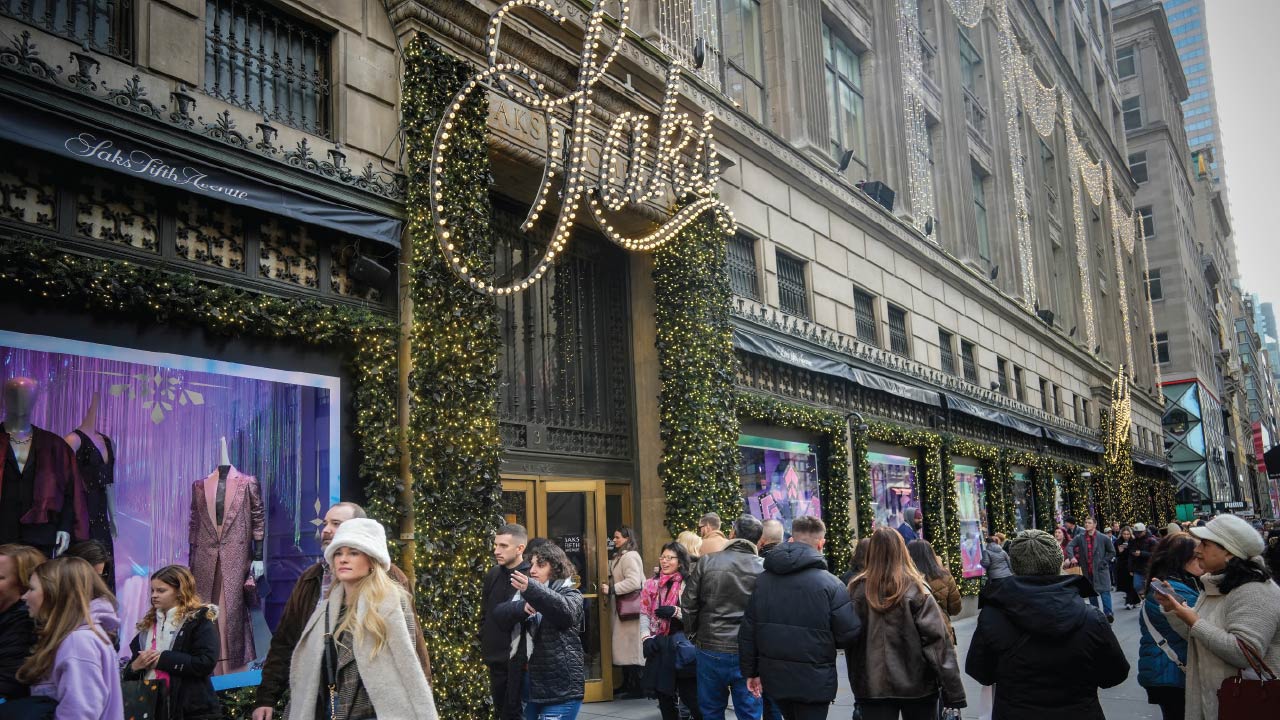
Main image: Saks department store on New York’s Fifth Avenue. (Shutterstock)