 WhatsApp
 Email
Email
 Facebook
 Twitter
 LinkedIn

At Christie’s Paris in January, designer Elie Top celebrated his house’s 10th anniversary with a collection entitled Liaisons Dangereuses — a name that evokes the shimmering gilded salons of 18th-century Paris and jewels sparkling under candlelit chandeliers. Top’s designs emulated heirlooms from that period — especially his girandole ear pendants, with their distinctive trio of pear-shaped ornaments dangling from a central bow motif or similar pear-shaped cluster.
The delicate, flattering girandole design is again resonating with jewelers, but what of the antique earrings themselves? Do many survive?
“We have had several lovely pairs over the years,” says Nicole Corsini, marketing director at Lang Antiques in San Francisco. Now, however, the estate dealer has only “a few necklaces that we’ve termed ‘girandole,’ and it’s entirely possible these were converted after someone lost an earring.”
It is getting harder and harder to find authentic 18th-century girandole earrings, affirms Elizabeth Doyle, co-owner of New York antique jeweler Doyle & Doyle. Loss is one of the reasons, but as she points out, “Georgian jewelry was also typically made with techniques that don’t work well with our modern lifestyle. Lightweight components that are stamped or hollow are prone to denting. Closed-back stone mountings can also deteriorate when exposed to water.” As such, restoring damaged pieces, when possible, “can be quite pricey, so many pieces are lost or repurposed over the years.”
Across the pond
Of course, the Georgian era was a tumultuous period, not least during the American War of Independence, when England’s King George III was on the throne. Nevertheless, jewelry did make its way across the Atlantic.
“Historically Americans considered European jewelry to be superior to American-made jewelry,” says Doyle, so “a good amount of jewelry was imported from Europe for the American high-end market, even during the Georgian era.”
There are several fine examples at FD Gallery in New York, including some from the Iberian peninsula — where Spanish women favored the eye-catching style — and a pair of rose-cut diamonds in silver and gold mountings from 1740. The estate jeweler also has a pair of intriguingly modern-looking antique steel girandoles from 1845 among the longer ear pendants from the period.

The designs are dramatic, luxurious and ultra-feminine, and their popularity has surged among Americans in recent years, according to Doyle: “As the interest in antique earrings in England [has] waned, more Georgian girandoles have steadily made their way from England to the US” — a point that London-based antique jeweler Hancocks confirms.
Girandoles “are completely timeless and surpass trends,” says Hancocks specialist Amy Burton, though she adds that “finding them is not so easy these days.”
A drive to stand out
The style appeals to women who want bold, confident looks, because the ear pendants are generally large and often contain rose-cut diamonds, white topaz, or richly hued gems like garnets, emeralds and citrines. Later Victorian versions included turquoise, aquamarines and pearls. Jewelers would frequently set the rose-cut diamonds in silver, which acquires a patina over the years that makes the diamonds sparkle even more. Eighteenth-century styles usually appear in closed-back settings, often with tinted or silvered-copper “foiled” backings to enhance the jewel in candlelight. This made them perfect for evening events and weddings, as well as for catching the sun’s rays during the day.
Bejeweled updates
Elie Top is not the only jeweler reviving the girandole style. Stephen Silver has dramatic peridot and diamond girandoles in his Menlo Park boutique in California, while in Australia, South Sea-pearl specialist Autore creates decorative 18th-century-style girandoles with pearl and tsavorite pendants. London-based Jessica McCormack, who specializes in Georgian jewelry design, gives her girandoles a contemporary spin by inverting the pear-shaped diamonds and setting them in blackened gold for a clean silhouette.
Emily Satloff has had a decades-long love affair with 18th- and 19th-century jewelry. “Girandole earrings and pendants have a special place in my design ethos,” says the founder, designer and curator of New York-based Larkspur & Hawk. “I love jewelry with a documented history and story.”
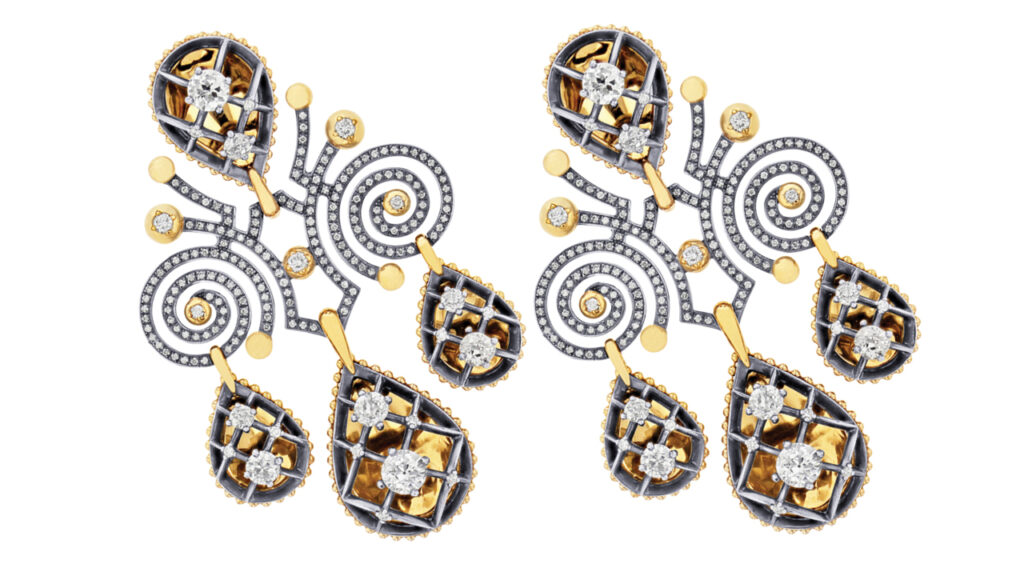
Using the same foil-backed techniques, she creates earrings that flicker and flirt in a way that she says is inherently feminine and “has captivated our clients since I designed my first pair in 2007.” In her New York showroom, she has seen firsthand that there’s always a market for girandoles, which often end up in the same jewelry box as modern designs.
“A well-rounded jewelry collection should include pieces that the collector is drawn to, even if some pieces reference the past while others are more futuristic,” she maintains. “Divergent styles have always coexisted.”
Main image: Model wearing Catherine girandole earrings by Larkspur & Hawk in gold-plated silver with foil-backed white quartz. (Larkspur & Hawk)