

RAPAPORT… Amid the tech boom that is shaping the diamond industry, a growing number of companies are challenging the grading laboratories, arguing that assessing the 4Cs should not be a subjective science.
“Five to 10 years from now, diamond grading won’t be done by gemologists,” claimed Haim Volner, the owner of Shirtal Diamonds, whose subsidiary Shirtal DiaCam is developing an automated solution for grading. “With the progress of artificial intelligence [AI] and deep learning, computers will do the job.”
DiaCam has teamed up with Matrix, an Israel-based software-services provider, to analyze the images of diamonds taken by the DiaCam360 system — a technology that enables a 360-degree view of the diamond.
Tapping its database of “hundreds of thousands” of images allows the platform to learn how to grade the stones, Volner explained in a recent interview at the JCK Las Vegas show.
When compared to the results of grading by the Gemological Institute of America (GIA), DiaCam360 showed 90% accuracy in assessing the color of the stone. DiaCam is confident it can raise that to more than 95% by making minor adjustments from that initial trial, noted Lior Hirsh, DiaCam’s chief operating officer, who is credited with developing the concept.
The company is conducting similar analysis to determine clarity through its deep-learning techniques. It is looking for strategic investors to help market the service and take the project to the next stage.
You need both
Others are also tackling automation in grading, acknowledging that color and clarity provide the biggest hurdles since cut, shape and carat weight have more standardized measured.
Sarine Technologies has developed machines that can determine the color and clarity of a diamond, based on its concept of “repeatability and accuracy” from the analysis of tens of thousands of stones, the company has explained.
Meanwhile, both De Beers and the GIA stressed that it is important to complement the use of technology with the skills and analysis of their grading experts.
“While we have equipment with the ability to automatically grade color, clarity and carat, it is important to remember that every natural diamond is unique and therefore there will always be some stones that require greater analysis by a grading specialist,” explained Jonathan Kendall, president of De Beers Group Institute of Diamonds, which oversees the company’s grading activity. “These specialists are not only vital for grading certain stones, but also for developing equipment that is highly accurate.”
Similarly, the standards set out in the GIA International Diamond Grading System are best applied using a combination of instrumentation and experienced diamond graders who apply those standards daily, stressed Tom Moses, the GIA’s executive vice president and chief laboratory and research officer.
The GIA applies its capabilities to automate grading in other areas. For example, its melee analysis service automatically separates natural melee from potential lab-grown diamonds and simulants, and sorts the natural diamonds by color, the lab explained. Last year, the GIA began a collaboration with IBM to test an application of the tech-giant’s software using AI to predict clarity grades.
Volner differentiates DiaCam, as the company has no ambition to be a lab. Rather, he envisages labs using the technology to provide accurate and more consistent grading results than a gemologist, “who is prone to human error.” It can also be used by manufacturers, dealers or jewelers to produce fast and cost-effective evaluation of the diamond that is compatible with a grading report, the company suggested.
“The idea is not necessarily to replace the labs,” Volner explained. “But [the technology] gives companies access to a gemologist in a machine. Such automation eliminates human error, saves time and money, and improves efficiency.”
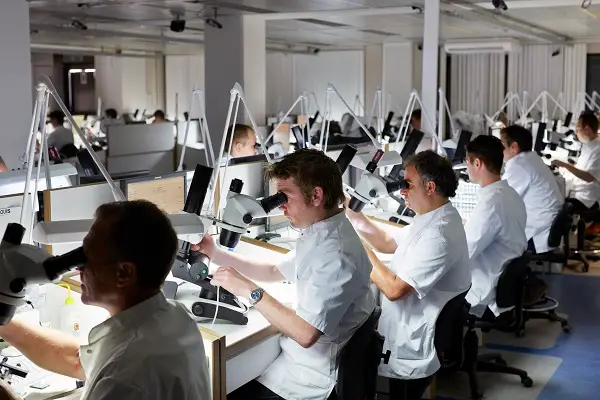
Image: Grading experts at a De Beers Group Institute of Diamonds facility. (De Beers)

Rapaport Appoints Yosi Botzer as CTO to Lead AI Transformation
Rapaport has appointed Yosi Botzer, former Chief Technology Officer of Perion Network, as its new CTO.
Richemont and Signet Consider Participating in Bid for De Beers
Retailers are in discussions with GDC to join the group.
TAGS Tender Generates $27.1M in Revenue
94% of lots find buyers, including many special-sized and fancy-colored stones.