
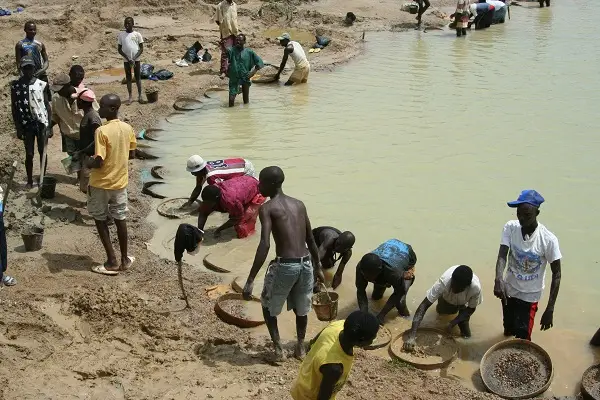
RAPAPORT… The community of Fandehun is not used to pomp and ceremony. The modest village in the heart of Sierra Leone’s Kono District has been sustained by diamond mining for over 50 years but lacks the basics many take for granted — notably, safe drinking water. Women, and often children, walk miles to fetch water from a neighboring village, and they tend to use the same source for all their needs, be it cooking or bathing.
It was therefore an important step for the townsfolk when local officials, including government ministers, gathered in early February to inaugurate a well for the community.
The significance of the event lay not only in providing an important water source, but also in the fact that it was funded by artisanal diamond miners who live there, explains Dorothée Gizenga, executive director of the Diamond Development Initiative (DDI).
In Sierra Leone, DDI is encouraging miners to put aside a percentage of their profits from diamond sales for community development. Gizenga hopes Fandehun’s example will motivate other artisanal mining communities to fall in line with DDI’s programs.
Setting the bar
Community development is one of five focal points DDI has adopted in its work to bring greater structure to the artisanal mining sector.
The nonprofit also engages with governments to sensitize their mining policies to the needs of artisanal diggers; works to register miners and organize them into cooperatives; provides professional training such as first-aid response and diamond valuation; and seeks ways to raise miners’ incomes by, for example, facilitating having new buyers operate in the country.
DDI took a significant step toward achieving those goals when it launched the Maendeleo Diamond Standards in April, which it claims enable ethical diamond production by artisanal and small-scale miners.
As more miners adopt the certification system, Gizenga expects artisanal communities will increasingly be included in a broader system of responsible supply chains. Slowly, the wider diamond industry is engaging more with the artisanal sector, she acknowledges, with De Beers, the Gemological Institute of America (GIA) and the Rapaport Group among those with projects in the communities.
Fair value
De Beers launched its GemFair program in Sierra Leone last April. It was a “big jump for a large-scale miner to work with the artisanal sector in this way,” notes Feriel Zerouki, De Beers’ vice president of international relations and ethical initiatives.
Through GemFair, the company acts as an international buyer, while working with the miners to raise transparency and improve environmental standards around their operations. That means the miners must adhere to the Maendeleo system and fulfill additional De Beers standards covering factors that extend beyond the mine site — such as trading, and meeting the source-disclosure requirements of the Organisation for Economic Co-operation and Development (OECD).
Having set up a local team in Sierra Leone, De Beers has committed to making an offer on any diamond presented to it, at the same price it would make to any other of its partners. The miners don’t have to take the offer, but at least they have an outlet, Zerouki explains.
Where the weakness lies
“Our hope is that GemFair will improve the miners’ overall ideas, and to do that, we need to bring the community on a journey with us,” Zerouki stresses. “We work with them to understand the issues, and work to implement better standards and to empower the miners when it comes to diamond valuation.”
The miners are keen to learn how to evaluate a diamond so they have better negotiating power when selling, explains Gizenga. DDI is working to facilitate training in this area so that each community has an expert who can serve as a resource for the miners, she adds.
Reaching further
That, at least, is the plan. DDI has a long way to go in all areas. Of approximately 300,000 diamond miners in Sierra Leone, about 1,000 have been trained in the Maendeleo standards since the pilot program started in 2012. It is also focused on registering more miners, with about one-quarter of the estimated 800,000 diamond miners in the DRC listed on its systems. Then there are other countries with sizable artisanal mining communities that still need to be tackled, such as Guinea and parts of South America.
It’s a mission Gizenga urges the international industry to embrace further, especially, as Zerouki notes, since there’s still a stigma about the operating standards in the artisanal sector.
“The artisanal miners are part of your family, they’re a part of our industry,” Gizenga stresses. “Pull them up and you’ll truly benefit, not only reputationally, but also in the fight for natural diamonds versus lab-grown diamonds. We really need to focus on upscaling the artisanal mining sector, because that’s where the Achilles’ heel is.”
This article was first published in the June 2019 issue of Rapaport Magazine.
Image: Artisanal mining in Sierra Leone.