
RAPAPORT… Lightbox, De Beers’ lab-grown brand, has started disclosing the treatments it uses to create its synthetic diamonds — but still believes such declarations are optional.
The new policy applies mainly to its Finest collection of D- to F-color, VVS-clarity stones, a premium offering the company launched in August. Lightbox grows the goods using chemical vapor deposition (CVD), and improves the color through a later heating-and-cooling process, known as High Pressure-High Temperature (HPHT) annealing.
Previously, Lightbox did not declare treatments to lab-grown diamonds, arguing that they didn’t affect the value and were just one part of a longer manufacturing process. It maintains this position, but it believes every producer should decide how open it wants to be, a spokesperson for Lightbox told Rapaport News this week. Whether these disclosures are obligatory has long been a matter of debate.
“It was important to us to be transparent with the consumer that the higher price per carat for a Finest stone is reflective of the additional refinement step,” the spokesperson explained.
The 1.5- to 2-carat stones in Lightbox’s classic line receive the same treatment, and also come with a declaration, the spokesperson continued. As with all the stones in this standard category, these are “near colorless” — roughly G to J — and have VS clarity, according to the retailer’s website.
The company departed from its earlier practice of only offering stones up to 1 carat, as it identified a cost-effective way to achieve the desired color level with bigger diamonds. This is usually more difficult, because longer growing times can reduce quality.
Meanwhile, the company is now disclosing that its standard pink and blue lab-grown diamonds undergo treatments, the spokesperson added. These items receive electron-beam enhancement, while the pinks are also treated with heat. Lightbox’s standard white stones under 1 carat do not receive any such upgrades.
The information appears on certain individual product descriptions, as well as on the Finest home page.
Before the launch of the Finest collection and larger carat sizes, Lightbox had marketed lab-grown diamonds as low-cost stones fit for fun fashion jewelry. The higher-end line retails for a fixed price of $1,500 per carat, compared with the $800 per carat it charges for all of its other stones.
Lightbox has no intention of labeling stones “as-grown” — a marketing term for goods that received no post-synthesis treatments. Some companies present this as a selling point.
“As we expand our lab-grown diamond product range to include stones of larger size and even higher qualities, we will continue to bring our fair and transparent linear pricing to all our high-quality lab-grown diamonds, and we will look at innovative ways of continuing to deliver exceptional quality at competitive prices,” the spokesperson commented. “We will not use ‘as-grown’ as an excuse to not offer higher-quality products at affordable prices.”
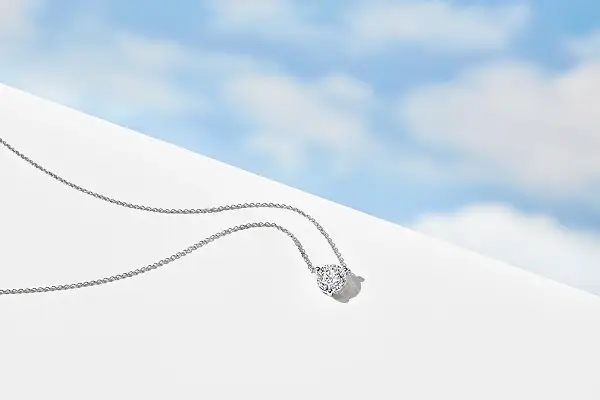
Image: A pendant featuring a 2-carat lab-grown diamond. (Lightbox)
Podcast: The Importance of Origin
Antwerp’s Paul Chieveley-Williams discusses fancy-color diamonds.
Lab-Grown Organization Strikes Back at CIBJO
Diamond Producers Council threatens action against jewelers who “deceptively use the term synthetic.”
GIA Analyzes Atypical Color Center in Natural Diamond
5.22-carat, pinkish-brown stone displays unusual absorption features.