
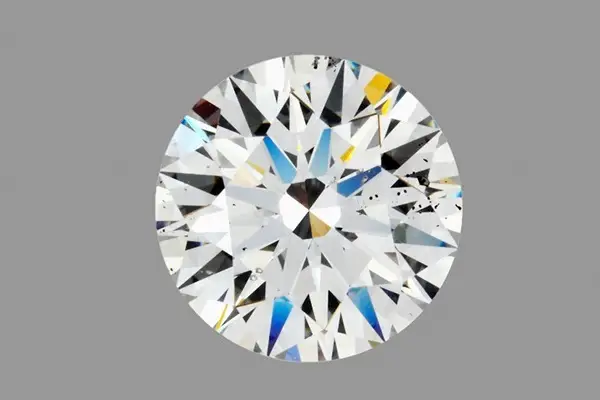
RAPAPORT… A client of the Gemological Institute of America (GIA)
wrongly submitted a natural diamond as a lab-grown stone, the organization
said.
The GIA’s Carlsbad laboratory recently received the round brilliant,
2.23-carat, D-color diamond, which the customer had sent in for a
synthetic-diamond grading report.
“When a declared synthetic diamond is submitted to a GIA
laboratory, it is not often that the diamond turns out to be natural,” GIA
analytics technician Garrett McElhenny and senior research scientist Sally
Eaton-Magaña wrote in the Winter 2018 edition of Gems & Gemology, the institute’s quarterly scientific journal.
It was easy to mistake the stone for one created using High Pressure-High Temperature (HPHT). It had no clearly visible “strain”
under detailed optical inspection — a pattern of lines that is usually absent
in HPHT diamonds. The GIA only spotted the feature in a few scattered areas of
the diamond following extensive efforts, it said.
Further tests confirmed it was from the earth, but also
revealed additional pitfalls: The stone contained dark, natural inclusions that others
might have mistaken for metallic flux, a common feature of HPHT diamonds, the
institute explained.
“Subsequently, the client indicated that this stone was
believed to be synthetic after examination by another party in the trade,”
McElhenny and Eaton-Magaña reported.
The case proves there can be exceptions to the general
guidelines for distinguishing between natural and lab-grown diamonds, the
authors added.
“In this case, the correction worked to the client’s
advantage,” they observed.
Main image: The 2.23-carat natural diamond submitted to the GIA as a synthetic. Inset: The strain pattern visible in small areas of the stone. (Robison McMurtry/Garrett McElhenny/GIA)
Van Cleef Pink-Diamond Ring to Lead Christie’s Sale
2.20-carat stone likely to fetch up to $153,050 in Hong Kong.

DDG to Fund Training in the Arts for 900 Botswana Youth
Organization will team up with actor Denim Richards to support children in diamond communities.

Jeweler TSL Back in the Black in First Half
Group reports income of $12.3 million, up from last year’s loss of $4.5 million.